
What to Record in a Small Fragrance-Blend Comparison
Select an image to view it at full size.
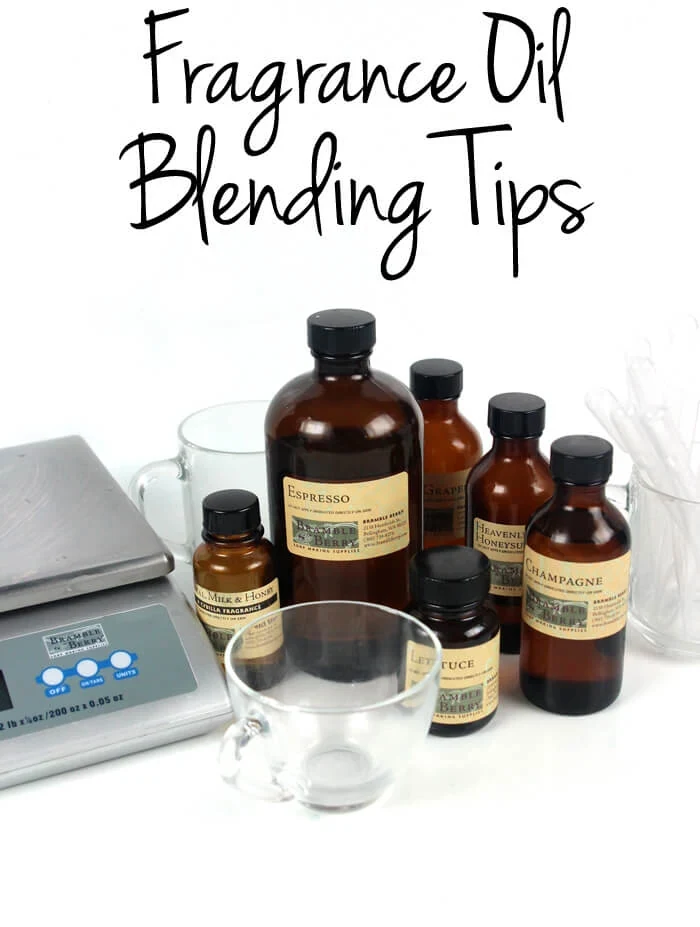
Record the identity and actual mass of every fragrance material, the resulting blend proportions, the sample label and the conditions of each observation. Keep those proportions separate from the amount eventually added to soap. A blend that smells promising in a small container still needs the applicable usage checks and a comparison in the intended product.
The goal is to be able to remake a specific mixture and understand why you preferred it. “A little more citrus” may capture an impression, but it does not preserve a formula.
Give Each Material an Unambiguous Identity
Write the supplier and exact product name from the bottle, plus any item, lot or version information available. Do not use “lavender” to stand for several different fragrance oils or an essential oil. Keep purchase or opening dates when useful, and retain the relevant current product documents.
Use short material codes only after defining them. For example, A and B can make a comparison table readable, but your record must state which exact bottles they represent. A later order from a different supplier is a new input even if its scent name sounds similar.
Define what you want to compare before mixing: perhaps whether increasing B makes a blend less sweet while retaining a recognizable note from A. Soap Queen suggests considering the notes and relative strength of each material. This helps turn an unstructured smell session into a question you can answer.
Weigh Small Trials Within the Scale’s Ability
Use clean, fragrance-compatible containers and handling tools appropriate to the suppliers' instructions. Work in a ventilated area, avoid skin contact, and keep concentrated materials away from children, pets and food preparation. Do not apply a neat blend to skin to assess it.
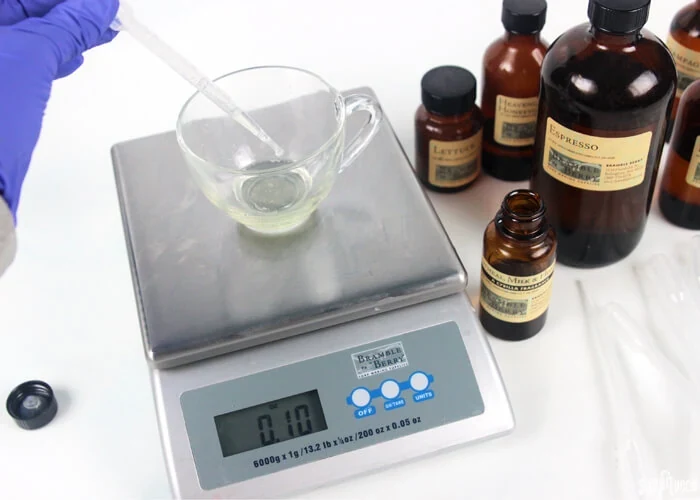
Place the receiving container on the scale and exclude its mass with tare. Record each actual addition, not only the intended recipe. Use a trial size that the scale can measure reliably: an amount near its display increment is not made accurate just by calling it a micro-batch.
Soap Queen recommends measuring by weight because materials can differ in density. Drops can help explore an initial scent idea, but a drop count does not establish a repeatable mass ratio; different droppers and liquids produce different drops. Rebuild a promising idea with measured masses before treating it as a reproducible blend.
Keep lids and labels organized as you go. Fragrance on the outside of a container or an ambiguous cap can confuse both handling and your impression of what is inside.
Preserve the Ratio and the Actual Recipe
For an illustrative two-material comparison, choose a 4 g total only if your scale and materials make those additions practical. A 1:1 mass ratio uses 2 g A and 2 g B. A 3:1 ratio uses 3 g A and 1 g B. The ratios describe composition; neither is a recommended fragrance dose in soap.
| Sample | A, actual mass | B, actual mass | Composition by mass |
|---|---|---|---|
| Blend 01 | 2.0 g | 2.0 g | 50% A, 50% B |
| Blend 02 | 3.0 g | 1.0 g | 75% A, 25% B |
These are hypothetical records, not observations from tested fragrances. If you accidentally add 2.1 g A and 1.0 g B, preserve those quantities. A is 2.1 ÷ 3.1, or about 67.7% of that actual mixture. Calling it 2:1 would hide the deviation.
If you adjust a container after smelling it, keep an addition history and recompute the cumulative masses. Adding 1 g A to the 2 g A/2 g B mixture produces 3 g A/2 g B, a 3:2 ratio. It does not produce 3:1. A fresh container for each planned ratio often makes comparison and labeling easier.
Make the Smelling Notes Comparable
Use the same appropriate evaluation method and comparable sample amounts. If using scent strips, label them with the sample code and time, keep them separate, and follow material guidance. Avoid touching concentrated fragrance to your face or repeatedly inhaling deeply from bottles.
Record the elapsed time between mixing and observation. A first impression and a later impression can differ, so preserve both instead of overwriting the first. Alternate samples thoughtfully and take breaks when they become difficult to distinguish. If you cannot tell, write that rather than forcing a ranking.
Describe what you notice: which note leads, what remains in the background, whether sweetness dominates, and whether a component seems masked. Personal preference belongs alongside the description. “I prefer 02 because B is less dominant” is more informative than assigning an unexplained five-star score.
Label and Retain the Preferred Blend
Label the container with the sample code, mixing date and a link to the complete mass record. Store it according to the suppliers' requirements in a suitable closed container. Soap Queen recommends labeling a retained sample so the mixture can be smelled again and recreated. Its photograph shows a small bottle beside handwritten blend proportions; keep the identifying information attached to your own container so moving it does not separate the sample from its identity.
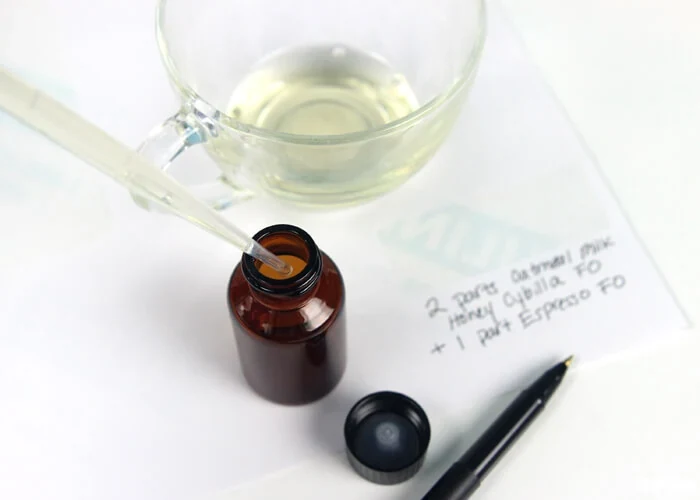
Keep the rejected candidates' records too. You do not have to keep every physical sample indefinitely, but knowing that 50:50 overwhelmed one note prevents repeating the same experiment without realizing it. Record disposal or loss of a sample so that an empty bottle does not later become a mysterious missing control.
To scale a preferred 75:25 blend to a hypothetical 20 g premix, calculate 15 g A and 5 g B. That preserves composition only. It does not mean 20 g is suitable for any particular soap batch.
Check Usage Limits Before Moving Into Soap
Check each exact material's current guidance for the intended application, including relevant IFRA documents and restrictions. IFRA conformity is specific to the mixture and use, and finished-product concentrations matter. Do not take the highest limit listed for either component as the permitted limit for the combined blend. Shared restricted constituents can require more than a simple average of certificate maxima.
If the documentation does not establish how to assess your combination, obtain appropriate supplier or formulation guidance before using it. A pleasant smell does not resolve composition restrictions. Keep the final chosen dose, its denominator and the supporting assessment separate from the blend ratio.
Start a Separate Soap-Performance Record
For the intended soap trial, record the exact checked base recipe, batch identifier, blend mass, addition point and working conditions. Observe acceleration, discoloration and retention at recorded ages. Nurture Handmade's performance categories make those separate questions explicit; passing one does not answer the others.
Use the cold-process fragrance information guide to evaluate the supporting data. Keep the concentrated-blend preference and cured-soap result as two linked entries. If a favorite mixture becomes faint or behaves poorly in soap, retain that result instead of rewriting the original preference as though it never happened.
The record is complete when another session can reproduce the material identities and masses, follow the relevant usage assessment, and compare the same intended outcome. A poetic name can come later; the useful formula is the one your notes can actually recover.