
A Preparation Checklist Around an Already-Checked Cold-Process Recipe
Select an image to view it at full size.
Prepare for cold-process soapmaking by turning a checked recipe into a clear batch sheet, arranging compatible equipment and protective clothing, and securing the workspace before opening sodium hydroxide. Then confirm the ingredients, weighing method, mold and protected resting area. A calculator result is one part of that preparation; it does not establish that the room, containers or process are ready.
This checklist concerns a conventional sodium-hydroxide bar-soap session using an already-reviewed recipe and an understood method. Milk, acids, unusual additives, mixed alkalis and improvised processes introduce additional formulation and handling questions. Resolve those before preparing to make the batch.
Keep the Final Recipe in Front of You
Use one final version. Record the exact oils and quantities, NaOH amount, stated purity, lye discount, water basis and water amount. Include every planned addition and its separate calculation where needed. Save or print the result with the batch identifier and date, and check that the unit is the one you will use on the scale.
Confirm that the ingredients actually available match the recipe. Running short of an oil is a reason to stop and recalculate a deliberate substitution, rather than topping up the pot with whatever is nearby. A familiar oil name can also conceal a materially different type; match the actual product to the supported calculator entry.
Soap Draftbook's calculator supports its listed oils and NaOH/water calculation. It does not automatically account for fragrance, milk, acid neutralization or every possible additive. A checked base calculation should not be extended to those additions by assumption.
Keep a place to record actual amounts and deviations beside each target. Oak Hill Homestead describes using a batch sheet and checking off ingredients as they are weighed. That organizational method helps prevent an omitted or duplicated ingredient; its separate milk recipe and container choices are not requirements for this checklist.
Secure the Room and Clear the Work Area
Arrange an uninterrupted period and keep children, pets and uninvolved people out of the area. Remove food, drinks and unrelated utensils. Provide good light, stable work surfaces and enough clear space to move between weighing, mixing and pouring without reaching across open containers.
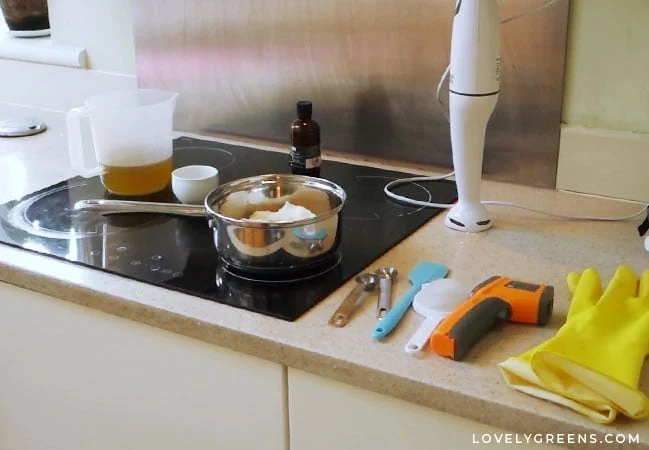
Plan ventilation for the actual lye-mixing step, and avoid exposure to dust, mist or the plume above hot solution. Do not lean over the vessel. A fan that blows across open dry NaOH or toward another person creates another problem. If you cannot meet the handling controls required by your product and setting, do not begin.
The oil-preparation photograph shows Lovely Greens' pan of solid oils, separate jug of liquid oils and mixing tools. It illustrates staging those objects, rather than demonstrating the ventilation controls for handling alkali.
Keep access to running water unobstructed. Know how to get immediate medical help and keep the product's safety data sheet accessible. Decide where an exposed person would rinse before filling the sink or covering the route with equipment. Lovely Greens emphasizes a clear, organized area, ventilation and protection from interruptions.
Identify and Protect Against the Actual Chemicals
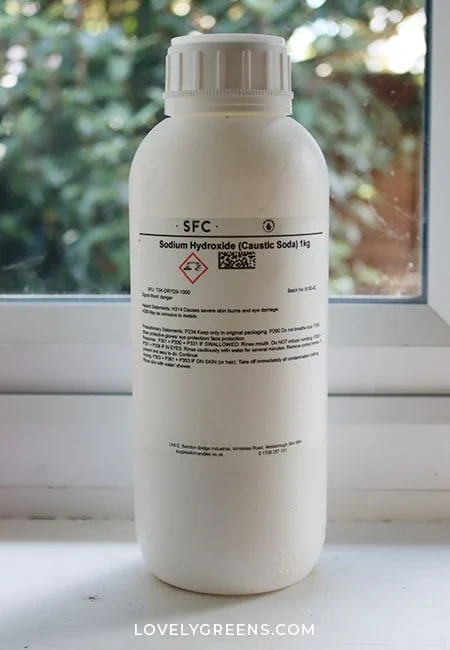
Confirm that the alkali is the sodium hydroxide specified by the recipe, in a suitable grade and documented condition. Read its label and current safety data sheet. Do not use an unknown drain-cleaner mixture or assume potassium hydroxide is interchangeable. Keep dry NaOH tightly closed and dry in a secure, labeled location when it is not being dispensed.
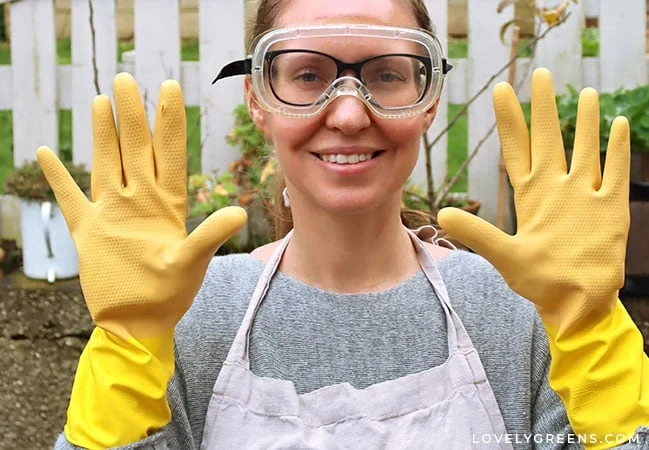
Wear chemical splash goggles, suitable chemical-resistant gloves and clothing that protects exposed skin, including closed shoes and long sleeves. The opening portrait demonstrates goggles worn over spectacles and long gloves; complete your own working outfit with the skin coverage needed for the session. Choose glove material and protection for the actual chemicals, concentrations and handling conditions using the product guidance; a thin glove's appearance does not establish resistance to every fragrance or caustic solution. Ordinary spectacles do not provide the same splash protection as goggles.
Fisher Scientific's sodium-hydroxide SDS identifies severe skin burns, eye damage and respiratory irritation hazards. Sections 7 and 8 require a chemical fume hood, with eyewash stations and safety showers close to the workstation. This SDS covers that laboratory product; it is a hazard reference here, rather than a recommendation to buy it for soap. Lovely Greens describes a household arrangement with an open window, which does not establish equivalence to those specified controls. Neither an open window nor a generic dust mask should be treated as satisfying that laboratory SDS. Follow the current SDS for your actual material and the applicable requirements for your workplace; if the required controls are unavailable, stop.
Do not remove protection just because the batter has been poured. Residue, fresh soap and contaminated tools still need controlled handling. A fixed number of hours does not make an incorrectly formulated batch or a separate deposit of alkali harmless.
Check Containers, Tools and Working Capacity
Prepare separate suitable vessels for weighing dry alkali, holding the water and mixing the lye solution. Their materials must tolerate both the chemical and the heat generated. Use sound, purpose-suitable equipment with manufacturer-confirmed compatibility; an unidentified food tub is not qualified by its shape alone.
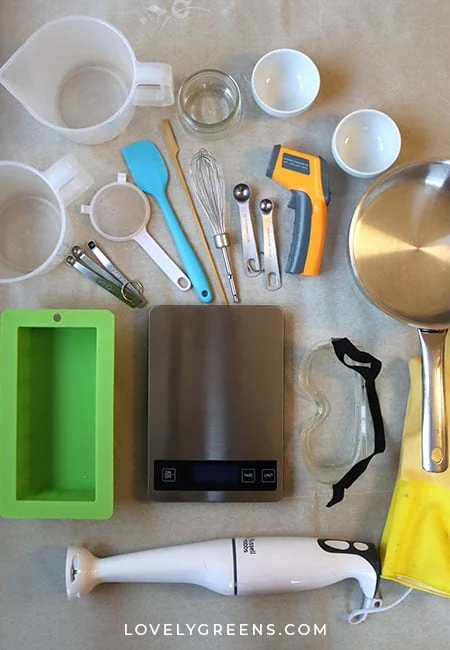
Do not use aluminum or other reactive, incompatible metals with lye. Suitable stainless steel is used in the process described by Lovely Greens, and its water jug is heat-proof polypropylene. These are useful material identities to investigate, but the suitability of your particular vessel still needs confirming. Select a vessel intended for the job rather than treating a generic measuring jug as sufficient.
Leave working headroom for stirring and safe handling. The capacity printed on a container is not its comfortable mixing capacity. Check that the scale can support container plus contents, that the receiving vessel sits securely, and that the display remains visible.
Prepare a suitable spatula, thermometer and immersion blender if the chosen method uses them. Inspect cords and attachments before there is caustic batter nearby. Keep electrical connections dry and arrange the cord so it cannot pull a vessel over. Reserve and clearly identify soapmaking equipment to prevent accidental food use.
In Lovely Greens' equipment photograph, the empty jugs, pan, spatula, thermometers, immersion blender and green loaf mold can be checked as separate objects. The arrangement is a tool inventory; it does not show which jug contains water or alkali. Keep ingredient identities clear when those vessels are filled.
Set up Weighing Before Dispensing
Place the digital scale on a stable, level surface and confirm its unit, capacity and usable resolution. Check operation according to its instructions. A display with several digits does not by itself establish accuracy for a small NaOH quantity. If the required amount is below reliable measuring ability, choose appropriate equipment or a properly recalculated batch size before proceeding.
Exclude the container weight with tare, then weigh each ingredient by mass. The container-weight guide explains both separate and cumulative additions. Mark the actual amount and ingredient as soon as it is weighed. Do not rely on remembering which identical jug contains which material.
Keep water, alkali and oils separate until the chosen process calls for combining them. Close ingredient containers promptly and leave labels visible. Do not set an unlabeled cup of NaOH beside an unlabeled cup of a white additive.
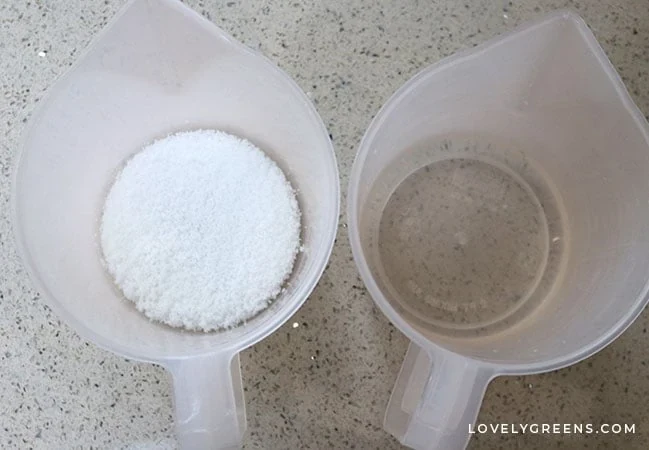
The two-jug photograph shows the source's dry alkali and water held separately before mixing. Identify your own contents explicitly; do not rely on matching a photograph's left-right arrangement. The image also does not establish that the surrounding room meets your product's exposure controls.
Measure dry alkali only when the workspace and subsequent step are ready. Prepare a controlled, labeled place for the weighed material; do not leave it accessible while you search for a mold or answer an unrelated interruption. Oak Hill's preparation sequence similarly keeps alkali dispensing until the maker is ready to continue.
Arrange the Mold and the Next Storage Location
Confirm the mold's usable capacity against the checked recipe's total batter and planned pour height. Oil weight is not the whole wet batch weight. Make sure the mold is supported, assembled and lined where the chosen mold requires it, and place it where you can pour without lifting a hot or heavy vessel across an obstacle.
Prepare any recipe-specific tools and additions in advance, including their checked quantities and labels. Fragrance documentation and use limits belong in the preparation record, rather than being guessed when the batter is already thickening. Use a simpler project if the planned design exceeds your available working time or setup.
Choose a protected resting area for the poured mold, followed by a suitable cutting and curing arrangement. Keep the batch identifier with the mold and later bars. Protection includes preventing access to the fresh batch, rather than merely covering its top. Lovely Greens' process guide shows how equipment and ingredients are organized through a conventional session.
Prepare the Response to a Problem
Read the first-aid and spill instructions before exposure occurs. For lye on skin, begin immediate water rinsing and remove contaminated clothing while obtaining appropriate medical advice. For eye exposure, rinse immediately and continuously, removing contacts if easy, and seek urgent medical attention. Fisher's SDS specifies at least 15 minutes of eye rinsing and immediate medical attention. Do not substitute vinegar or another neutralizer on the body.
Plan a safe place to isolate contaminated tools and waste while maintaining access control. Follow the actual product SDS and local disposal requirements. Do not plan to flush a lye spill down a drain or neutralize a large spill improvisationally. An uncontrolled release is a reason to keep people away and obtain appropriate help.
Finally, make the stop conditions explicit. Pause before mixing if ingredient identity, quantity, container compatibility, ventilation or access control is uncertain. Once a hazardous material is open or prepared, first secure it safely rather than leaving it unattended. An interruption should not force you to choose between an unprotected room and hurried chemistry.
Make the Last Check Before Starting
Read the batch sheet aloud or deliberately line by line: correct recipe, correct actual ingredients, correct units, suitable scale, prepared vessels, protection on, clear workspace, ready mold and a protected destination. Confirm the intended mixing procedure; when preparing a conventional water-based lye solution, add sodium hydroxide gradually to the measured water, never pour water onto a pile of dry alkali. Dissolving it releases substantial heat.
If any essential item is missing, resolve it before opening the alkali. The useful outcome of preparation is a session you can carry out in order, with every quantity identifiable and every necessary tool already within safe reach.