
How to Account for Container Weight When Weighing Ingredients
Select an image to view it at full size.
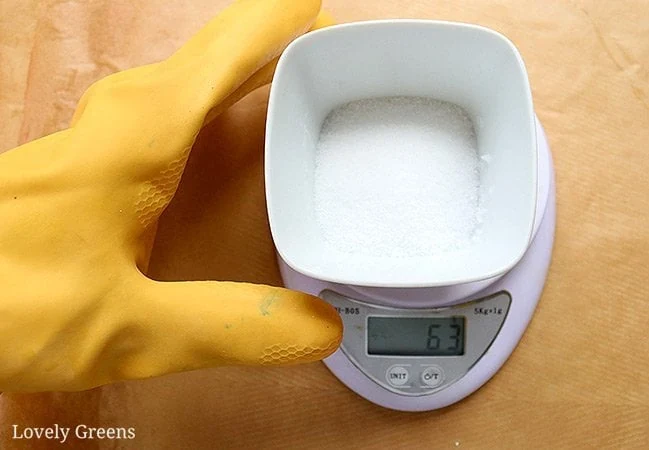
Exclude the empty container's mass before deciding how much ingredient you have added. The usual method is to place the empty receiving container on the scale and press tare so the display returns to zero. The subsequent reading represents the added contents, within the scale's capabilities, while the container still contributes to its physical load.
You can also subtract a known empty-container mass from a gross reading. That works only when both numbers refer to the same container setup and the unit is consistent. An unknown jug weight cannot be recovered by guessing.
Distinguish Gross, Tare and Net
Gross mass is container plus contents. Tare mass is the excluded container or packaging. Net mass is the contents you intend to measure. For a hypothetical empty jug of 180 g and a filled reading of 430 g, net contents are 430 − 180 = 250 g.
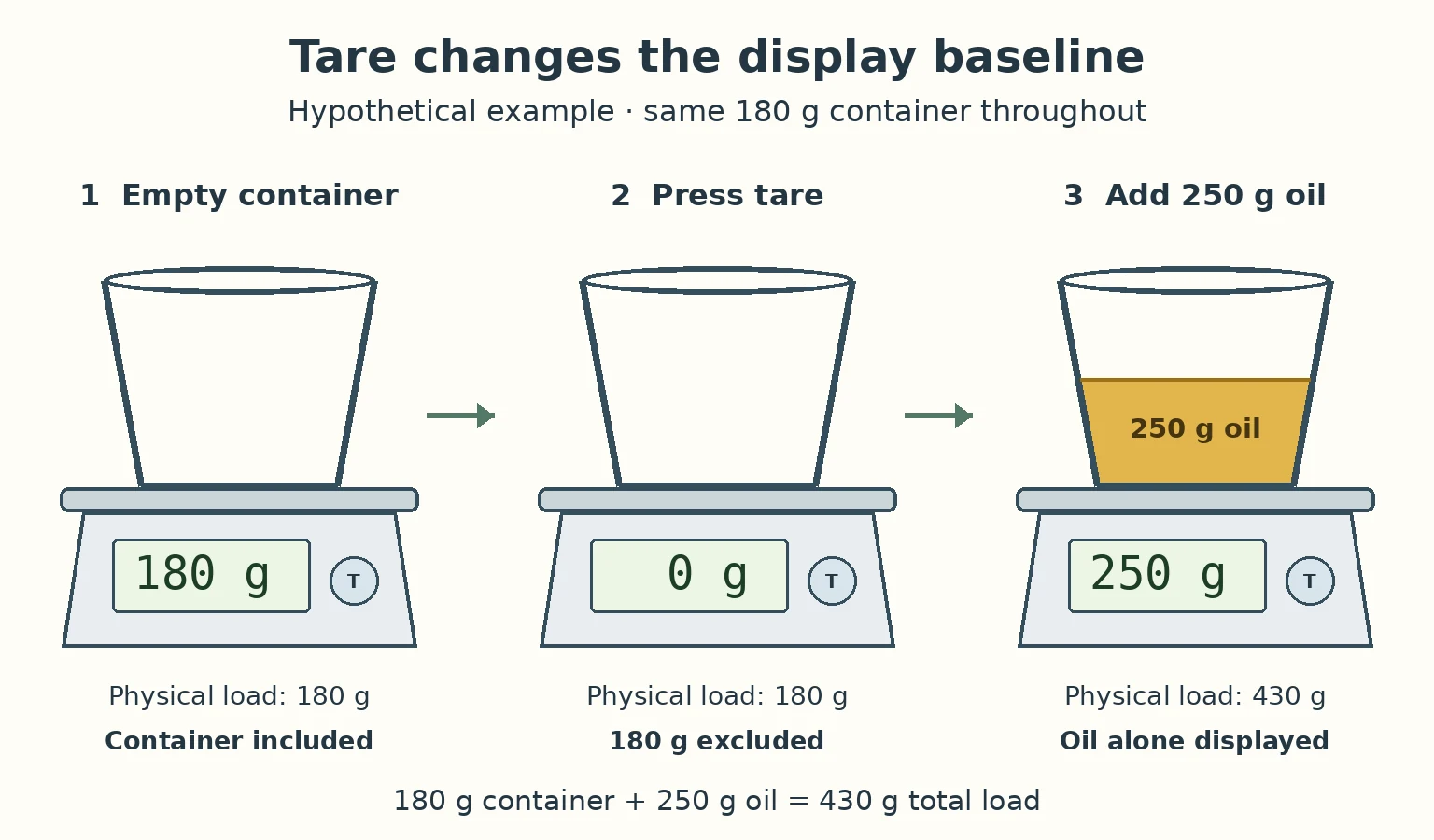
The 430 g gross reading is not 430 g of oil. Conversely, a tared display showing 250 g already excludes the jug; subtracting its 180 g again would be a second subtraction and would give the wrong result.
The hypothetical sequence keeps that same 180 g container on the platform throughout. Tare changes its displayed baseline to zero; adding 250 g of oil then gives a 250 g net reading, while the physical load is 430 g.
Jan Berry explains this distinction in a reply in The Nerdy Farm Wife's troubleshooting discussion: place the container on the scale, zero it, and then add the ingredient. Oak Hill Homestead describes the same tare method when weighing soapmaking oils.
Tare the Actual Receiving Setup
Set the scale on a stable, level surface and select the recipe's unit. Put the clean, empty container on the platform, check that it rests freely, and press tare. Wait for a stable zero before adding the ingredient gradually toward the target.
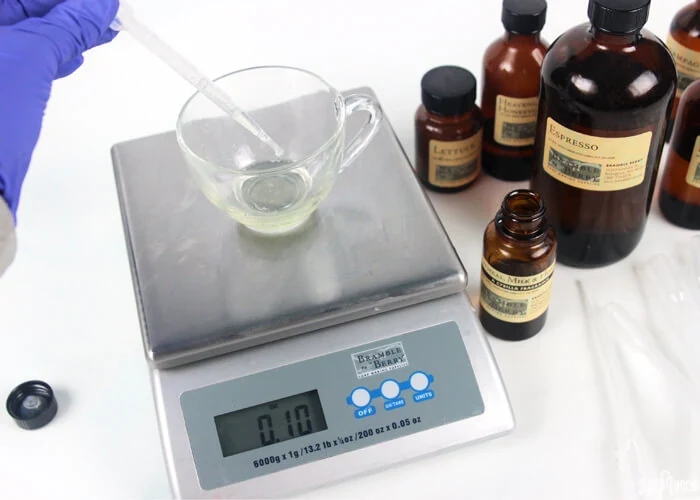
Include any item that will remain part of the weighing setup when you establish zero. For example, if a tray is needed beneath the container, place it there before taring. A spoon added afterward increases the reading. A jug touching a wall or being supported by your hand may prevent the scale from carrying the full load.
Keep the display visible, and check the unit again if a button press may have changed it. In Soap Queen's blending photograph, the receiving cup is supported on the scale while a small fragrance addition is made. It shows the physical arrangement; use your own scale's tare and unit instructions rather than copying the photographed display as a recipe amount.
Once the target is reached, record the actual mass and identify the ingredient. When transferring it, account for material left in the receiving container: the weighed quantity and the quantity reaching the batch can differ if a substantial residue remains behind.
Choose Separate or Cumulative Additions Deliberately
Separate containers make it easier to verify an amount before combining ingredients. Weigh one ingredient into its own tared container, record it, then transfer it at the appropriate stage. This is useful when an accidental excess would otherwise enter a mixture that is difficult to correct.
Cumulative weighing can reduce the number of containers, but requires a clear record. With the first ingredient already in the vessel, record its mass, press tare again, and add the next ingredient to that ingredient's own target. The new zero excludes both the vessel and the previously added contents.
For example, add 200 g of oil A to a tared vessel, record it, then tare and add 150 g of oil B. The final display is 150 g, while the vessel contains 350 g of oils. It does not contain only the last displayed amount.
Alternatively, without re-taring, the cumulative target after those additions is 350 g. Both methods can work, but switching between individual and cumulative targets without recording the change causes errors. Keep the chosen method beside the ingredient list and check off each addition.
Recover a Reading Only When the Missing Information Is Known
If you forgot to tare but have a reliable empty mass for the exact container setup, subtract it from the gross reading. A hypothetical gross mass of 612 g minus the same empty vessel's 212 g gives 400 g contents. Do not substitute the mass of a similar-looking jug.
If the scale turns off mid-addition, determine whether the ingredient can be reweighed with a known container baseline. Some scales zero whatever is present at startup, which can hide already-added contents. Consult the scale's behavior and reconstruct from recorded masses, rather than assuming the restarted display preserves the old net reading.
If neither the baseline nor the amount added is recoverable, stop. Do not add more NaOH or oil to an uncertain mixture on the theory that the rest of the recipe will balance it. Keep the material identified and safely contained while resolving the uncertainty or arranging appropriate disposal.
Handle Overshoots Before They Become Mixture Errors
For a single ingredient still isolated in a suitable receiving container, you may be able to remove the excess carefully into another suitable labeled container and reweigh the remainder. Follow the material's handling requirements; do not pour contaminated material back into the original supply.
Once an excess is mixed with another ingredient, removing some liquid generally does not remove only the ingredient you overshot. Taking a spoonful from a mixed oil pot is not equivalent to subtracting that spoonful of the last oil added. Reconstruct all actual quantities and recalculate deliberately where a valid correction is possible; unresolved quantities require stopping.
Tare also does not increase capacity or precision. A heavy pot that has been zeroed still loads the scale, and a coarse scale does not become suitable for tiny alkali amounts because its display reads zero. Match the equipment to the actual gross load and smallest required addition.
Keep weight ounces separate from fluid ounces and milliliters. Tare removes a container baseline, not a unit mismatch. Correct container accounting, consistent units and a written actual-quantity record work together; none can replace the others.