
Where Does the Lye Go When Oils Become Soap?
Select an image to view it at full size.
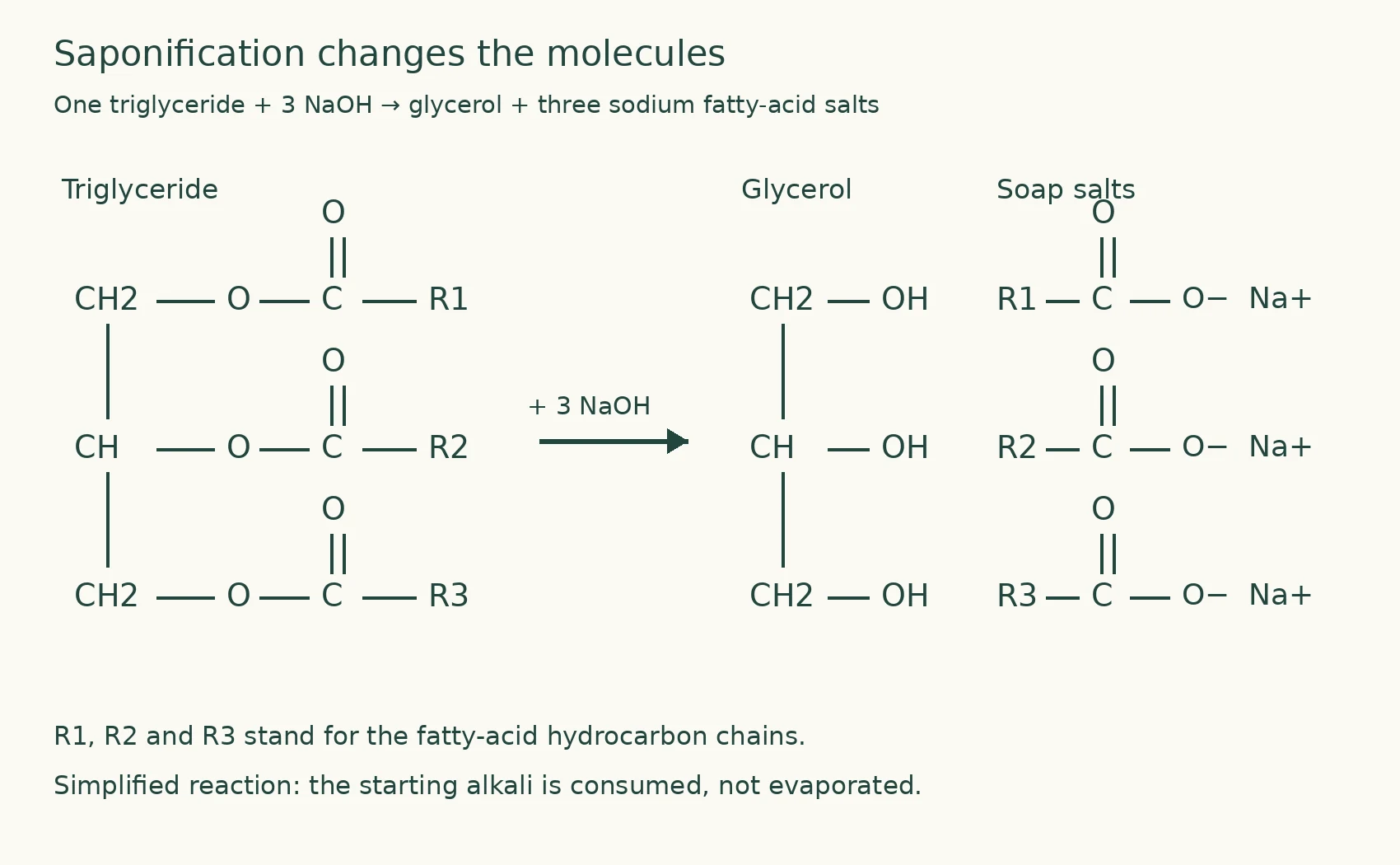
In a correctly formulated and properly made soap, sodium hydroxide is consumed by the saponification reaction. It reacts with the fats to form different substances, including sodium fatty-acid salts—the soap—and glycerol. It does not simply disappear when the bar dries, evaporate out of the mold or become harmless because a fixed number of weeks has passed.
When a maker says a finished bar contains “no lye,” the useful meaning is that there should be no unused, free sodium hydroxide remaining from a correctly balanced and completed process. That statement depends on the actual formula and manufacture. It is not something the appearance of an unfamiliar bar can establish on its own.
The Starting Ingredients Become Different Substances
The oils and the sodium hydroxide are starting materials. The resulting soap is a salt of a fatty acid, rather than the original oil with dry lye powder still mixed through it. Elly's introduction to soapmaking describes this conversion as saponification.
For a simplified triglyceride molecule, chemist Kevin Dunn gives the relationship as one oil molecule plus three sodium hydroxide units producing glycerol and three soap units. The diagram shows that same relationship using R1, R2 and R3 for the hydrocarbon chains. It is a simplified chemical picture, not a recipe or a set of weighing quantities.
The numbers in that relationship count chemical units, not equal spoonfuls or equal masses. A spoon of oil and three spoons of lye would not follow from it. Actual oils differ in composition and alkali demand, so a practical recipe needs appropriate oil identities, weights and saponification values. Dunn explains that even the same named oil can vary from the sample used to establish a table value.
This is why the amount of NaOH matters. It is tied to the ingredients being transformed, rather than added as an optional cleaning booster. Changing an oil or its actual quantity requires a deliberately recalculated formula, not the assumption that any remaining lye will eventually go away.
Dissolving Lye in Water Is Not Saponification
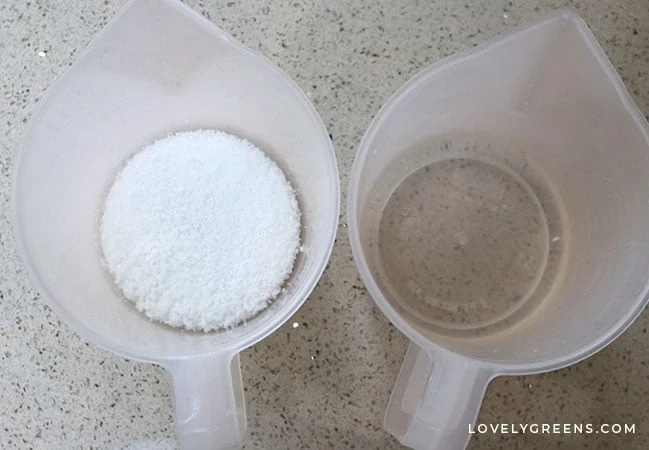
The separate containers in Lovely Greens' photograph show dry sodium hydroxide and measured water before mixing. That is an earlier stage of the process. Dissolving the alkali prepares a solution; it does not, by itself, turn the alkali into soap. The oil reaction has not occurred merely because the solid is no longer visible.
Water quantity and alkali quantity also play different roles. Dunn distinguishes the alkali required for the reaction from the water used as its solvent. More water does not cancel extra NaOH, and less water does not automatically mean less alkali. A water setting changes the solution conditions while the calculated alkali demand still depends on the oils and the chosen formula settings.
Do not interpret a clear lye solution as an absence of lye. Nor should a dissolved solution be handled as though it has the properties of a finished bar. The safety requirements belong to the actual material and stage you are working with.
Cure Time and Chemical Completion Are Different Questions
Saponification and curing are related parts of soapmaking, but they are not interchangeable descriptions. Dunn's study explicitly separates their time scales: much of the reaction occurred early under his processing conditions, while bars continued changing and losing moisture over a much longer period. Those experimental conditions do not supply a universal completion time for a different home batch.
A bar can become harder as it loses water without that hardness proving its chemical balance. Conversely, the fact that soap has formed does not mean the bar has reached the texture or performance you want after cure. A cure record can help you compare weight, handling and later use characteristics, but those observations should not be relabeled a test for free alkali.
This distinction matters when something went wrong. An error in oil quantity, alkali quantity or mixing is not automatically corrected by leaving the bars on a rack longer. Age can be a useful record, but “it has been six weeks” does not reconstruct unknown ingredient amounts or demonstrate that a separated batch is now uniform.
What “No Free Lye” Does and Does Not Tell You
The conditional wording is important. Elly's FAQ says the lye should be consumed if the soap is formulated and made correctly with the right amount. If unused lye remains, that is a problem; the claim is not a guarantee applied to every homemade bar.
The finished soap's chemistry is also different from the question of whether sodium hydroxide was ever used. A bar can have been made with NaOH even though the intended finished product has no unused NaOH. Those statements are consistent because the starting material has reacted.
A lye discount is another formulation choice, not a certificate for every possible production error. It reduces the calculated alkali amount relative to a selected baseline, but a wrong oil identity or an incorrectly weighed ingredient can still undermine the intended calculation. The separate lye-discount guide explains that setting without treating it as proof of a finished-bar result.
Do not judge an uncertain batch by color, smell, firmness or an appealing surface alone. Those observations may be useful to describe a problem, but none supplies the missing formula and process information. A photograph of a normal-looking bar cannot establish the absence of free alkali.
Start with the Batch Record When There Is Doubt
Keep the checked recipe version alongside the quantities actually weighed, ingredient identities and any deviations. If a batch separates, an ingredient is omitted or a quantity is unknown, preserve that information instead of editing the original plan to make it look as though the change was intended.
An uncertain batch needs an assessment based on what actually happened and, where required, an appropriate testing method. This chemical explanation does not supply a home test or certify a suspect bar for use. Keep it separate from usable stock while the issue is resolved rather than handing it to someone else on the strength of its age.
For a properly made batch, there is no mystery disappearance to explain: sodium hydroxide takes part in the reaction that forms soap. The useful habit is to distinguish that transformation from dissolution, evaporation and cure, and to keep the claim of a correctly finished bar tied to the actual formula and process.