
Superfatting and Lye Discount: What the Calculation Actually Changes
Select an image to view it at full size.
A lye discount reduces the calculated alkali for a given oil blend. Superfatting, in its literal formulation sense, adds oil relative to a given alkali amount. Both can leave a formula with more fat than its available alkali would theoretically saponify, but the percentages do not automatically use the same denominator. Neither setting measures the free oil in a finished bar.
In Soap Draftbook, the field labelled Superfat / lye discount (%) performs the first operation: it reduces the theoretical NaOH requirement by the entered percentage before accounting for product purity. It does not secretly add another oil or choose which oil remains after the reaction.
Begin with the Theoretical Requirement
Every base oil contributes to the reference alkali requirement. The calculator multiplies each oil’s mass by its NaOH SAP coefficient, then adds those contributions. At zero lye discount and an assumed 100% pure product, the result is the reference amount needed for complete saponification under that model.
For simple arithmetic, imagine 500 g of a particular oil blend has a reference NaOH requirement of 70 g. That means its weighted coefficient is 0.140 g/g. These numbers define this example; 70 g is not a universal lye amount for any 500 g recipe.
The reference remains an assumption about the oils. Their actual SAP values can differ, and the weighed product may not be pure NaOH. A nominal zero-discount calculation therefore does not constitute a laboratory finding that a particular finished bar contains neither excess alkali nor free oil.
Discounting Lye Keeps the Oil Total Fixed
For the example, a 5% lye discount means using 70 × 0.95 = 66.5 g NaOH, with the oil blend still at 500 g. The 3.5 g reduction is 5% of the original 70 g alkali requirement. It is not a reduction of 5% of the oil weight.
| Discount in this example | Reference calculation | Nominal NaOH |
|---|---|---|
| 0% | 70 × 1.00 | 70 g |
| 3% | 70 × 0.97 | 67.9 g |
| 5% | 70 × 0.95 | 66.5 g |
| 8% | 70 × 0.92 | 64.4 g |
The table describes the operation, not recommended settings for different soap uses. Choosing a working discount requires the actual formulation, materials and intended use; an arithmetic demonstration cannot settle that choice.
With fixed oils and a documented purity assumption, changing the discount changes the weighed NaOH product. If concentration is held constant, the calculated water changes with it. If water is held at a percentage of oils, that oil-based water amount stays fixed instead. Review the whole result rather than treating the discount field as an isolated adjustment.
Adding Oil Holds a Different Quantity Fixed
Now keep 70 g nominal NaOH and add 5% more of the same oil blend to the original 500 g oils. Five percent of 500 g is 25 g, so the new oil total is 525 g. At the same weighted coefficient, its theoretical requirement is 525 × 0.140 = 73.5 g NaOH.
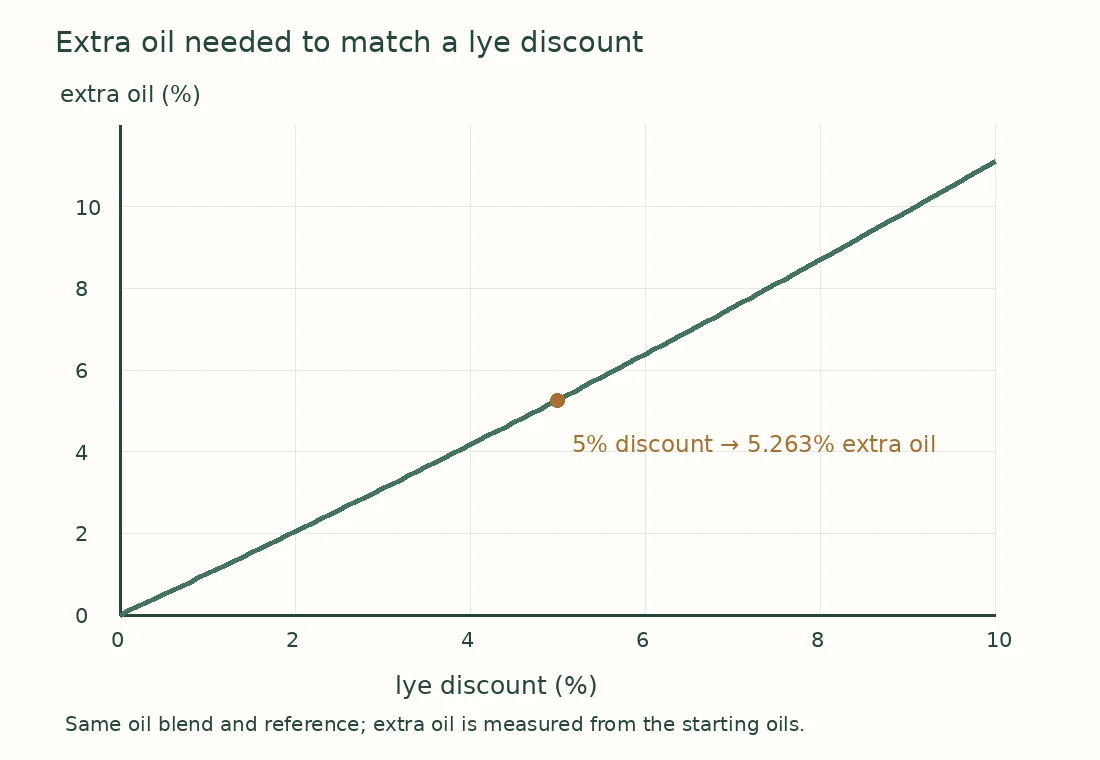
Using 70 g against a 73.5 g requirement represents a discount of (73.5 − 70) ÷ 73.5 × 100 = 4.7619%. The extra oil is 5% of the starting oil amount; the alkali shortfall is measured against the new requirement. That is why the percentages differ.
For the same oil blend, equivalent extra oil is 100 × d ÷ (100 − d) percent of the starting oils, where d is the desired lye discount in percent. Thus 5% lye discount corresponds to about 5.263% extra oil, rather than exactly 5%. The curve displays that relationship.
Equivalence here means the oil-to-alkali ratio under the same reference assumptions. If the added oil has a different SAP value from the starting blend, this shortcut no longer applies. Calculate the complete revised blend from its actual ingredient identities instead.
Include Every Added Base Fat in the Accounting
If a recipe already specifies its whole oil blend and a calculator lye discount, adding an unrecorded extra oil creates another formulation change. It does not merely label the existing discount more precisely. The final oil total, percentages and alkali relationship have changed.
For example, adding 25 g shea butter to a 500 g oil formula produces 525 g oils with a different blend, not the original 500 g formula with an unchanged composition. Record the shea in the oil list, recalculate the oil shares and review the resulting lye and water. Do not assume that the 4.7619% result for adding more of the same blend applies to that substitution.
Likewise, adding an oil late in mixing does not exempt it from the recipe. Kevin Dunn’s published comparison did not support the idea that the oil added at trace automatically becomes the residual superfat. Visible thickening is not a mechanism that reliably reserves a named oil.
Keep essential oils, fragrances and non-fat additions conceptually separate from these base-fat calculations. Their use and chemical effects need their own appropriate information. Soap Draftbook does not provide automatic alkali or water adjustments for unsupported additives.
Separate the Setting from the Finished Composition
A displayed 5% discount tells you how the reference requirement was reduced. It does not establish that exactly 5% of a finished bar’s mass is unchanged oil. The final bar includes soap, water, glycerin and other constituents, and its mass changes during cure. “Five percent of the bar” introduces another denominator altogether.
Nor does the setting identify the residual oil. Dunn’s limited study found different enrichment of particular fatty-acid components in the extracted residual oils, without finding that simply adding the chosen oil at trace reliably reserved it. Those results are a reason to avoid a blanket identity claim, not a new formula for predicting the composition of every batch.
Material uncertainty matters too. If the actual oils need less alkali than the reference predicts, a nominal discount produces a different effective relationship than the same setting with a higher-SAP batch. If the product purity assumption is wrong, that introduces a separate discrepancy. Changing one number until the recipe looks familiar does not identify which assumption failed.
Compare Changes with a Saved Baseline
In the calculator, first enter the exact supported oils and their intended weights. Set the documented NaOH purity assumption and water basis, then read the whole calculated result. Save the original recipe before changing the discount or oil blend.
For a useful comparison, change one intended factor and note what it was: “discount changed from 5% to 6%; oil weights unchanged,” or “25 g shea added; complete oil blend recalculated.” Those describe different actions and should not share the same vague “more superfat” note.
The practical distinction is simple to retain: discounting changes the calculated alkali; adding fat changes the oil formula. Track each operation explicitly, keep its percentage basis attached, and do not read an input setting as a measurement of the bar you eventually make.