
Why is there a tunnel inside my soap, and how does liquid leakage change the diagnosis?
Select an image to view it at full size.
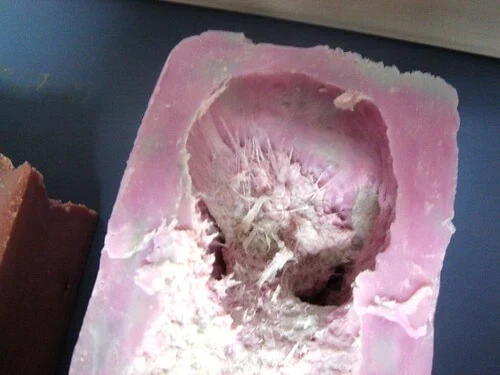
An internal tunnel can occur in an overheated cold-process batch, but a hollow space and a cavity that releases liquid are not equivalent findings. Jan Berry distinguishes a dry hollow tunnel associated with heat from major separation involving oil or caustic liquid. Once material escapes, the amount and identity of what remains become part of the problem.
Stop cutting if an unfamiliar cavity releases liquid. Protect the batch from contact and do not identify the liquid by tasting, touching or smelling it closely. A visible hole cannot tell you whether the whole batch was correctly measured or mixed.
Examine the Structure Without Treating It as a Test
Record where the cavity appears, whether similar openings occur in neighboring slices and whether any material comes out. Include when the soap was poured and cut. An isolated small air hole is a different observation from an elongated opening through several bars; size and continuity help describe what happened without proving a chemical cause.
The real Soap Queen photograph above shows the source's heat-tunnel example from November 2011. It makes the internal structure visible. It does not provide a test by which every similar-looking hole in another soap can be certified as harmless.
Keep the rest of the record alongside the photographs. Was the loaf heavily insulated? Did its top crack or rise? Were honey, beeswax, milk or a new fragrance involved? Was a visibly uneven mixture poured? A description of the hole alone leaves those different routes unresolved.
Do not probe an unidentified wet cavity with bare hands to decide whether it is oily. Preserve the observation and treat an escaping liquid as unknown until there is a reliable basis for assessment.
A Dry Tunnel Makes the Heat History Relevant
Berry identifies a hollow tunnel without oozing or separating liquid as one possible consequence of overheating. Soap Queen's actual example also attributes the structure to excess heat and calls attention to fragrance or essential oil, beeswax, honey, cocoa butter and some milk additions in the thermal investigation.
Review heat retention as a complete setup. Write down the mold and fill depth, room conditions, initial ingredient temperatures, blankets, any powered heat source and how long each remained in place. Several layers of covering in a warm room are a different arrangement from an uncovered small cavity mold.
For the next pour, use the applicable recipe method and adjust a specific condition rather than copying a universal cooling number. Soap Queen's source recommends lowering the temperatures in its context and checking excessive insulation; that does not establish one temperature reduction or one towel thickness for every mold and formula.
A previously overheated center also does not mean you should cool hard fats until they begin setting before mixing. The next process still needs fully prepared ingredients and adequate incorporation. Separate the goal of controlling retained heat after pouring from the earlier goal of making a uniform mixture.
Leaking Liquid Introduces a Quantity Problem
The schematic in this section follows unidentified material from an opened cavity over the exposed face and outside the batch. It illustrates the loss relationship, not a chemical identification or a measured leak. A liquid-filled cavity may accompany separation rather than a purely structural hole. Berry describes an extreme situation in which cutting releases both oil and caustic liquid. That description should not be simplified into a rule that any yellow liquid is oil or any clear liquid is lye solution.
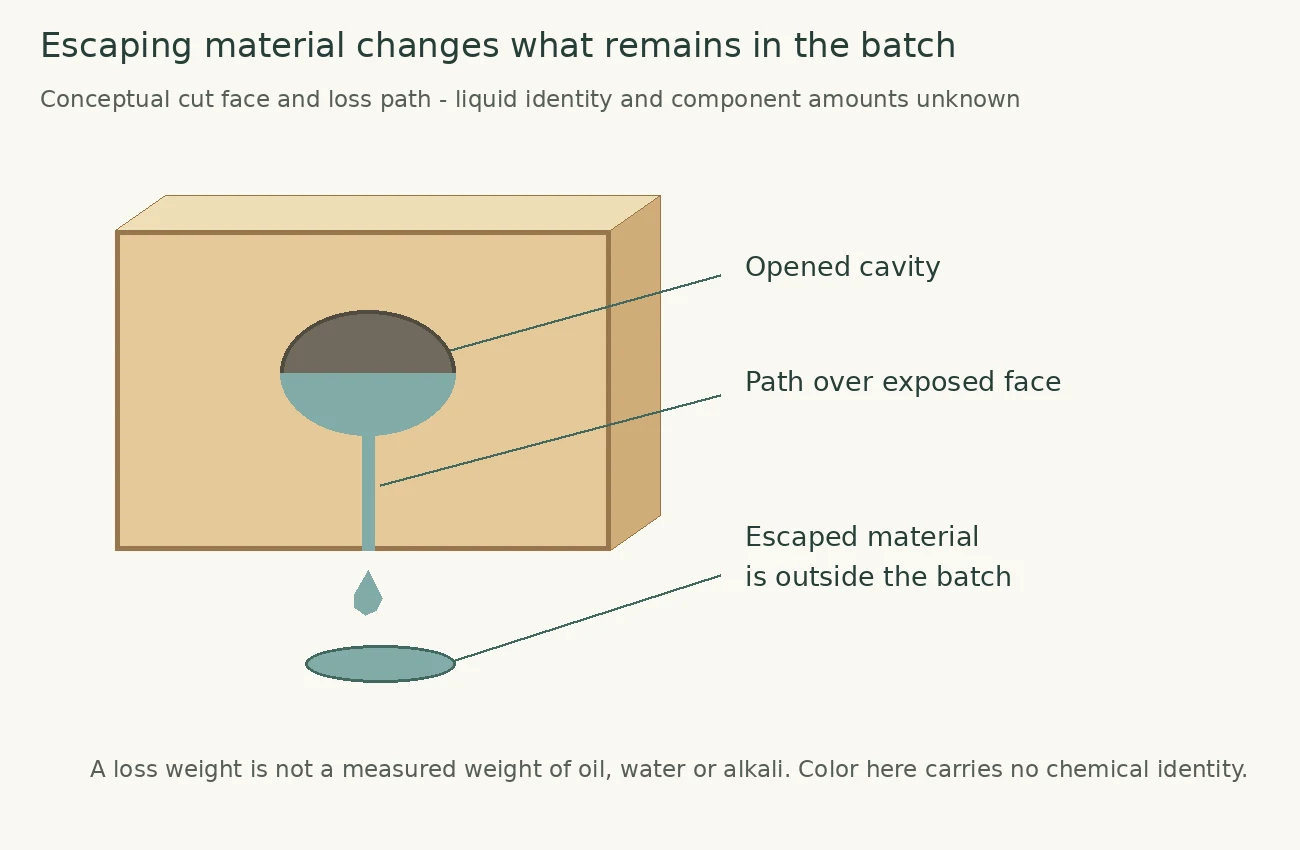
If material has already left the batch, record that loss without inventing its composition. Even a measured total weight of escaped liquid does not show how much was oil, water or alkali. Replacing the same weight with one guessed ingredient would not reconstruct the original mixture.
That is why scooping out a wet region, wiping the cut faces and using the neat-looking bars is not a reliable correction. Nor can a longer cure restore ingredients that have leaked out or redistribute a nonuniform mixture by itself.
Berry advises discarding batches with major separation, tunnels and uncontrolled liquid loss because the lost quantities cannot be accounted for. Her caution concerns that combination of conditions; it should not be turned into a blanket instruction to discard every dry air hole.
Do Not Assume Rebatching Solves Both Cases
A dry heat tunnel and an unknown liquid-loss event need different decisions. The first prompts a review of the formula and thermal history; the second additionally raises whether the current material balance is knowable. A general reheating or rebatching instruction cannot fill in unknown quantities.
For example, an otherwise documented batch with a dry opening and recorded heavy insulation presents a different investigation from one that gushes liquid after an uncertain mixing stage. The same cavity-shaped word, "tunnel," does not make the evidence equivalent.
Keep the affected batch out of use while a quantity, incorporation or liquid-identity problem remains unresolved. Do not use a tongue test, lack of skin sensation or a smooth surface after reheating as a substitute for that assessment.
Make the Next Batch Easier to Understand
Use a checked formula, actual recorded weights and a mold prepared before mixing. Observe the batter for visible oil ribbons or uneven regions before pouring; apparent thickness from cooling fats is not the same thing as uniform incorporation. Keep the exact fragrance product and addition sequence in the record.
Then monitor the chosen thermal method for signs of excess heat rather than pursuing a particular color at all costs. If a covered batch begins cracking or rising, end unnecessary added heat or remove insulation only when that can be done with stable handling and without touching fresh soap.
After cutting, record the internal appearance alongside that process history. The useful result is a specific comparison: the next batch used the same checked formula with a clearer mixing observation or a controlled change in heat retention. That helps prevent repeating the documented cause without pretending that appearance alone can tell you the composition of an unknown cavity.