
Weight Ounces, Fluid Ounces and Milliliters in Soap Recipes
Select an image to view it at full size.
An ounce on the weight setting of a digital scale is not a fluid ounce marked on a measuring jug. Weight ounces and grams describe mass. Fluid ounces and milliliters describe volume. Soap Draftbook accepts grams or ounces by weight; its ounce input is not a fluid-ounce input.
Read the unit before converting a number. Changing “oz” to “g” is straightforward when it means weight ounces. Changing milliliters of an oil to grams requires information about that particular oil’s density. If the original recipe leaves the unit ambiguous, resolve that ambiguity before calculating its lye requirement.
Identify the Kind of Quantity First
In ordinary soapmaking language, “weight” usually means the mass reading from a scale. You place a suitable container on the scale, account for the container, then weigh the ingredient. The scale is measuring how much material is present; graduations on the container are not the measurement being used.
A jug’s mL or fl oz graduations describe the space occupied by its contents. A tablespoon, cup or fluid ounce is also a volume measure. The same volume of two different liquids need not have the same mass.
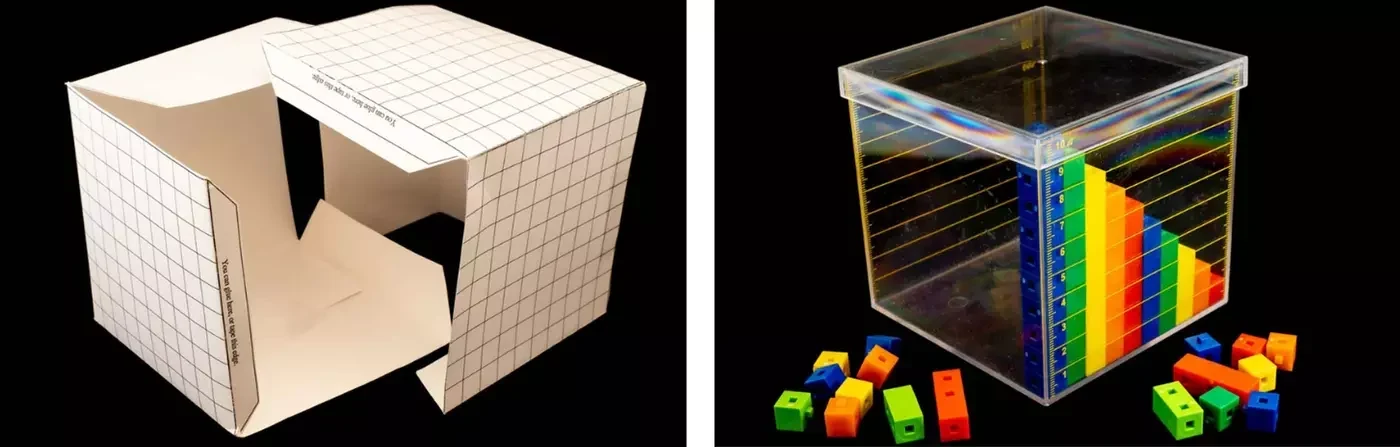
NIST’s physical liter models illustrate this distinction: a liter is a specified volume, not a promise that whatever fills it weighs one kilogram. A cube measuring 10 cm along each edge has a volume of 1,000 cubic centimeters, equal to 1 L. Each 1 cm³ is 1 mL. The contents determine the mass.
| A recipe or instrument says | Quantity | Can it go directly into a weight field? |
|---|---|---|
| g or kg | Mass | Convert kg to g if needed |
| oz, explicitly by weight | Mass | Yes, using the scale’s ounce setting |
| fl oz | Volume | No |
| mL or L | Volume | No |
| Cup, tablespoon or teaspoon | Volume | No |
The letters “oz” on their own may be insufficient. A supplier’s bottle size, a recipe’s ingredient line and a scale display can use different conventions even when they all involve the same ingredient.
Convert Mass to Mass Without Changing the Recipe
Soap Draftbook uses 1 weight ounce = 28.349523125 g. Thus 8 weight ounces are 226.796185 g, or about 226.80 g when shown to two decimals. The conversion changes the unit, not the underlying quantity.
For an oil blend given as 10 oz olive, 5 oz coconut and 1 oz shea, first confirm that all three entries are weights. Their total is 16 weight ounces, equivalent to 453.59237 g. Converting all three entries consistently preserves their proportions. Converting only one and then adding the bare numbers does not.
Carry adequate precision through the calculation and round the displayed final quantities, rather than repeatedly rounding intermediate conversions. NIST recommends identifying the starting and desired units, selecting the appropriate factor, cancelling units and checking whether the result makes sense.
Do not choose a volume mode on a kitchen scale just because the ingredient is liquid. Such a mode relies on a density assumption. Its “mL” reading is not an independent measurement of volume and does not establish the correct mass of an unfamiliar oil.
Use Density Only When a Volume Conversion Is Justified
The relationship is mass = volume × density. When volume is in mL and density is in g/mL, the result is in grams. Conversely, volume equals mass divided by density.
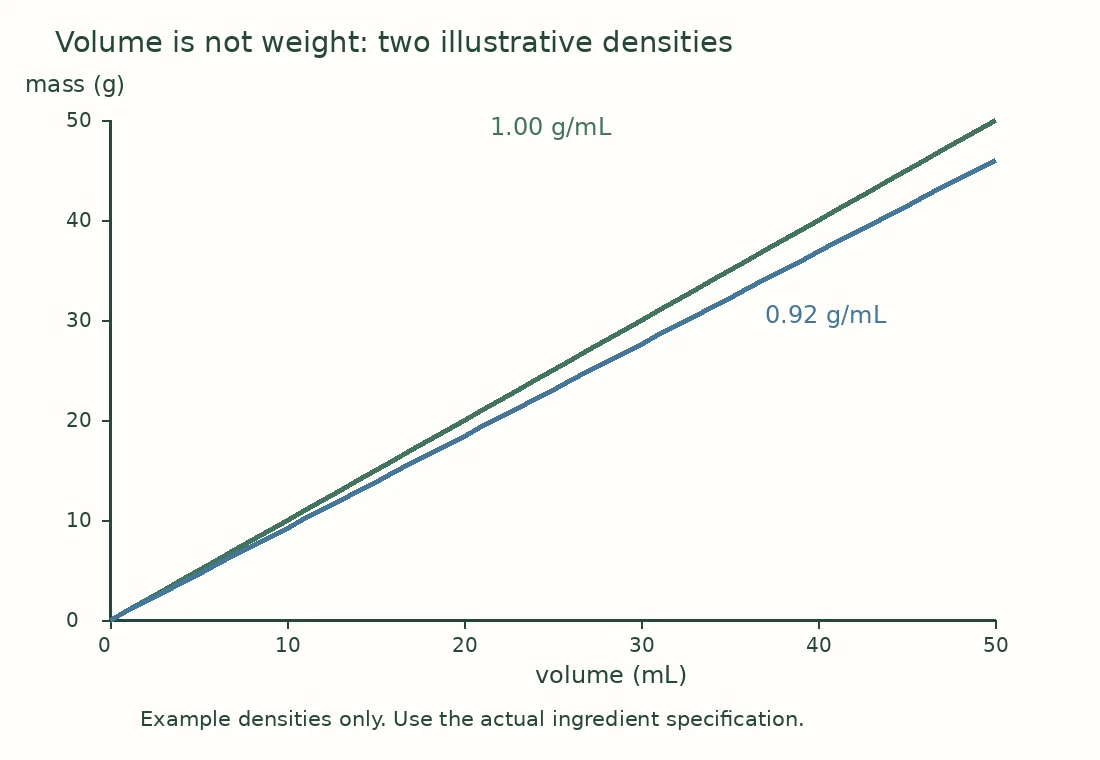
The graph uses illustrative densities of 1.00 and 0.92 g/mL. At 50 mL, those would correspond to 50 g and 46 g respectively. The numerical example shows why “100 mL = 100 g” is not a general rule; 0.92 is not a measurement of your oil bottle.
If a documented ingredient density is 0.918 g/mL under its stated conditions, 100 mL corresponds to 91.8 g. Modern Soapmaking gives 0.918 g/cm³ for one specific olive oil in its mold-sizing example. That value is useful for understanding its example, not as a universal density for every oil and temperature.
A reliable conversion therefore needs the ingredient identity, relevant grade and density conditions. A whipped butter, loose flakes or a partly melted fat presents additional problems for a household volume measurement. When a mass-based soap recipe is available, weighing the specified mass avoids introducing a density conversion at all.
Distinguish U.S. and Imperial Fluid Ounces
Even within volume units, “fluid ounce” needs a system. NIST lists a U.S. fluid ounce as approximately 29.57353 mL, and a Canadian or U.K. Imperial fluid ounce as approximately 28.41306 mL. Neither is the same unit as a weight ounce.
One U.S. fluid ounce of a hypothetical liquid at 0.92 g/mL would weigh about 27.21 g: 29.57353 × 0.92. One weight ounce, however, is about 28.35 g regardless of whether the weighed material is oil or water. Similar-looking numbers are not interchangeable definitions.
Avoid using the water shortcut to settle an ambiguous recipe. Water’s familiar approximate relationship between milliliters and grams does not transform an oil quantity, a lye-solution quantity or an unspecified ounce into a known weight.
Resolve Mixed or Unclear Recipes Before Entering Them
Look for an explicit statement such as “all amounts by weight,” a complete gram version, or the author’s description of the measuring equipment. Check whether a bottle label states net mass or net volume. If the recipe mixes those quantities, keep each original unit beside its number while you investigate.
When the amount of a base oil cannot be established, do not select whichever calculator field produces a familiar answer. The lye calculation depends on actual oil mass and identity. Ask the recipe author for clarification, or use an adequately specified recipe instead of inventing the missing conversion.
Once the quantities are established, put every oil into the same mass unit, check their total, and enter those weights in the calculator. Keep the original units and any documented conversions in your notes so that the next person reading the recipe can follow the same calculation.