
How to Estimate Oil Weight for a Soap Mold
Select an image to view it at full size.
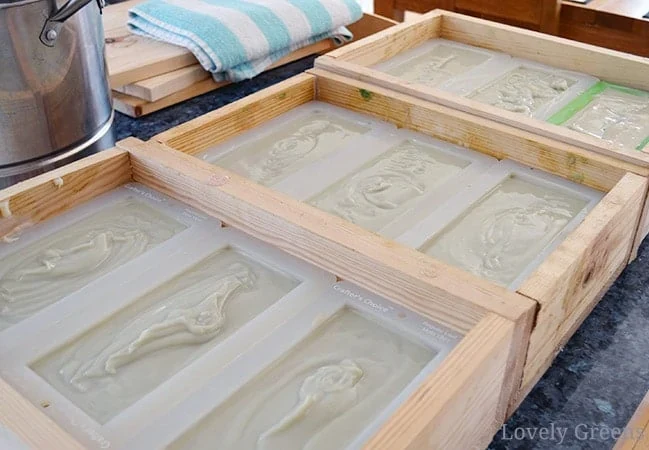
Estimate a mold’s usable volume first, then translate that volume into an oil-weight target for a particular formula. Measuring the outside of a mold or entering its advertised “soap weight” directly as oils skips an important step. Water, lye, other additions and the space deliberately left above the pour all affect the result.
A volume-to-oil multiplier is a planning estimate. It is most useful when its units and recipe conditions are known, and more useful still when checked against your own previous fill records. Soap Draftbook can resize a supported blend to the chosen oil target; it does not measure the mold or verify the fill height.
Measure the Usable Inside Space
For a straight-sided rectangular mold, measure the internal length, internal width and intended pour depth in one length unit. Multiply those dimensions to obtain volume. Include the liner when deciding where the inside boundaries actually are.
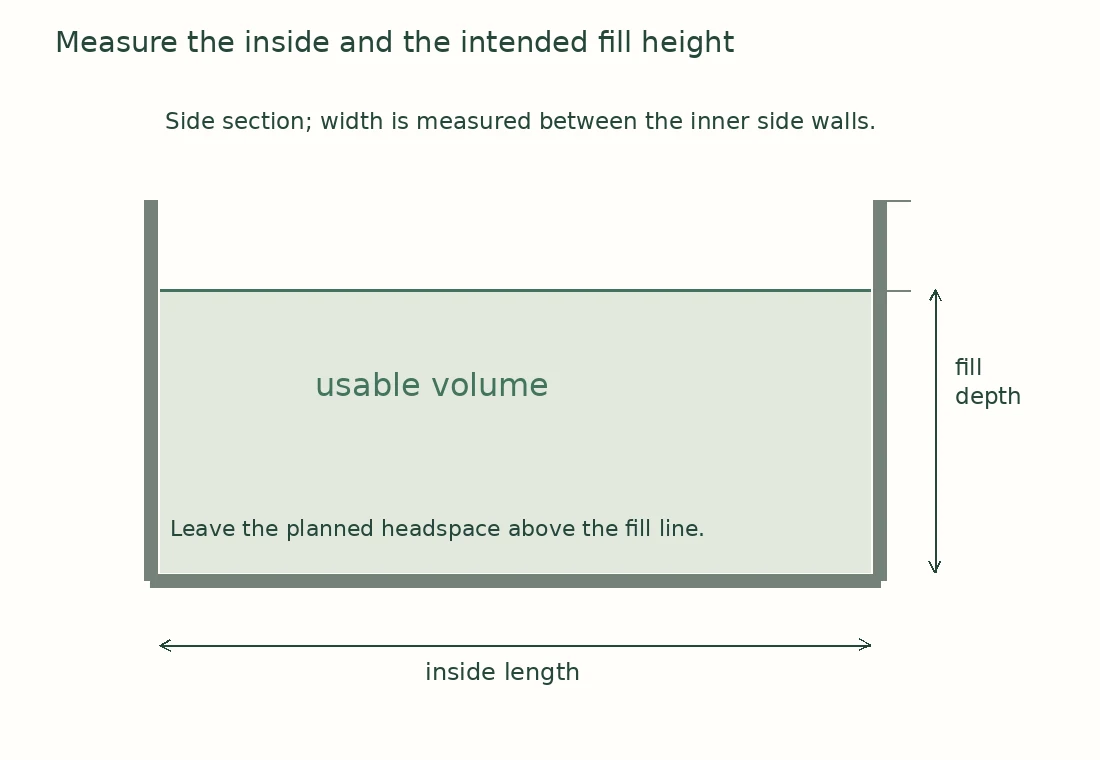
The diagram’s shaded region is the intended fill, not the mold’s complete height. If a mold is 8 cm high but the planned pour is 6 cm deep, use 6 cm. Headspace above that line is not part of the usable volume for this pour. Measuring a wooden support box instead of the lined cavity similarly overstates the space available to the batter.
For an example measuring 20 cm long, 7 cm wide and 6 cm to the fill line, usable volume is 20 × 7 × 6 = 840 cm³, equivalent to 840 mL. These are illustrative interior dimensions, not dimensions inferred from the photograph.
Measure where the batter will sit. Thick silicone walls, rounded corners and a removable insert can make an outer measurement misleading. A tapered mold also has different widths at different heights, so multiplying its top dimensions by depth overestimates its volume. Obtain the supplier’s useful cavity volume or use an appropriate volume measurement instead of treating it as a rectangular box.
Keep the Multiplier Attached to Its Units
Modern Soapmaking describes common starting estimates of 0.65–0.70 g of oils per cm³ for metric measurements, and 0.38–0.40 weight ounces of oils per cubic inch for inch measurements. The author explains that the customary figures assume particular water amounts and become less accurate when those conditions change. They are not densities of all soap batter.
For the 840 cm³ example, choosing an illustrative 0.70 g/cm³ coefficient gives 588 g oils. The following table shows how much the answer depends on that coefficient, without declaring any row correct for your recipe.
| Assumed oil-per-volume coefficient | Calculation for 840 cm³ | Estimated oils |
|---|---|---|
| 0.65 g/cm³ | 840 × 0.65 | 546 g |
| 0.70 g/cm³ | 840 × 0.70 | 588 g |
| 0.75 g/cm³ | 840 × 0.75 | 630 g |
The spread is 84 g of oils even though the mold did not change. Selecting 0.70 without knowing what it represents can therefore create a substantially different batch from a recipe-specific estimate.
Do not apply the metric number to cubic inches, or the inch-based number to cubic centimeters. “0.70” without its units is incomplete information. If converting a coefficient between systems, convert both the mass unit and the volume unit rather than changing only the mold measurements.
Understand Why the Formula Changes the Estimate
At a fixed oil weight, a formula using more water has more material to accommodate than the otherwise identical formula using less water. Oil identities and densities matter too. Fragrance, fillers and other additions can change the actual fill; an estimate that omits them does not acquire that information automatically.
Modern Soapmaking develops a recipe-dependent method by estimating individual ingredient volumes from volume = mass ÷ density, summing them and dividing oil mass by estimated total volume. For its example using 1,078 g olive oil, 203.72 g water and 135.82 g lye, the article estimates about 1,441.78 cm³ total component volume and a coefficient near 0.748 g oil/cm³.
That example illustrates the reasoning, not an exact measurement of mixed batter. Adding separate ingredient volumes is an approximation: solution formation, temperature and the developing batter can affect actual volume. Density figures also need to match the materials and conditions. The source explicitly treats its calculation as an estimate and discusses material left behind in the pot.
Use a supplier’s oil-weight recommendation when its formula conditions match yours, or a previously successful coefficient from the same formula and pour procedure. If neither is available, document which estimate you selected and its uncertainty. Do not present an unfamiliar coefficient as a measured property of your batch.
Calculate Cylinders and Small Cavities Appropriately
For a straight cylinder, volume is π × radius² × intended fill depth. The radius is half the internal diameter. An 8 cm internal diameter and 10 cm fill depth give π × 4² × 10, or about 502.65 cm³. At the illustrative 0.70 g/cm³ coefficient, that corresponds to about 351.86 g oils.
Using the diameter where the radius belongs would multiply the estimate by four. Check that distinction before changing a recipe. Also check whether a nominal tube diameter describes the actual internal opening; the advertised size is not always the cavity measurement needed here.
For identical individual cavities, find the usable volume of one, then multiply by the number you intend to fill. Do not automatically count every cavity if some will remain empty. Decorative or irregular cavities may need a supplier volume specification rather than a rectangular approximation.
If an empty mold is suitable for holding water without damage or leakage, a measured water fill to the intended line can help establish volume. Approximately 1 g of ordinary room-temperature water occupies 1 mL; use the net water amount, excluding the container. This establishes a volume estimate, not an equal oil-weight target. A 100 mL cavity does not therefore call for 100 g oils. Empty and dry the mold completely before production; do not add test water to soap batter or lye. If a mold or liner cannot tolerate a water fill, use another measurement method.
Resize the Blend, Then Review the Whole Calculation
Once an oil target has been selected, enter the exact supported oil identities and original proportions in the calculator. Use Scale this blend, enter the new oil total and choose Apply scale. Review every oil weight and the recalculated NaOH product and water, preserving the intended lye discount, purity and water basis.
Do not scale only the oils and leave the previous lye weight unchanged. Do not replace an unavailable oil with an approximate name just to complete the entry. Either change alters what the original formula represents. This mold-sizing exercise also does not supply chemical adjustments for ingredients outside the calculator’s scope.
There are two separate questions at this point: whether the formula and production plan are appropriate, and whether the planned batch will occupy the desired space. A plausible mold estimate answers neither the ingredient-review question nor a finished-soap safety question.
Turn the First Result Into a Useful Fill Record
Record the mold identity, liner, intended fill line, interior measurements, formula version, oil target, water basis and chosen coefficient. After a batch, note the actual fill height, significant material left in the pot, overflow or unused batter, and any deliberate changes during pouring.
If a particular 600 g oil formulation repeatedly fills a measured 850 cm³ usable volume under the same procedure, its practical coefficient is about 0.706 g oil/cm³. That is a record of the complete practice, including its transfer losses, rather than an independently measured universal batter density. Check that the whole planned batch actually corresponds to the recorded fill before deriving it.
Reuse that experience cautiously when the formula, water amount, additions or procedure changes. A record that says “600 g oils filled this mold” is much more useful when it also says which blend and water setting produced that result. It lets the next estimate improve for a concrete reason instead of accumulating a series of unexplained capacity guesses.