
How to Size a Soap Mold and Cutter from Wet and Cured Bar Measurements
Select an image to view it at full size.
A finished bar's target weight cannot, by itself, tell you which mold or wire spacing to buy. The mold holds fresh batter, the cutter divides a relatively fresh loaf or slab, and the bar you eventually package has a different mass and potentially different dimensions. Connect those stages with measurements from your own recipe before committing to a fixed cutting system.
Start with the cured bar you want, including its fit in the intended packaging. Then measure identified bars when freshly cut and again at your chosen cure endpoint. Use those observations to estimate the fresh bar dimensions, fresh batch mass and cutting layout. Keep allowances for trimming and actual equipment clearances separate from the bars themselves.
Define the Finished Bar Before Ordering Equipment
Write down the desired cured mass, length, width and thickness. A label saying “4 oz” supplies only the mass target. Many shapes can have that mass, and a broad thin bar will not fit the same box as a short thick one. Check all three dimensions against the actual packaging, including space for a wrapper or sleeve.
Decide when you will assess that finished state. A measurement at four weeks and a measurement after several more months need not agree. Record the endpoint and storage conditions rather than calling an early measurement “completely dry.” For this purpose, you need a repeatable comparison stage; you do not need to assume that a bar eventually contains no water.
Linda Stevens' Choosing a Cutter, published by the Handcrafted Soap and Cosmetic Guild from a 2006 journal article, makes this central distinction: the mold and cutter handle wet soap, while the maker wants a particular dry bar. Its numerical examples are useful illustrations of working backward, rather than universal shrinkage factors.
Measure the Same Identified Bars at Both Stages
Use an established, checked recipe that you intend to repeat. Record the full formula, water setting, additives, mold, pour depth and cutting time. If you change those between trials, you are no longer measuring quite the same production arrangement.
Give the test bars identifiers so the fresh and cured readings can be matched. At the normal cutting stage, weigh each selected bar and measure its three axes. Keep the axis names consistent: if thickness means the wire spacing along a loaf today, it must mean that same direction when the bar is measured later.
Use the same unit and measurement approach for both readings. A domed top or uneven cut makes dimensions harder to compare. Note where the measurement was taken; do not alternate between the tallest peak and the average body height. Include bars from different positions if your loaf has noticeably different end and center shapes. The aim is to see the variation that the cutting system must accommodate, rather than select one unusually convenient bar.
At the chosen cure endpoint, reweigh and remeasure the same bars. Check packaging fit then. Repeat across batches before assuming one set of observations will predict every later batch. Stevens similarly emphasizes measuring the maker's own soap and checking a bar thought to be dry again later.
Keep Mass Retention Separate from Dimensional Change
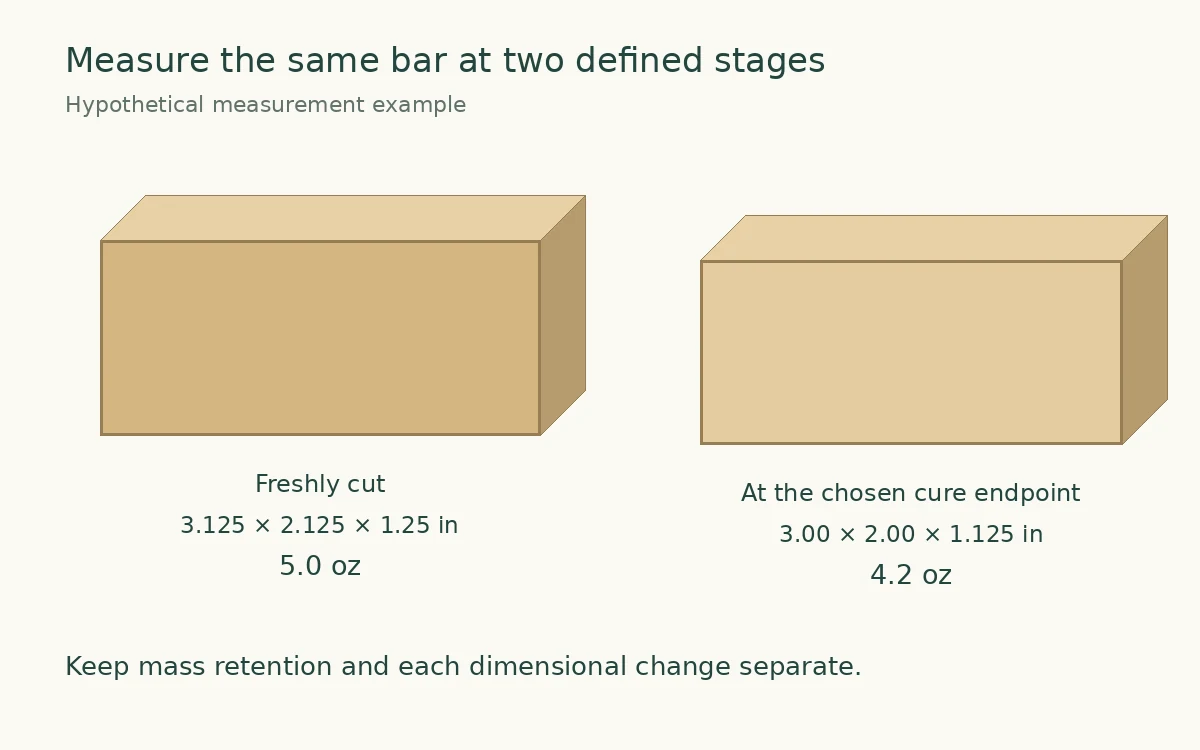
For an identified bar, divide its cured mass by its fresh mass to find the observed mass-retention fraction. Suppose a hypothetical bar weighs 5.0 oz freshly cut and 4.2 oz at the chosen endpoint. Its retention is 4.2 ÷ 5.0 = 0.84, or 84%; its observed mass loss is 16%.
Using that example's retention, a 4.2 oz cured target corresponds to 4.2 ÷ 0.84 = 5.0 oz fresh. That is a planning estimate tied to those observations. It does not establish that another recipe, another cure endpoint or every bar in the same batch retains exactly 84%.
Measure the axes separately. If the example fresh bar is 3.125 × 2.125 × 1.25 inches and its cured dimensions are 3.00 × 2.00 × 1.125 inches, the thickness retention is 1.125 ÷ 1.25 = 90%. The other two axes have different retention fractions. Applying the 84% mass figure to every length would therefore give the wrong cutting dimensions.
Volume is different again. Multiplying the three dimensions gives approximately 8.301 cubic inches fresh and 6.75 cubic inches cured, or about 81.3% volume retention. A percentage change in volume is not the percentage change along each edge. Avoid averaging weight loss and volume loss into a new figure and treating it as a measured linear shrinkage rate.
The historical Guild article works through an averaged estimate and an assumption about water loss. Keep those assumptions visible if you consult its example. For your equipment decision, actual paired mass and dimension readings are a clearer basis than assuming all starting water evaporates or that matching water-to-lye ratios guarantees identical shrinkage.
Turn the Fresh Bar Into a Cutting Layout
Once you have a plausible fresh bar size, lay out the required number of bars before choosing a mold. In a loaf arrangement, two dimensions describe the cross-section; the third is the cut spacing along the loaf.
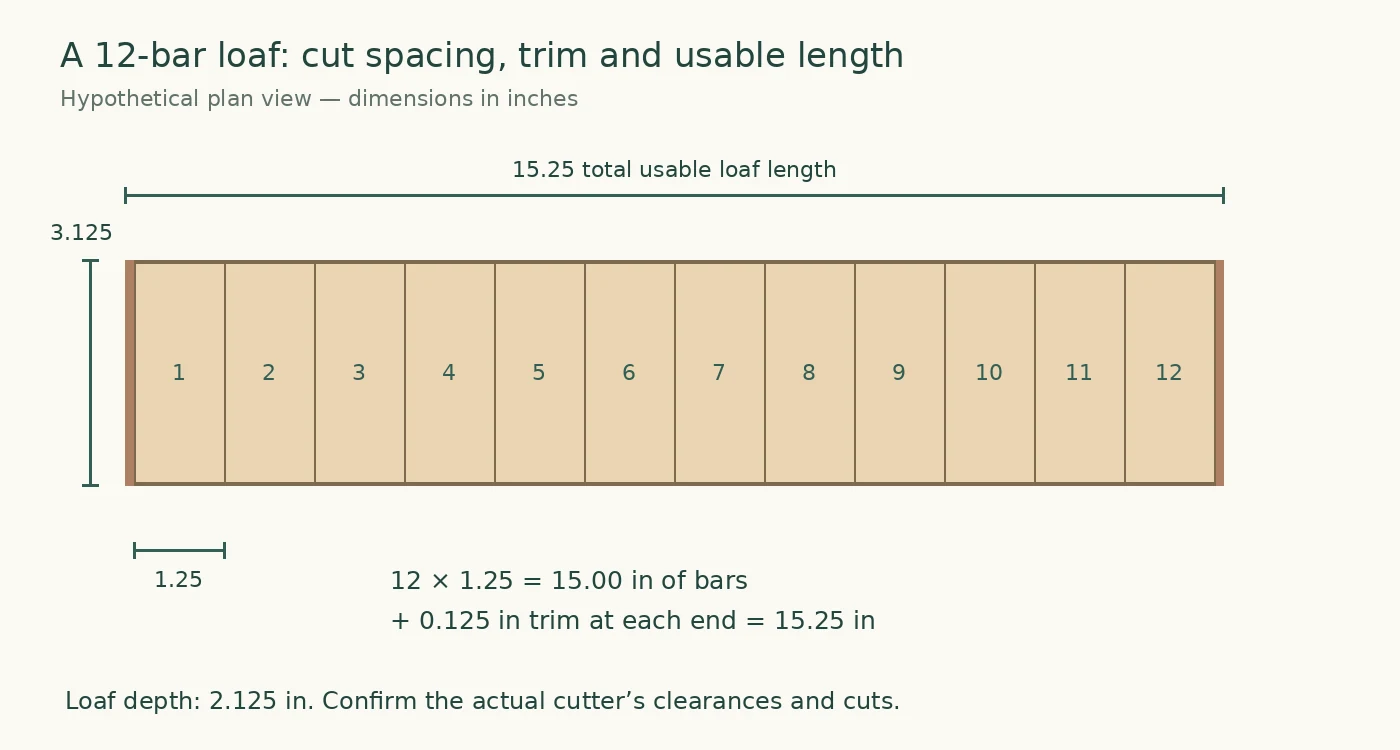
Using the hypothetical fresh dimensions above, assign 3.125 inches to loaf width, 2.125 inches to pour depth and 1.25 inches to bar thickness. Twelve bars then require 12 × 1.25 = 15.00 inches of bar-producing length. If you also plan to remove 0.125 inches at each end, the usable loaf length becomes 15.25 inches.
That trim allowance is an explicit example choice, not a requirement for every mold. A liner may leave wrinkled sides, a shaped top may need a different treatment, and an end bar you keep is not waste. Draw the actual layout and count usable bars after those choices. Confirm which cuts the proposed cutter makes: a frame's overall length, wire count and spacing do not necessarily describe the same usable length.
For a slab, draw rows and columns using the fresh dimensions in their intended orientation. A three-by-four layout can produce twelve bars, but it occupies different dimensions from a single twelve-bar loaf. Add the actual edge allowances, and ensure the grid lines correspond to the bars you want. Embossed cavities or patterned slabs introduce alignment requirements that should be checked with the mold and cutter maker.
Check Internal Capacity and Handling as Separate Questions
Use the mold's usable internal dimensions after its liner is fitted. External box dimensions include walls and do not describe available batter space. Keep the intended pour depth below the mold's full height; the entire wall height is not automatically the fill target.
The illustrative loaf above has a bar-producing cross-section of 3.125 × 2.125 inches and a total usable length of 15.25 inches. Multiplying those gives about 101.27 cubic inches at that fill depth. This is a geometric volume, not a weight of oils. Do not enter 101.27 as an oil weight or turn it into batter mass using an assumed universal density.
Estimate batter required from your own measured output and the actual layout, allowing separately for material retained in vessels and planned trimming. Then recalculate the recipe at the appropriate oil scale, keeping its ingredient identities and settings consistent. Soap Draftbook's oil scaling is a calculation step; it does not establish the density or cure behavior of your particular batter.
Check the filled mold's total handling load, including the mold itself. A block that promises fewer pours may be awkward to lift onto the cutter or rotate safely. Stevens highlights this tradeoff alongside wire length and the force needed to push a grid through soap. Ask the equipment maker about the actual arrangement, working limits and manual effort instead of inferring them from bar count alone.
Confirm the Fit Before Making the Permanent Choice
Give the supplier the fresh bar dimensions, desired count, total loaf or slab dimensions, trimming plan and actual mold design. Ask about usable cutter clearance, maximum loaf length, wire spacing options and how the loaf is supported through the complete cut. A cutter that matches the nominal spacing can still be too short or too shallow for the workpiece.
Try the intended dimensions on a modest scale before buying a fixed system or ordering a large run of packaging. Compare the cured results with your target and keep the spread of measurements, not just their average. If some bars miss the target, investigate that variation before treating a single calculated size as settled.
Recheck the measurements when you change the formula, water setting, pour depth, additives or cure arrangement. The useful result is a repeatable link between your fresh bars, your cutter and your eventual packaged bars. A single finished-weight target, an assumed drying percentage or a calculator's oil total cannot supply that link on its own.