
Why a Calculator SAP Value Can Differ from Your Oil Batch
Select an image to view it at full size.

A calculator needs one working number for each oil, but your bottle contains a particular batch of material. Those are different kinds of information. A selected reference SAP value lets the software calculate consistently; it is not a laboratory measurement of every oil sold under that name. Natural composition, grade and processing can make a real batch differ from the reference.
The useful response to a mismatch is to identify what each number describes before changing the lye setting. Check the oil identity, SAP units and source, then separate that issue from NaOH purity, lye discount and water settings. A convenient number on a supplier sheet is not necessarily a batch-specific result.
Check What the SAP Number Means
Saponification value describes the alkali required to saponify a given mass of fat. It is commonly reported as milligrams of KOH per gram of oil. A NaOH calculator uses a corresponding sodium-hydroxide value; the numbers are not numerically interchangeable.
Soap Draftbook documents the conversion as:
NaOH SAP in g/g = KOH SAP in mg/g × (39.997 ÷ 56.106) ÷ 1,000.
For an illustrative KOH SAP of 190 mg/g, this gives about 0.135448 g NaOH per gram of oil. The factor of 1,000 accounts for milligrams versus grams; the molecular-mass ratio accounts for KOH versus NaOH. Entering 190 where 0.135448 belongs would not be a small reference disagreement.
When comparing two sources, write their units beside the values. “SAP 0.19” might be a KOH value in g/g, whereas “SAP 190” may be the same value in mg/g. Neither should be assumed to be a NaOH g/g coefficient merely because it appears on a soapmaking page.
Distinguish a Range, a Typical Value and a Batch Result
A specification interval sets limits for a defined material. A typical value describes a representative property rather than promising that exact value in every delivery. A batch test, if actually supplied for the relevant lot, describes the tested sample and method. The headings and document identity matter as much as the number.
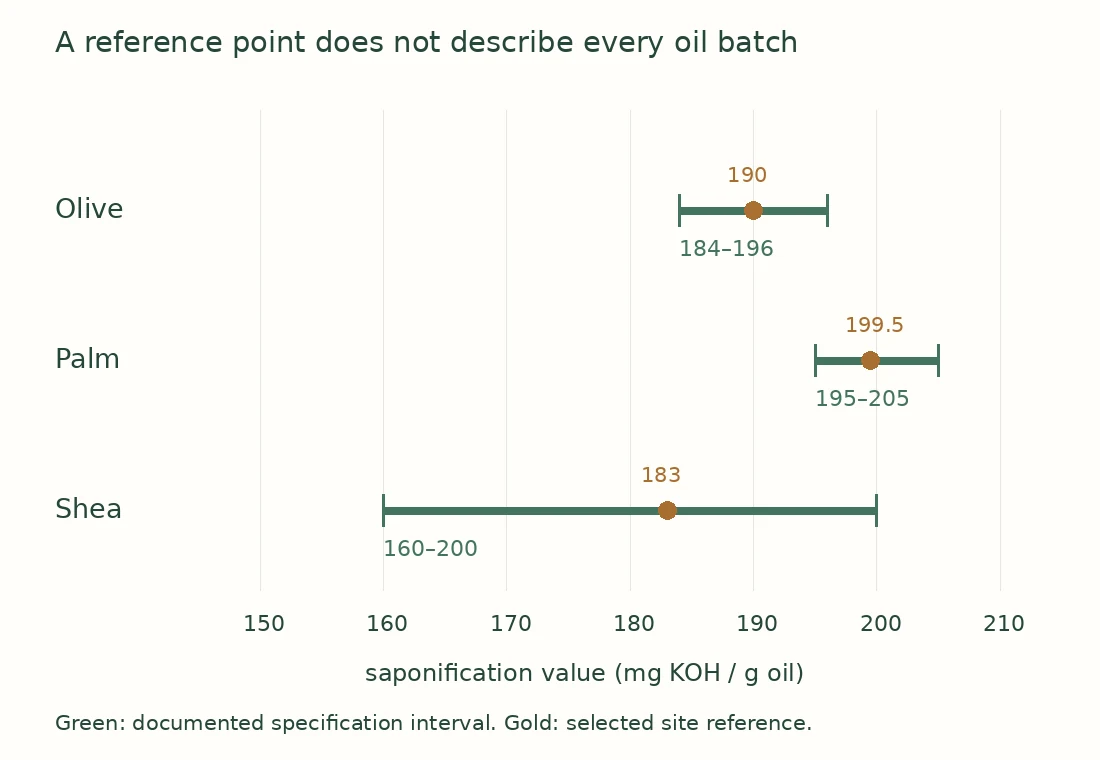
Soap Draftbook’s current notes illustrate this distinction. They document an olive-oil specification interval of 184–196 mg KOH/g and select 190 as a midpoint reference. Palm oil is documented with a 195–205 interval and a selected approximate typical value of 199.5. Shea has a broader documented interval of 160–200, while the selected 183 comes from a refined whole-butter product reference, rather than that interval’s midpoint.
The chart shows the documented intervals and selected points separately. It does not imply a uniform distribution of real batches inside each interval, nor establish that every supplier grade is covered by those labels. A gold point is a software reference, not an assay of the material in the photograph.
Ask a supplier whether its figure is a specification limit, a historical typical value or a result for your lot. Check whether the document names the whole oil, a fraction, a blend, a refined grade or another product. An “average shea” entry cannot be assumed to describe shea olein, shea stearin or a blended product.
See How a Reference Difference Affects the Arithmetic
Kevin Dunn describes a palm-oil example in which the supplier listed 203 mg KOH/g but the received sample measured 196. His article explains that such values can vary and that the supplier’s average need not be a measurement of the delivered sample.
Consider the arithmetic for 500 g of an oil, using those two values only as an illustration:
| Assumed KOH SAP | Converted NaOH SAP | Calculated NaOH at zero discount |
|---|---|---|
| 203 mg/g | About 0.144715 g/g | About 72.36 g |
| 196 mg/g | About 0.139725 g/g | About 69.86 g |
The difference is about 2.50 g NaOH. Applying a 5% lye discount to the 203-based calculation gives about 68.74 g. Relative to the hypothetical 196-based theoretical requirement, that corresponds to about a 1.61% alkali shortfall, not 5%.
This calculation explains a source of uncertainty. It does not identify the true SAP of an untested batch or establish an appropriate discount for another recipe. The inverse case also matters: if the actual alkali demand is higher than the reference, the same nominal discount produces a different relationship again.
Keep Lye Purity Separate from Oil SAP
The oil coefficient describes alkali demand. NaOH purity describes the sodium-hydroxide product being weighed. Reducing a purity input increases the calculated product mass needed to provide a given nominal amount of NaOH; it does not establish the correct SAP value for an oil.
Likewise, a lye-discount setting reduces the calculated requirement by a chosen percentage. It is not a measurement of the finished bar’s free-oil percentage. Water settings describe an additional relationship and cannot repair an incorrect oil identity or undocumented lye product.
Keep each assumption in its own line of the record. If two calculators disagree, align oil variants, units, reference coefficients, lye discount and purity before attributing the difference to rounding. Two matching outputs can still share an unsuitable assumption, so agreement alone is not material verification.
Preserve the Reference with the Recipe
Soap Draftbook’s current drafts use its documented 2026 reference set. Historical drafts retain their earlier set, including a different shea reference; the site does not silently convert old recipes to the new numbers. A library can therefore contain two versions whose oil names look similar but whose references differ.
Before comparing or copying a saved recipe, check which reference it carries. Keep the ingredient identity, supplier lot information, relevant specification and purity documentation alongside the recipe version. If a supported entry does not match the actual material, do not select a nearby one merely to obtain an answer.
A supplier document can reduce uncertainty only when its meaning is clear. An actual batch assay may justify a qualified review using that batch’s data, but the present calculator is a reference-based workspace rather than a facility for proving material composition. Its documented scope and assumptions remain the starting point for interpreting every result.