
Rice-Like Lumps After Adding Fragrance to Cold-Process Soap
Select an image to view it at full size.
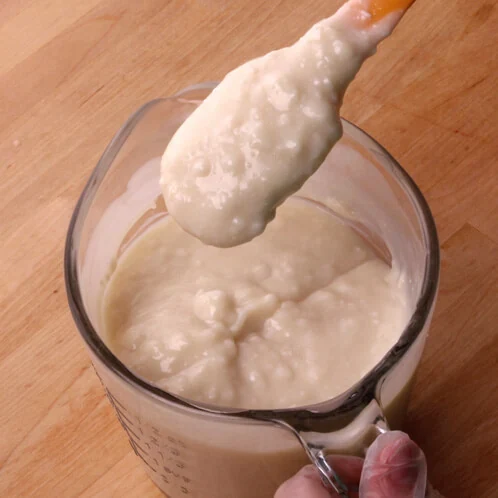
Little rice-like lumps appearing just after fragrance addition are commonly called ricing. First look for whether they are dispersed through an otherwise uniform batter or accompanied by separate pools of oil. In the first situation, controlled additional mixing may disperse the lumps, but it can also make the whole batch much thicker. In the second, smoothing the lumps alone does not resolve the separation.
Keep the fresh batch protected and maintain your splash goggles and suitable gloves while investigating. Neither the name “ricing” nor a familiar photograph establishes the identity of every pale particle in soap. Do not touch or taste a particle to decide whether it is harmless.
Start with the Timing and the Visible Pattern
In Soap Queen's fragrance tests, ricing appeared as small, firm lumps after a fragrance was added to an already prepared cold-process batter. Its close-up photograph shows uneven pale pieces on the spatula and through the jug, rather than a uniformly smooth, thick mixture. The author describes an interaction between a fragrance ingredient and harder components of the oil blend. That explanation belongs to the source's test context; it does not identify the chemistry of your particular product.
Record the sequence before deciding that your batch matches. Was the oil blend fully melted and mixed before lye addition? Were lumps already present before fragrance? Did the problem appear in only the scented part of a divided batch? A symptom that existed earlier needs a broader investigation than fragrance ricing alone.
Jan Berry's troubleshooting guide also identifies rice-like pieces after fragrance as a distinct mixing problem. Other sections of that guide describe pale spots from hard fats, air and poorly dispersed colorants. Their shared color does not make them equivalent. A particle noticed during mixing and an isolated spot discovered in a cured bar are different observations.
Check for Oil Pools as a Separate Problem
Look across the batter and around its edges without putting your face over the container. In Soap Queen's comparison, ricing and separation can happen together. The distinguishing additional observation is free oil collecting around the mixture, rather than merely granules distributed through it.
| Observation | What to record | What not to conclude |
|---|---|---|
| Rice-shaped lumps after fragrance | Product, quantity, addition stage and whether lumps disperse during mixing | Every lump is a lye crystal, or every lump is harmless |
| Smooth batter becoming thick rapidly | How quickly it changed and whether it stays uniform | It must be ricing just because it is difficult to stir |
| Oil slicks or pools beside lumps | Whether separation persists and whether any material was spilled | Removing visible granules will automatically make the whole batch uniform |
| Stiff, clay-like mass | Whether the ingredients can still be incorporated evenly | More forceful blending must be the right correction |
Do not pour off an unknown separated layer to improve the appearance. That removes material whose composition and quantity are not established, making the batch record less useful. Keep the original quantities and any losses clear before considering a later reprocessing decision.
Understand the Trade-Off in Additional Blending
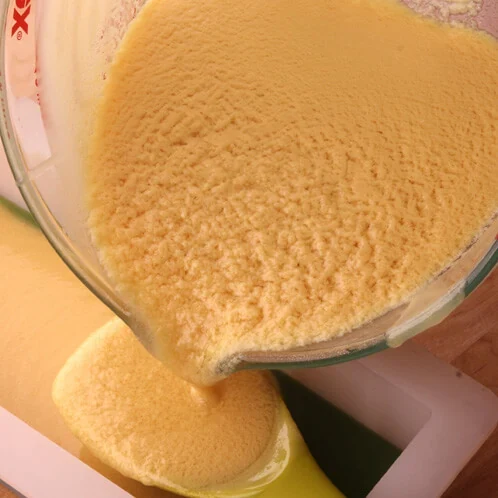
Soap Queen reports dispersing ricing with an immersion blender in one test, then finding the batter thick enough to spoon into the mold. Jan Berry likewise notes that blending out lumps can leave a very thick trace. Those two observations explain the main compromise: a smoother texture may cost the working time needed for a planned swirl.
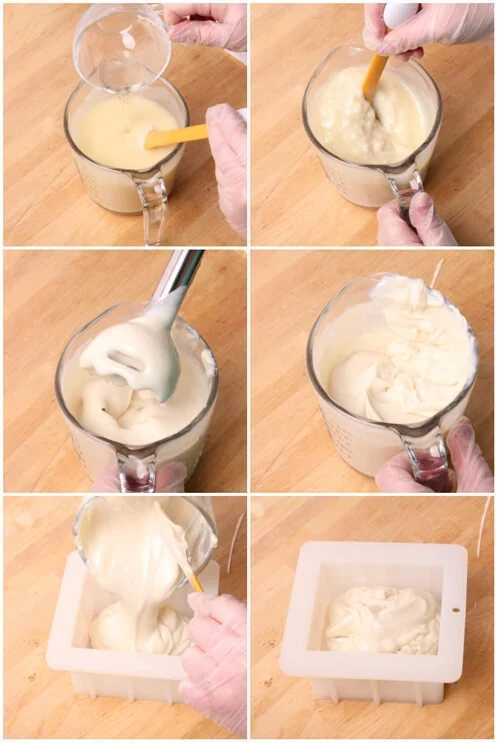
If the mixture is still workable, use the blender only as much as necessary to address the actual unevenness. Keep the head properly submerged and the receiving container stable; do not churn a nearly solid mass or lift a running head through caustic batter. Stop trying to achieve the original decoration if doing so would require rushed or uncontrolled handling.
The source's sequence shows fragrance addition followed by visible lumping, further mixing and a thick transfer. It is evidence of what happened to that test batch, not a fixed blending time. The pictures cannot tell you how many seconds your formula needs or whether a different separated mixture has become adequately mixed.
If you cannot work the ingredients together uniformly, isolate and label the batch. A blanket instruction to blend until it “looks right” is not useful when the mass is too stiff to move evenly. More blending is a possible response to a particular workable ricing state, not an obligation to keep forcing a failing process.
Leave the Formula Quantities Alone
Do not pour in extra oil, water or fragrance as an unmeasured attempt to dissolve the lumps. Oil changes the formula balance; fragrance has its own use calculation; additional liquid changes the planned water setting. A visible improvement in flow would not show that the resulting formula is correct.
Also avoid adding dry alkali to the soap because you suspect an oil pocket. Appearance does not tell you a missing alkali quantity. Keep the recipe reference, actual weights and ingredient identities together so any subsequent investigation starts with known information rather than a series of compensating guesses.
If a batch is suitable for reprocessing, that is a separate decision requiring its actual composition and the chosen method. The possibility of rebatching does not prove that an unknown, spilled or seriously separated mixture can be made suitable for use. These distinctions matter more than saving the decorative plan.
Simplify the Mold Transfer If Uniformity Is Restored
For smooth, evenly mixed batter that remains movable, use a simple prepared mold and a controlled spatula transfer. Thick batter can retain folds and trap spaces, so expectations for the finished surface should change. Do not force an intricate pour just because it was possible before the fragrance was added.
In the historical Soap Queen test, the ricing sample was transferred thickly and subsequently developed a brown color. The close-up problem and later color change were separate fragrance behaviors. A smooth-looking surface after transfer would not establish that there will be no further discoloration or other changes during hardening.
Keep the batch protected while it develops, maintain its identifier and record any later changes. Do not use a fixed age or a pleasing appearance as evidence that unresolved formulation or mixing errors have disappeared.
Reduce the Chance of Repeating It
For the next batch, start with the exact fragrance's supplier documentation and cold-process behavior notes. Record the full product name and version rather than only the scent description. A fragrance that smells similar to a previously successful one can contain a different mixture.
Use a small, controlled comparison instead of repeating an elaborate design with many changing ingredients. Hold the base formula, fragrance quantity and water setting steady while examining one relevant handling change. Note whether the fragrance was added around emulsification or at a thicker trace, how much mechanical blending followed, and the actual oil and lye-solution temperatures. Jan Berry discusses alternative addition approaches using a reserved portion of the recipe oils; these remain conditional methods to assess, not guarantees.
Do not infer purity or adulteration merely from a ricing event. The useful evidence is the actual product information and repeatable observation under recorded conditions. If that fragrance repeatedly produces difficult granules in your chosen formula, selecting another appropriate fragrance may be more practical than redesigning the whole batch around it.
The most useful final note describes both the lumping and the outcome: whether there was free oil, whether mixing dispersed the pieces, whether the batter became too thick for the design, and how it was transferred. That gives the next comparison something concrete to test.