
How to Make Soap Harder and Longer Lasting
Select an image to view it at full size.
A soap that feels firm in your hand can still wear away quickly at the sink. Conversely, a young bar that dents easily may improve substantially during cure. If you want soap to last longer, separate initial firmness, cure development and what happens while the bar is wet.
Start with the current formula and its age before buying a hardening additive. Then check drainage between uses. Those steps help distinguish a formulation change from a curing or storage problem, and give you a more useful comparison for the next batch.
Define the Problem You Want to Change
“Harder” can mean easier release from the mold, cleaner slicing, greater resistance to denting or less soap disappearing during washing. These are related observations, but they are not interchangeable tests.
Record which problem occurs and when. A loaf sticking at unmolding is an early handling issue. A cured bar becoming mushy in a water-filled dish has a use condition that an earlier unmolding time will not solve. A bar wearing quickly despite good drainage may merit a closer look at the formulation and cure.
Keep the actual recipe, making date, water setting and additives beside your notes. If you compare two bars, use similar ages and washing conditions. Otherwise a longer-cured sample may seem to prove an oil change when age was also different.
Give the Existing Formula a Fair Cure
Jan Berry's troubleshooting guide identifies water amount and rushed curing as common contributors to disappointing hardness and longevity. She also notes that formulas high in liquid oils may benefit from longer curing rather than being dismissed immediately.
Classic Bells explains cure as more than evaporation. Its account includes loss of water and slower changes in the soap's internal structure. That is why “the weight stopped changing much” and “this soap has reached its best performance” need not be the same conclusion.
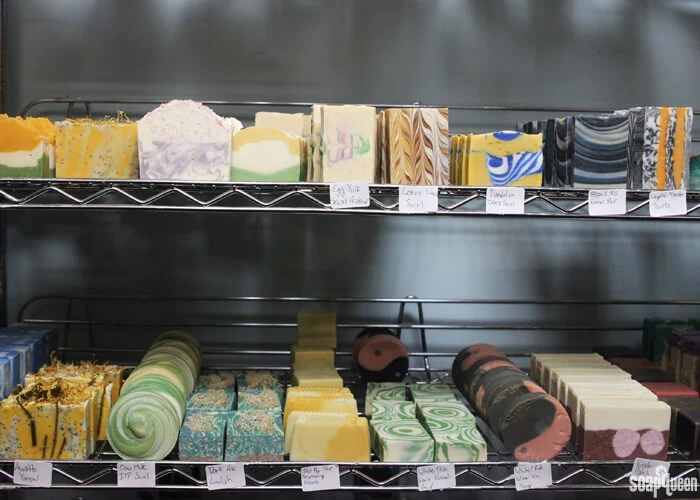
Use a suitable curing location with space around the bars and keep a labeled reference. Soap Queen's rack photograph shows separated, labeled batches, a practical arrangement for keeping their histories distinct.
For a properly made batch, compare its firmness and use behavior again at later, recorded ages. A calendar date is not a universal result, and waiting cannot correct a known formulation or weighing error. Keep those production questions separate from a comparison of curing performance.
Water Changes Can Affect Early Hardness Without Proving a Shorter Cure
Reducing the water in a future recipe can change its initial drying and handling. It does not automatically shorten every part of cure by the same proportion.
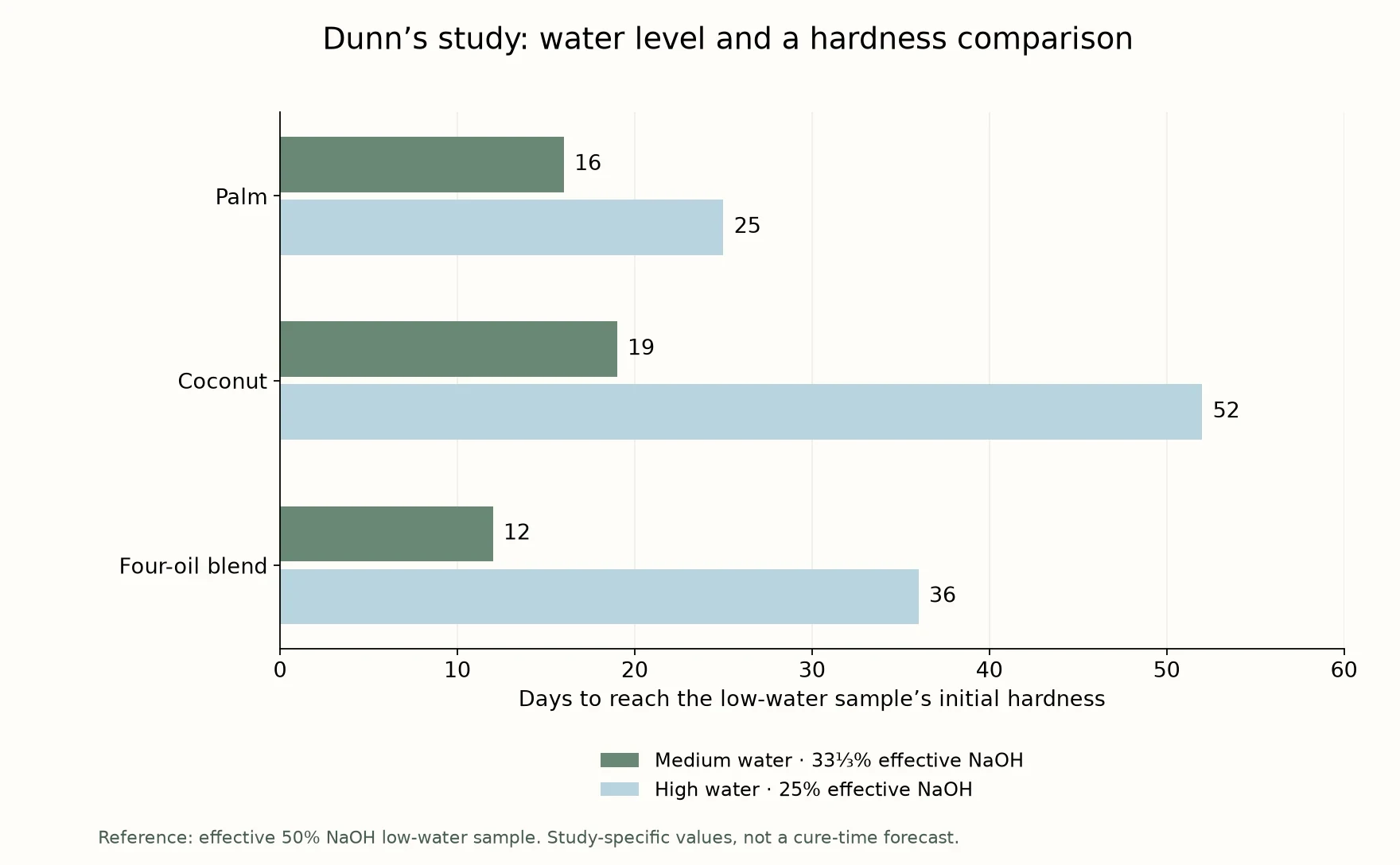
Kevin Dunn's published water-discount study gives a useful example of a narrowly defined hardness measurement. Under its experimental conditions, medium- and high-water palm samples took 16 and 25 days to reach the low-water sample's initial hardness. The corresponding observations were 19 and 52 days for coconut, and 12 and 36 days for a four-oil blend.
The chart transcribes those stated observations. Its endpoint is the hardness of another sample at the beginning of the comparison, not a completed cure, shower lifetime or proof of readiness for sale.
The study used small 100 g oil samples, mechanical shaking and a specified warm hold, with different lye concentrations. Those conditions do not transfer directly into a household recipe. The value of the comparison is the distinction it makes: water setting can affect a measured hardness timeline, while the result still does not answer every question about finished soap.
If you change water next time, record the actual setting and its basis. “Water as a percentage of oils” and lye concentration describe different relationships. Choose an approach suitable for the actual formula and handling demands rather than simply taking out as much water as possible.
Review the Oils Without Equating Every Hard Bar with Slow Wear
Berry suggests increasing suitable hard fats or butters as one formulation direction when a recipe stays too soft. That is a choice about the complete blend, not a license to replace any liquid oil with an arbitrary solid fat.
Classic Bells also distinguishes the water solubility of soaps made from different fatty acids. Its explanation describes lauric and myristic soaps as relatively soluble, with palmitic and stearic soaps less soluble. This helps explain why a broad “hardness” label is not a complete prediction of wear during washing.
Do not read a higher calculator hardness number as a guaranteed number of extra showers. It does not specify the cured bar's size, water exposure, washing frequency or how vigorously it is used.
Choose a blend that fits your other goals as well: lather, ingredients and finished feel. If you increase one oil, identify which one decreases, keep the oil percentages coherent, and recalculate the sodium hydroxide for the entire revised formula. The old alkali amount is not automatically correct at the same total oil weight.
Use Hardening Additives for a Defined Purpose
Sodium lactate and beeswax are sometimes considered when the aim is improved firmness. Berry discusses both, but her same guide also identifies excessive sodium lactate as a contributor to crumbly soap and higher beeswax amounts as potentially reducing lather.
That is a useful reason to define the purpose before adding either. Easier unmolding is a different claim from longer life in a wet dish. An additive that helps with the first has not thereby proved the second.
Use the actual product's appropriate method and amount basis. A historical teaspoon recommendation does not establish a universal dose for every preparation. Beeswax also belongs in the formulation calculation and changes processing considerations; do not add it to an otherwise unchanged formula merely because it is physically hard.
If you make an additive comparison, keep the rest of the formula and practical conditions as comparable as possible. Record the result you wanted to improve rather than just “harder.”
Keep the Bar Out of Standing Water Between Uses
Berry's guide notes that handmade soap can soften or dissolve when left in water. Check whether the dish actually drains and whether water remains in contact with the underside of the bar.
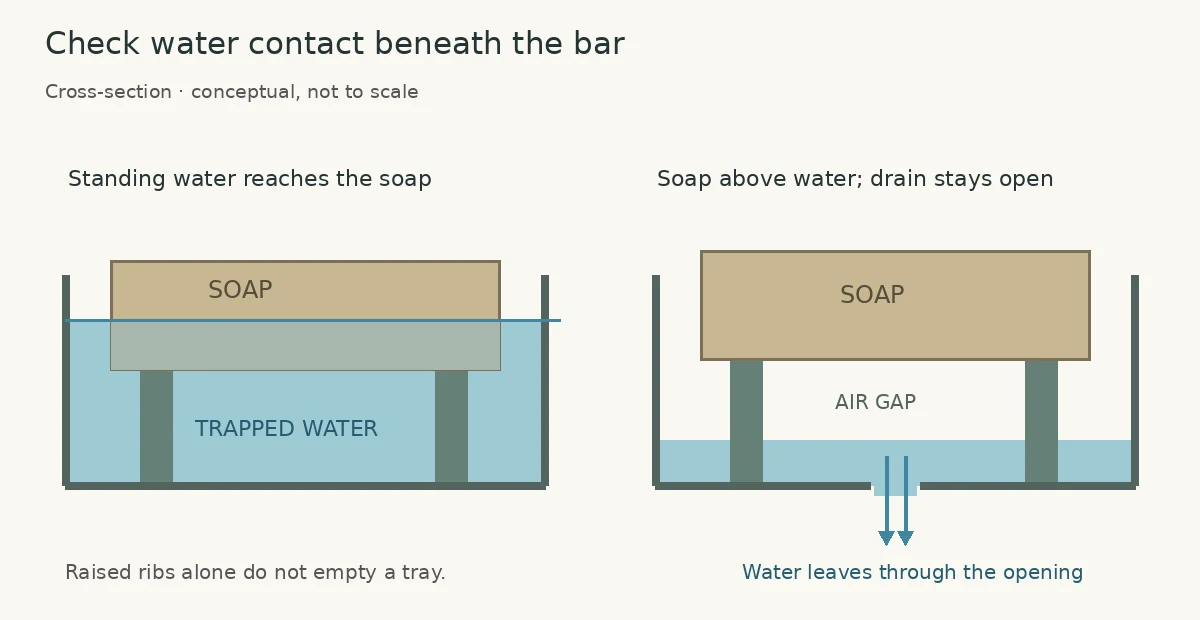
A decorative dish with raised ridges can still hold a puddle above the ridges. The cross-section shows why: ribs only help when the soap stays clear of water and the tray can empty. Move the bar out of standing water and allow it to dry between uses. Also consider whether it sits under a running shower or receives frequent splashes even when nobody is using it.
Before reformulating a bar that performs poorly in one bathroom, compare it in better-drained conditions. That does not guarantee the blend needs no improvement; it removes an obvious use variable from the decision.
Keep a Comparison That Answers the Original Question
| Goal | Record the result that matters |
|---|---|
| Easier unmolding | Actual age and condition at release |
| Cleaner cutting | Age, tool and observed edge damage |
| Firmer cured bar | Formula version and cure age |
| Less wear during use | Drainage, exposure and comparable washing pattern |
| Additive evaluation | Exact product, amount basis and the specific improvement sought |
A useful next step might be more curing time, a better dish, a carefully recalculated blend or an additive selected for early handling. Choose the change supported by the current batch's history. Keeping those outcomes separate prevents a firm-looking bar from becoming a promise of long life that its actual use never supports.