
Why are hard and soft patches appearing when I cut my soap?
Select an image to view it at full size.
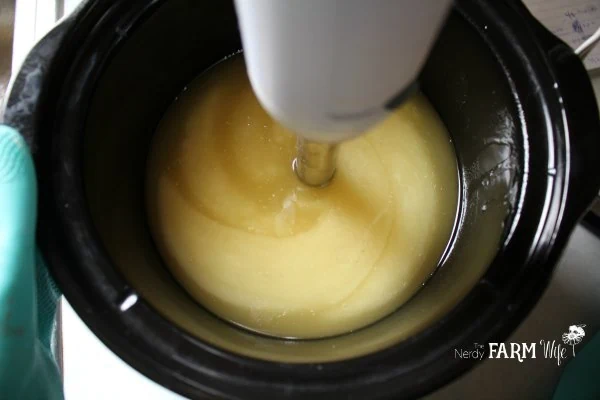
Distinct hard and soft regions in the same cold-process loaf can point to uneven incorporation of the oils and lye solution. Jan Berry identifies stopping the mixing too early, apparent thickening from cooling fats and a fast-moving fragrance that cuts mixing time short as possible routes. The contrast is a reason to review the whole batch, not proof that every hard patch contains a known excess of alkali.
Stop cutting if the loaf releases liquid or exposes an unfamiliar pocket. Keep the batch protected and out of use while its actual quantities and mixing history are unresolved. Do not test a patch by taste or bare-skin contact, and do not assume that removing the soft region leaves a correctly formulated remainder.
Describe the Difference You Actually See
Record whether the texture varies within each slice or between different parts of the loaf. Note the pouring and cutting times and whether the soft area smears, the hard area crumbles, or any liquid appears. A photograph can preserve the positions without establishing their chemical identities.
This differs from a uniformly soft loaf that simply needs more time before clean handling. Berry discusses slow initial firming in some high-liquid-oil or higher-water formulas separately. The focus here is a contrast between regions of the same batch, especially when there is evidence that the batter was not uniform before pouring.
Keep the actual recipe and weighing record available. Include the exact fats, water, alkali and additives, together with anything left behind or lost. If all that is known is the intended recipe, say so. A later calculation based on that intention cannot prove what reached each region of the mold.
Reconstruct the Mixture Before It Was Poured
Ask what the batter looked like just before transfer. Were visible oil ribbons still present? Were there different textures in the same pot? Did a concentrated addition remain at the bottom or around the walls?
The real mixing photograph above is Berry's example of visible oil swirls before sufficient incorporation. It is not a photograph of hard and soft patches in a cut loaf; its value is showing a possible earlier warning sign. Modern Soapmaking likewise distinguishes a thin, uniform emulsion from a mixture with visible oil streaks.
A thin mixture is not automatically unmixed. Conversely, a thick mixture is not automatically uniform. The observation you need is distribution of the ingredients, together with the actual process, rather than the thickness of one spoonful or how long a surface trail persisted.
Do not use a fixed number of stirring minutes as proof. The formula, mixing method, water setting and additives can all change the available working time.
Check for Cooling Fats and Fast Fragrance Behavior
Some hard fats can start setting as the mixture cools. That physical thickening can resemble trace even though it is not evidence that the oils and lye solution have been uniformly incorporated. Both Berry and Modern Soapmaking identify this false-trace route as a source of later unevenness.
Review whether the fats were fully melted and mixed, and whether cloudiness, granules or thickening appeared before fragrance addition. A copied low-temperature target is less useful than knowing whether the actual blend stayed suitable for mixing. Cooling everything further is not a universal answer to fast trace.
Next, mark exactly when the fragrance entered. Was the batter uniform first, or did sudden stiffening leave no time to distribute it through the pot? Keep the precise product and amount; another supplier's fragrance with the same scent name is not necessarily the same material.
For the next test, use a manageable batch and a simple design. Prepare the mold and additives before combining the main ingredients so there is no need to interrupt an already changing batter. These choices preserve observation and working time without prescribing more or less blending for every recipe.
Do Not Correct One Region by Guessing
A visible hard region is not a measurement of excess sodium hydroxide, and the weight of a soft piece is not a known weight of missing oil. Adding guessed oil, water or alkali would change a batch whose internal distribution is already uncertain.
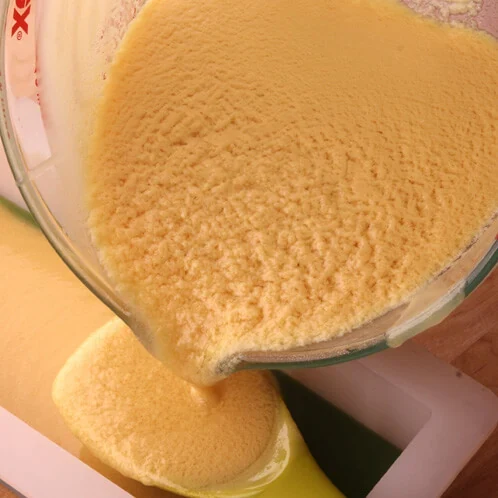
Soap Queen’s actual separation photograph in this section shows grainy batter alongside free yellow liquid in a different source batch. It makes a visibly nonuniform mixture clear; it is not a photograph of hard and soft cut patches or a means of identifying the ingredients in your own loaf.
Berry mentions reprocessing for some uneven batches, but a successful recovery method needs the actual original quantities, retained material and an applicable procedure. If liquid or other material has escaped, those quantities may no longer be reconstructable. Do not turn a general mention of rebatching into permission to heat any patchy loaf and declare it fixed.
Preserve the observations and identify the specific uncertainty: incomplete mixing, a known quantity error, material loss, or an unexplained texture difference. If the batch cannot be assessed with reliable quantities and an appropriate method, keep it out of use rather than relying on a smooth-looking remade bar. The next pour can then address the recorded mixing or temperature problem with a checked formula and a clearer sequence.