
Understanding Glycerin Rivers and Reducing Unwanted Veining in Soap
Select an image to view it at full size.
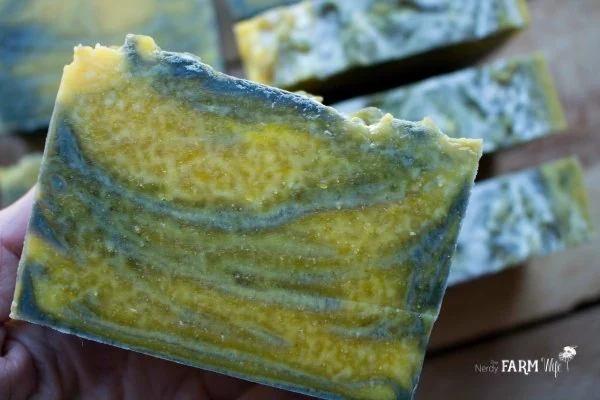
The translucent lines commonly called glycerin rivers are an appearance pattern in cold-process soap, often made conspicuous by a contrast with opaque colored areas. Water amount, heat history, time in gel and colorant conditions can all matter. To reduce an unwanted pattern, investigate those recorded variables rather than assuming the answer is simply to remove glycerin or add less titanium dioxide.
The name does not establish the chemical composition of a vein. It also does not identify an unknown liquid pocket or prove that an otherwise unexplained batch is suitable for use. First distinguish a continuous visual pattern in the bar from separation, leaking material, unmixed particles or an uncertain formula.
Describe the Pattern You Actually See
Record whether the lines are translucent, whether they follow colored regions, and whether the same pattern continues across several cut faces. Keep the pouring and cutting dates, colorant identity, water setting and heating or insulation record attached to the batch.
Jan Berry's troubleshooting example pictured above contains several problems together: the author identifies glycerin rivers, ricing, an unwanted color and heavy surface ash. That is useful because it shows why one familiar label should not absorb every observation. A rough or spotted bar can have more than one issue.
Do not identify an unknown pocket by touching or tasting it. If the bar leaks material or contains unexplained hard and soft regions, preserve those observations as separate problems. A visual resemblance to a published river photograph cannot resolve missing ingredient quantities or a mixing error.
For an otherwise understood batch, the appearance may simply be something to accept or avoid in the next design. Keep that aesthetic decision separate from the chemical and formulation checks that apply to the batch as a whole.
What the Published Experiments Show
Wholesale Supplies Plus publishes an account of experiments varying water, gel duration and added glycerin. Its discussion also describes Clara Lindberg's side-by-side comparison, using the same oil batch and titanium dioxide with different water portions. Under the reported oven-processing conditions, the higher-water portion developed visible rivers while the lower-water portion did not.
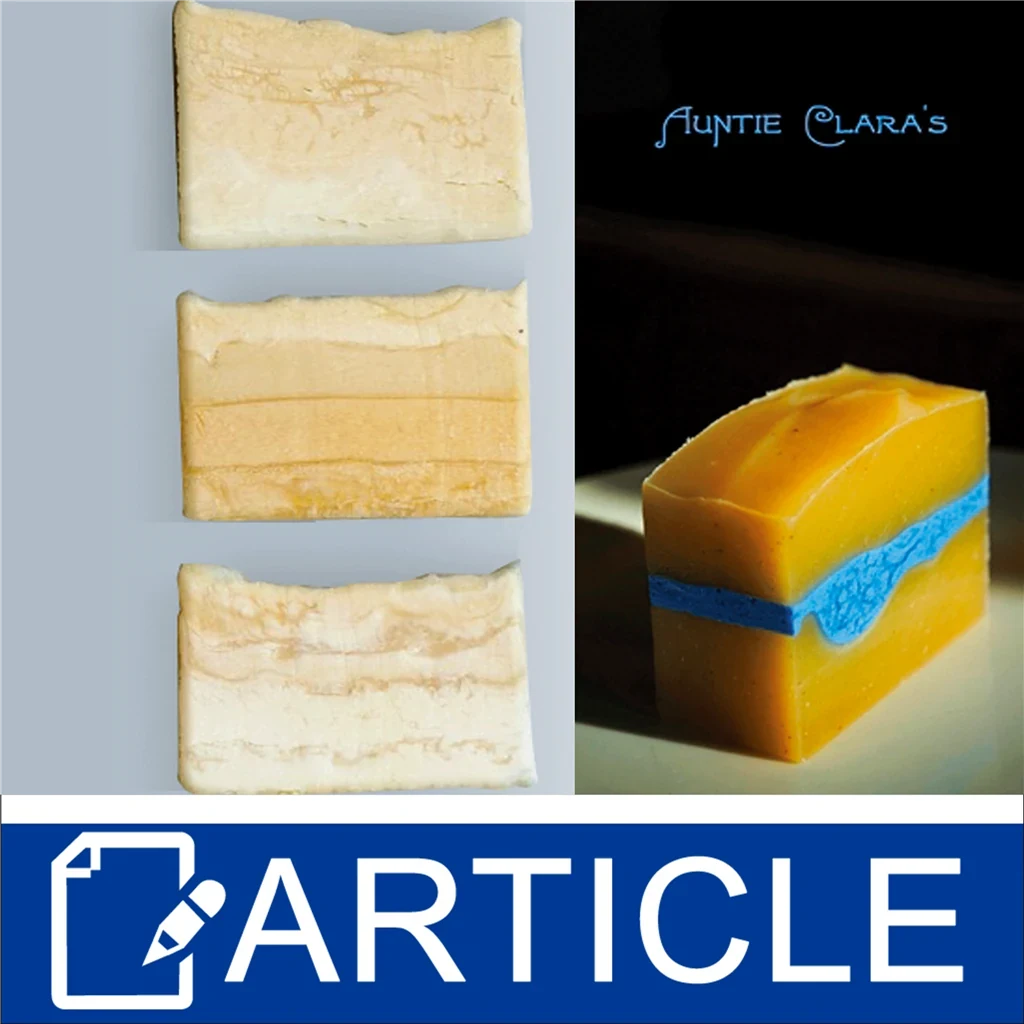
The important comparison is conditional. Giving two portions the same external heating does not automatically establish that their internal gel behavior was identical. The Wholesale Supplies Plus account describes the high-water side as gelling and the low-water side as not gelling. It therefore supports investigating water and thermal history together, rather than treating the comparison as a proof that water alone determines every result.
The source montage in this section includes experimental bars and Auntie Clara's colored-layer example. It shows how vein-like contrast appears within actual soap. The colored band also illustrates why pigment distribution affects how conspicuous the pattern looks.
Do not transfer an oven temperature or a published test formula directly into a recovery method for your own soap. Here those conditions explain the observations; they are not instructions to heat an unfamiliar batch until a chosen appearance develops.
Why a Reported Concentration Threshold Is Not a Universal Setting
In one experiment described by Wholesale Supplies Plus, successive layers contained increasing amounts of water. The report describes the pattern becoming apparent around a NaOH-to-water ratio of 1:2.2, approximately 31% nominal NaOH concentration, for that particular oil blend, pigment addition and heating treatment.
That number is an experimental observation under stated conditions. It is not a guarantee that soap above 31% concentration will never show veins, or a recommendation to increase every recipe to a particular percentage. Other ingredients, actual temperatures and the length of gel exposure still need consideration.
Also check the calculation field before comparing settings. “Water as a percentage of oils” is a different basis from lye concentration. Copying the same number between them does not reproduce the same water amount. The water-setting guide explains that distinction.
A deliberate reduction in water can be one comparison to make with a suitable, established formula. It must still leave an appropriate dissolving-water allocation and enough usable working time for the intended design. Do not create an unrelated mixing problem while chasing a visible one.
Include Gel Duration and Extra Glycerin in the Record
The Wholesale Supplies Plus time comparison describes otherwise matched layers spending different lengths of time under its gel-promoting treatment. The report associates the longer exposure with larger, more defined rivers. Its separate glycerin-addition comparison also reports a more pronounced effect with more added glycerin.
These are useful reasons to record how a mold was insulated or heated, how long it remained there, and whether extra glycerin entered with a colorant dispersion or other addition. Two recipes can have the same base oils and nominal concentration while differing in those details.
The account does not settle the composition of the rivers; it explicitly leaves the question of their actual glycerin content for another discussion. Avoid converting its observed effect of added glycerin into a claim that every visible river is a channel of pure glycerin. Likewise, ordinary soap naturally contains glycerin, so a report about adding more is not an instruction to eliminate the normal byproduct of soapmaking.
Review whether a design actually needs the same added glycerin or extended heating as the previous version. If you change those conditions, keep the change explicit so that the next result remains interpretable.
Plan a Useful Next-Batch Comparison
Start with the exact formula and actual quantities, not only the oil percentages. Include the alkali product and purity used in the calculation, water basis, colorant and its dispersion liquid, fragrance, mold geometry, batch size and intended gel method.
Then choose one practical question. You might compare a suitable lower-water version of an already understood formula, or compare the existing formula with a different established insulation arrangement. Keep the other conditions as comparable as possible, and record the actual differences that occur. A new mold, fragrance, colorant quantity and water setting in the same test would leave too many explanations for a changed appearance.
Photograph cut bars under similar lighting and keep them labeled. Note where the pattern appears and whether it changes as the bars lose water. If the appearance is acceptable, you may decide that no correction is necessary; if it disrupts a plain or pastel design, use the result to choose the next controlled change.
Do not add more water, pigment or heat to an existing unexplained batch merely to see whether the pattern disappears. The useful evidence comes from a recorded comparison, not from repeatedly changing the composition after a problem has appeared.
Keep the Goal Clear
Reducing unwanted rivers is an appearance goal. It does not replace an appropriate cure, a correct formula or an investigation of material that has separated from the soap. Conversely, a familiar translucent pattern should not automatically be called a failed batch when the formula and process are otherwise understood.
Use the visible pattern, the actual batch record and the limited findings of the published experiments together. That gives you a more useful next step than the broad rule that “glycerin overheated,” while leaving the unresolved chemistry and recipe-specific conditions in their proper place.