
How can I avoid flower toppings dragging grooves through soap when cutting?
Select an image to view it at full size.
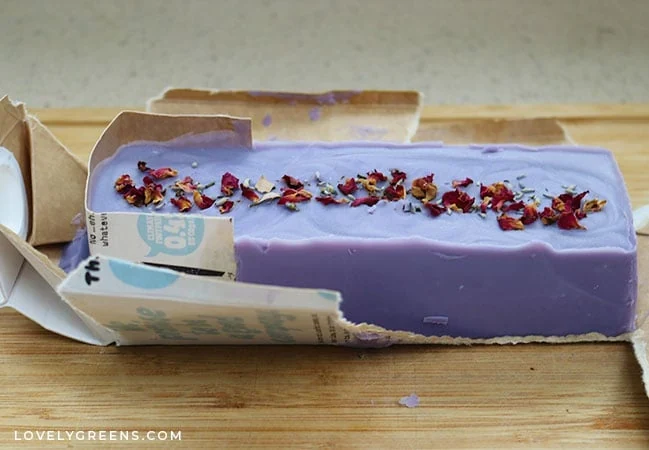
Turn the loaf onto its side before slicing so the original decorated top sits along the side of the cut face. When a knife or wire enters through dried flowers on top, it can catch pieces and carry them down the new cut face, leaving grooves. Changing the loaf's orientation moves the decoration away from the top edge across which fragments can be dragged down the face. Jan Berry recommends the side-cut for this problem, and I'd Lather Be Soaping applies the same approach to toppings and pencil lines.
Support the turned loaf securely and check that the cutter can complete the cut in that position. The aim is a controlled slice with a better path through the decoration, not balancing a slippery loaf on an unsuitable edge.
See Where the Cutter Meets the Decoration
Picture a decorated loaf standing in its original molding position. A top-to-bottom cut meets the flowers first. If a piece catches, the remainder of the cutting stroke can drag it across the interior face that is being exposed. A sharp tool alone does not change where the topping sits in that path.
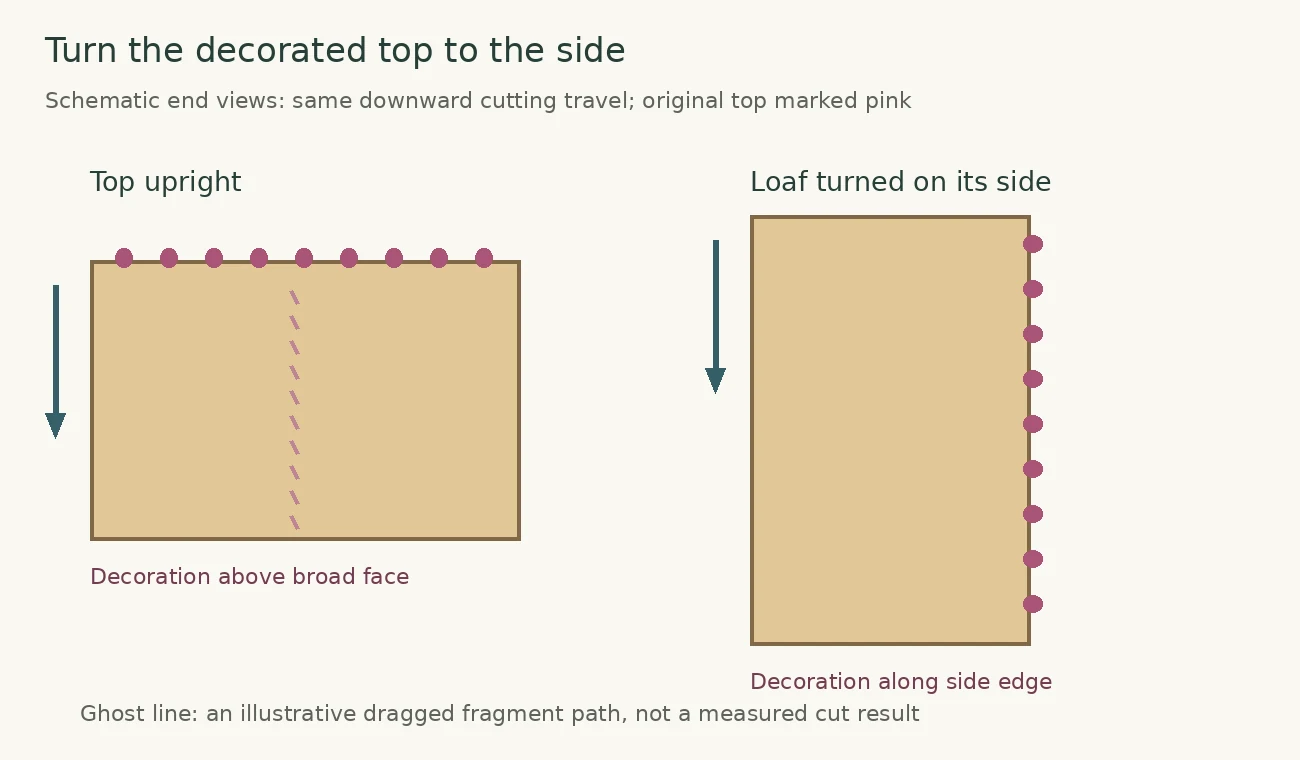
Now rotate the loaf a quarter turn so the original decorated top faces sideways. Decoration then lies along a side edge of the slice rather than across its top. A piece carried downward at that edge is less likely to be pulled through the broad interior face. The schematic in this section shows the original topping surface and cutter travel in both orientations; it does not show a measured groove depth or predict that every decoration will release perfectly.
Check the orientation with an end view before cutting. The decorated strip should be at the side of that face rather than spread across the top edge. This matters with irregular tops, where a raised flower ridge may extend farther around a corner than you expect.
Make Sure the Turned Loaf Fits the Setup
A cutting box or guide that fits an upright loaf may not fit it on its side. The dimension that was its height is now part of its width. Check the available opening and cutting depth before committing to the first slice.
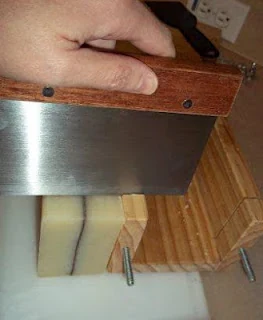
In the April 2012 Pencil Line article, the author describes this exact difficulty: the turned soap was too tall for the available cutting notches, and the cutter's thick handle prevented a full-depth cut. The accompanying photograph records that setup limitation. It is a reason to check clearance, rather than an ideal arrangement to reproduce.
Choose a stable support and a tool that can reach through the loaf without forcing the handle against the guide. Keep hands clear of the cutting path, and handle fresh soap with suitable protection. If the loaf shifts or the tool cannot travel cleanly, stop and change the setup instead of finishing the slice with an uncontrolled motion.
The same orientation principle applies to a knife or a wire cutter. Confirm the actual travel direction for the equipment you use: rotating the loaf should put the decoration at the perimeter of the resulting cut face.
Clean the Edge Between Slices
A fragment left on the blade after one cut can be carried into the next bar even if the loaf is correctly oriented. I'd Lather Be Soaping specifically recommends wiping the blade clean after every cut. Remove visible decoration and soap residue with the edge held safely away from your hand, then reposition the loaf for the next slice.
Make the first cut slowly enough to observe where any fragment moves. If a topping still catches, check the cut path and the protruding decoration before continuing through the whole loaf. A sequence of identical damaged faces is less useful than one test slice followed by a setup correction.
Do not confuse this with advice to brush or scrape a fresh decorated top aggressively. That can damage the surface and bring you into contact with fresh soap. The side-cut changes the cutting relationship while preserving as much of the intended top as practical.
Distinguish Drag Marks from Layer Separation
A dragged groove traces the movement of a piece through the cut surface. A loaf splitting along an internal powder line is a different problem. The Pencil Line author warns that too much mica or powder between layers can cause separation; turning the loaf cannot correct a layer that is poorly bonded.
The flower-decorated loaf above is Lovely Greens' actual lavender-soap project. It shows irregular pieces sitting above the surface; it is not a damaged cut sample. Use the orientation diagram to understand the proposed cutting path rather than assuming the photograph demonstrates a successful cut.
If a bar already has a groove, Berry suggests trimming the worst affected area for appearance. Assess the whole batch normally before deciding how to finish it; trimming a surface does not establish that its formulation is correct.
For the next loaf, keep a note of the topping placement, original top direction, cutter travel and what happened on the first slice. Once the setup works, repeat that same orientation and keep the edge clean. Those two small process choices directly address the dragging mechanism without redesigning the entire soap.