
Does Adding an Oil at Trace Reserve It as Superfat?
Select an image to view it at full size.
Do not assume that an oil added at trace will be the oil left unsaponified. Trace is a visible change in batter consistency, not a chemical gate that reliably excludes the next oil from saponification. A published comparison by chemist Kevin Dunn did not support that timing-based assumption in the three oil combinations studied.
You can account for all the base fats and choose an intentional oil-to-alkali relationship without making a claim about which specific fat survives. Those are different decisions. A recipe note saying “shea added at trace” records an action; it does not establish the identity or percentage of the finished bar’s residual oil.
What Trace Shows, and What It Does Not
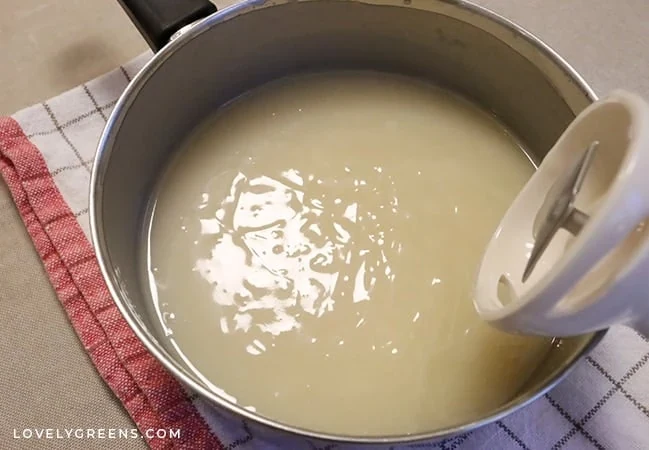
In a cold-process batch, trace is usually recognized when the emulsified batter thickens enough for a dribble to leave a visible trail on the surface. A light trace can be very fine, while a medium trace is thicker and holds a more obvious form. Lovely Greens’ process photographs show those different visible consistencies.
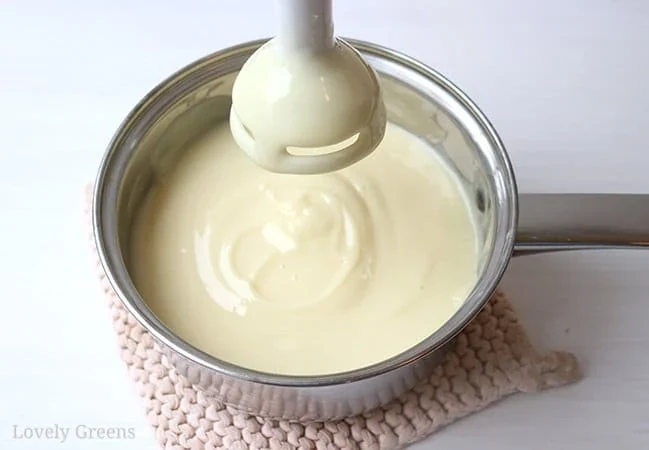
That observation is useful for handling the batter. It helps explain why an addition may be easier to incorporate earlier than after the mixture has become much thicker. But the appearance does not measure how much alkali remains, how far every component has reacted, or what fraction of a later addition will remain in its original form.
Saponification continues beyond the point at which a trail becomes visible. An oil added at that stage enters a reacting mixture. Treating trace as “all the original oils have finished reacting” introduces a chemical conclusion that the visible surface cannot establish.
What the Matched-formula Comparison Tested
Dunn describes pairs of soaps with identical amounts of oils and alkali, differing in the order of oil addition. In one member of a pair, all oils were combined before the lye was added. In the other, one oil was held back and added at trace. Comparing matched compositions matters: otherwise a different residual mixture could simply reflect different starting quantities.
The study used three deliberately selected combinations: coconut and olive, palm and castor, and palm and grapeseed. The researchers chose these blends because particular fatty-acid components could be distinguished analytically. The coconut/olive pair used a 5% lye discount; the other two used 10% to provide more residual oil for analysis.
After preparation, the samples were held at about 160°F for four hours. Residual oils were extracted and their composition investigated with NMR spectroscopy. Those conditions are part of the reported study; the results should not be presented as measurements of every ordinary room-temperature batch, every oil blend or every possible point of late addition.
What the Extracted Oils Showed
In the coconut/olive comparison, the starting blend contained approximately 7% oleic-acid contribution, while the extracted residual oils from both procedures contained about 22%. Adding olive oil at trace did not produce a distinct residual-oil result from premixing it in that comparison.
In the palm/castor comparison, the starting blend had about 9% ricinoleic-acid contribution, while the extracted residual oils contained about 4% in both procedures. The palm/grapeseed comparison similarly gave broadly comparable extracted results, about 19% versus 17% linoleic contribution, rather than demonstrating that the late-added oil had simply been reserved.
These percentages describe the composition of the extracted residual oils, not percentages of the entire finished soap bar. Confusing those bases would turn the study into an unsupported claim about how much free oil a bar contains.
Dunn treated the work as preliminary and suggested differing reaction behavior as an explanation for enrichment or depletion of components. That interpretation does not give a home calculator a reliable formula for predicting exactly which oil will remain in an arbitrary finished blend. The practical conclusion is narrower: order of addition did not support the proposed reservation mechanism in these comparisons.
Include the Late-added Oil in the Complete Formula
A base fat still belongs in the oil accounting even if it is added later. If a formula contains 500 g total oils including 25 g shea, record all 500 g and the correct identities. If you instead add 25 g shea to an already complete 500 g blend, you have made a 525 g blend with different proportions and alkali demand.
Do not leave that extra fat out of the ingredient list and assume the calculator’s existing discount describes the changed recipe. Recalculate the entire blend using matching reference values and the intended discount, purity and water settings. Soap Draftbook’s discount field reduces calculated alkali; it does not earmark a named oil.
The same reasoning prevents a misleading ingredient claim. Using a particular butter in the input formula and proving that it remains as unchanged butter in the finished bar are not equivalent findings. Timing alone cannot bridge that gap.
Make the Record Useful Without Overstating It
Keep the formula, the actual amounts and the addition sequence in the batch notes. Distinguish a chosen lye discount from an added-fat quantity, and record whether a change was a planned formulation revision or an unintended deviation.
If you compare premixing with a later addition, keep the compositions and other relevant conditions matched. Otherwise the comparison cannot isolate timing. A visible handling difference may be worth recording, but visual inspection or an informal lather comparison cannot identify the molecular composition of the residual oil.
For ordinary planning, it is enough to stop promising something the method does not establish. Include every base fat, calculate the intended relationship, and describe late addition as a process choice rather than proof that one ingredient was reserved as the superfat.