
Why Did One Mold Separate When Both Came from the Same Soap Batter?
Select an image to view it at full size.
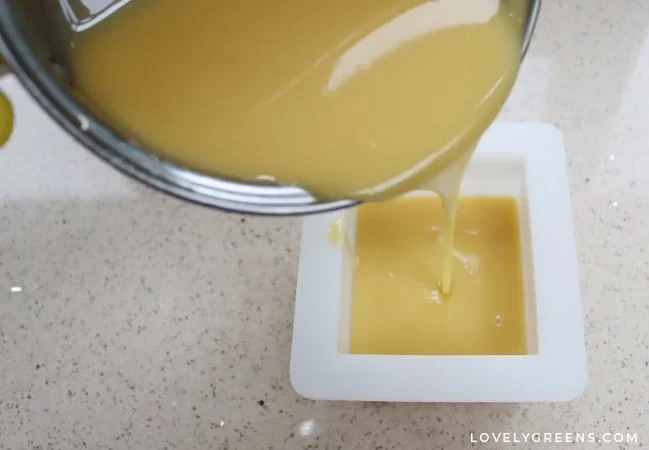
When one mold separates and another looks normal, “same batch” is useful evidence, but it does not mean every later condition was the same. Mold shape, amount in each cavity, covering, location and the order of pouring can all differ after the batter leaves the mixing vessel.
Start by mapping those differences. Then distinguish actual free liquid from a surface sheen or a normal color change. The goal is a controlled investigation, not a guaranteed diagnosis from one successful-looking mold.
Preserve the Whole Reported Contrast
In a 2023 reader question, James Peter described filling a silicone loaf mold and a mold with small round cavities from the same batter. The loaf was covered and placed under a bed. The small molds went on a dining table. After a few hours, the loaf reportedly separated oil, while the small molds did not.
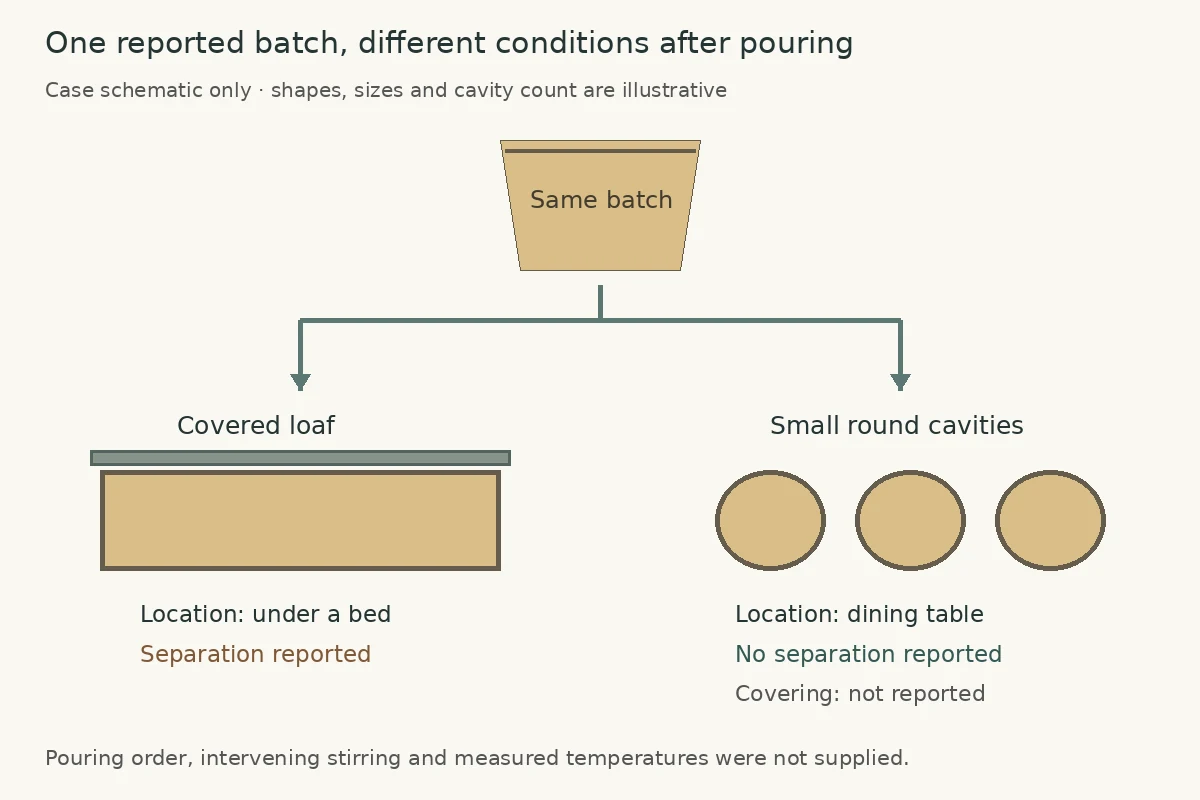
The posted formula listed 900 g coconut oil, 100 g castor oil, 145 g sodium hydroxide and 350 g water. The reader described pouring at medium trace and using the recipe successfully before. Those are source case details, not a validated recipe recommendation.
Jan Berry considered false trace, a new fragrance, moisture-related surface changes and the different conditions after pouring. She specifically asked about location, covering and pouring order, and closed by saying these were guesses. The exchange does not establish which explanation was correct or report a verified repair.
The schematic maps only the reported setup. Small-mold covering, exact cavity count, dimensions and pouring order were not supplied. Do not silently fill those gaps with assumptions.
Confirm What Actually Separated
Record whether there is a distinct free-liquid layer or pool, scattered droplets, a uniform sheen, or only a darker area. Photograph the whole mold and a close view without disturbing it first. Timing matters too: a change during pouring is different from a new surface change hours later.
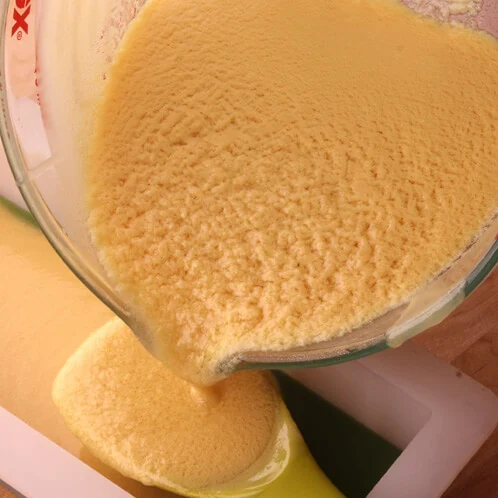
Soap Queen's actual separation example shows yellow free liquid bordering grainy batter in a different batch. That visible contrast is useful when describing a pool rather than a film. It does not identify an unexplained liquid in your mold as oil or prove that the rest of the soap is chemically suitable.
Do not blot away all the liquid and treat its disappearance as a correction. Lost material can make the batch record harder to reconcile. Keep an unresolved separated batch apart from normal stock and investigate the production history before ordinary use or salvage.
Different Appearance Is Not Always Separation
Lovely Greens shows an actual pair of soap outcomes from one batch: small pieces that did not gel and an insulated bar that did. The source describes the gelled soap as different in color and opacity.
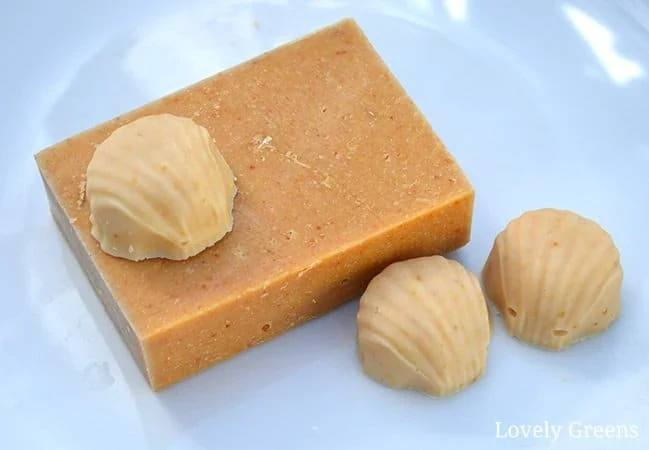
That is not an experiment demonstrating the cause of James's oil separation. It shows why “these molds look different” is too broad an observation. Gel-related color or translucency and distinct free liquid are different features to document.
Record the features independently. If a loaf is darker in the middle, note that; if liquid is also present, record it separately. Do not use a recognizable color pattern as a reason to disregard another production fault.
Compare Mold Geometry and Covering as Separate Variables
A loaf and small individual cavities do not hold the batter in the same physical arrangement. They differ in how much material is grouped together and in their exposed surfaces and support. Covering can add another difference.
For the original case, the loaf was covered, but the question did not establish whether the small molds were covered too. “Covered versus uncovered” is therefore a question to resolve, not an observed fact about both sides.
Record the mold type, approximate fill, support or outer box, and covering. If one mold sits in a wooden support and another is exposed, retain that detail even if both contact surfaces are silicone. A single material name does not describe the entire setup.
Avoid jumping from those differences to a measured temperature claim. Without actual temperature observations, the case does not prove that the loaf overheated or that the small molds cooled at a particular rate.
Recover Location and Pouring Order
Ask what differed between the two locations: airflow, nearby heat, drafts, enclosure and practical ability to observe the molds. The original under-bed placement is historical information, not a recommended curing or monitoring location. Choose a suitable, accessible place for future batches.
Also recover which mold was filled first. Was the remaining batter stirred before the second pour? Did thickening progress while the first mold was being filled? Did an addition enter only part of the batch? These are concrete questions that can change how much “same batter” really controlled.
A medium-trace description is not a timed record of every pour. Berry's false-trace suggestion remained a possibility, not a conclusion. Do not infer that the smaller molds received a better emulsion merely because they looked normal afterward.
Write down what is known and mark the rest unknown. An honest blank is more useful than a neat story built from unobserved stirring or cooling.
Design the Next Comparison Around One Question
Before another batch, verify the complete formula, actual oil and alkali identities, accurate weighing, additives and relevant supplier guidance. Previous success is useful history, but it does not replace checking a changed ingredient or an inconsistent scale.
Then choose a manageable comparison with suitable molds and a safe, observable setup. For example, if the question is location, keep mold style, fill and covering as comparable as practical. If mold geometry is the question, preserve the other practical conditions and document their limits.
Keep the chosen formula and process fixed where practical, and record pouring order and intervening stirring. Do not change the scent, water, oil blend, mold and storage location all at once, then attribute the result to one of them.
| Record for each mold | What to capture |
|---|---|
| Geometry and fill | Loaf or cavities, approximate amount and depth |
| Support and covering | Outer box, lid, wrap or other material actually used |
| Location | Airflow, enclosure and nearby heat or drafts |
| Pour sequence | First or later pour and any stirring or additions between |
| Observations over time | Color, surface sheen and distinct liquid recorded separately |
| Formula version | Complete weighed batch record shared by the comparison |
Treat a Better Result as Evidence, Not a Universal Cure
If a later comparison has no separation, review every condition that changed before choosing a cause. If the problem remains, that does not prove the oil blend is defective; it tells you the selected change did not eliminate the observation in that attempt.
Do not extrapolate a successful-looking small cavity into proof that every part of the original loaf is suitable. Do not choose automatic rebatching merely because the source mentions it in a general troubleshooting reply. A recovery decision still needs a known problem and a reliable material record.
The same-batch contrast gives you a strong starting question. Its value comes from preserving the differences after pouring and observing the actual state of each mold, not from assuming that one familiar explanation must account for both.