
Why Is My Cold Process Soap Still Soft and Squishy?
Select an image to view it at full size.
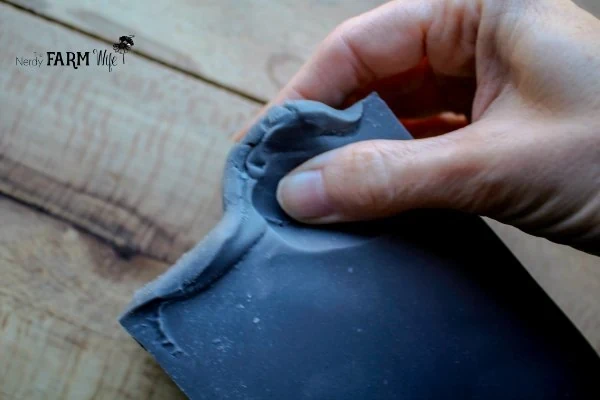
Soft soap needs a batch-history check before a fix. A young, high-olive bar with plenty of water may simply be slow to firm. A batch made with moisture-compromised sodium hydroxide raises a different question: the amount weighed may not represent the alkali amount the calculation assumed.
Honey and other recipe changes can complicate the picture too. Do not decide that every soft bar needs more time, or that every one needs more lye. Start with the making date, actual formula and ingredient condition, then choose between continued observation and a more serious formulation review.
Describe Where and When the Softness Appeared
Record whether the loaf never became firm enough to unmold, whether cut bars remain easily dented, or whether a previously firm bar became soft after sitting in water. The last situation concerns use and storage as well as the original batch.
Keep the actual weighed amounts and calculator settings together. Include oil substitutions, extra liquids, honey and other additions. Check for an omitted ingredient or an amount copied incorrectly while scaling. A remembered formula is less useful than the record of what went into this particular batch.
If there are separate oil pools, unexplained liquid pockets or a known weighing error, treat those as additional evidence. Softness by itself does not identify what a pocket contains or establish that the batch is suitable to use. Avoid repeated bare-hand squeezing or washing tests while the production record remains unresolved.
Check the Oil Blend and the Bar’s Age Together
Jan Berry's troubleshooting guide describes palm-free and high-olive recipes as sometimes taking longer to firm. That makes the exact blend important: a familiar unmolding schedule from one formula may be unsuitable for another.
Also separate the ability to release from a mold from a completed cure. A bar can be firm enough to cut while still changing during cure. Conversely, a soft young bar is not automatically evidence that the whole recipe failed.
For a batch with a sound formulation and weighing record, give it suitable curing conditions with space around the bars, and keep dated observations. If it is too delicate to unmold cleanly, stop forcing it out and reassess its firmness later. Record whether it is gradually becoming more self-supporting rather than repeatedly handling and deforming it.
Berry describes some soft soaps improving over a much longer period. That is a reason to preserve the history of a batch, not a guarantee that any unknown formulation will become correct if you wait long enough.
Reconstruct the Actual Water Amount
The water setting can explain why one version begins with more liquid than another. Be careful about the denominator: “water as a percentage of oils” is not the same setting as lye concentration.
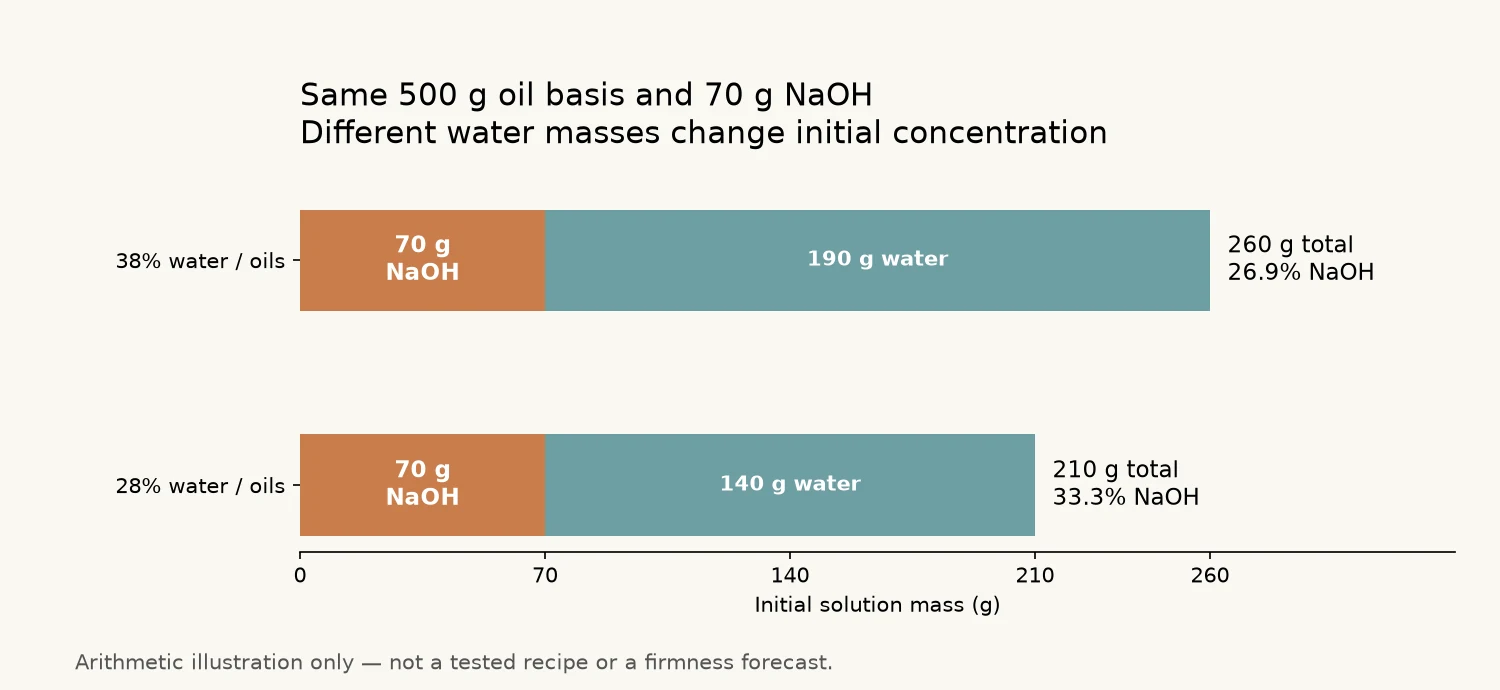
For a hypothetical arithmetic comparison, suppose both versions use 500 g of oils and 70 g of sodium hydroxide. A water setting of 38% of oil mass gives 190 g of water. A setting of 28% of oil mass gives 140 g. The initial nominal lye concentrations are different: 70 divided by 260 is about 26.9%, while 70 divided by 210 is about 33.3%.
The illustration compares those masses. It does not show tested soap firmness or recommend that either water setting suits your recipe. Its purpose is to make an unnoticed 50 g water difference visible.
Modern Soapmaking's lye-solution guide explains why water and alkali settings need to be read together. A lower water amount can change handling and processing as well as drying. Do not treat the most concentrated workable solution as a universal improvement, especially when a recipe contains milk, puree or other water-bearing ingredients.
For the next batch, select a water approach appropriate to the actual formula and process. For the existing one, recover the amount already used. Adding something later because you intended another setting is not the same as correcting a known calculation.
Inspect the Sodium Hydroxide’s Storage History
Berry describes clumpy lye exposed to humid conditions as one potential cause of soft, oily soap and slow trace. Sodium hydroxide can absorb moisture; a weighed portion may therefore differ from the material assumed in the original calculation.
Check the product identity, container, storage conditions and any visible clumping before another batch. Keep sodium hydroxide in its suitable, tightly closed original container and follow the supplier's handling guidance. A questionable supply should not be rescued by guessing an extra percentage to weigh.
Clumps are not a quantitative purity test. Neither a cooler-than-expected solution nor slow thickening tells you exactly how much active alkali was present. You cannot calculate a trustworthy correction to the finished batch from softness alone.
The actual charcoal-soap photograph comes from Berry's account of soap made with clumpy lye in humid weather. She reports that it eventually hardened over a year. That is her batch history, not independent proof that a similarly soft bar has the same cause or that waiting establishes chemical suitability.
Check Honey and Additions Independently
Berry also identifies excessive honey as a possible cause of overly soft soap. Recover the amount actually used and its basis. “A spoonful” can vary, and an addition that seemed small in a large recipe may be substantial when copied into a smaller batch.
Compare the batch with a version that did not contain the addition, if you have one. Also check whether other ingredients or water changed at the same time. You cannot isolate honey's contribution by comparing two recipes that differ in several respects.
Choose a documented amount and incorporation method for a future formula rather than adding more sodium hydroxide to counteract softness. Honey is not a base oil that you can casually balance with an extra alkali scoop.
Decide What to Do with the Current Batch
Use the evidence to keep the following cases separate:
| What the record shows | Appropriate next step |
|---|---|
| Sound formula, known weights, young high-olive or higher-water soap | Continue suitable curing and dated observation |
| Questionable sodium hydroxide condition or an uncertain amount | Review the material and calculation; do not infer a correction from texture |
| Added honey or another meaningful formula change | Recover its actual amount and compare the whole recipe |
| Separate liquid, an omitted ingredient or another unresolved production fault | Investigate that fault before ordinary use or any salvage decision |
Do not add raw sodium hydroxide to a loaf because it feels squishy. Rebatching also does not automatically correct an unknown original alkali amount. A defensible correction would require a known cause, reliable quantities and an appropriate method; otherwise the uncertainty remains.
For the next attempt, preserve one complete formula, use suitable ingredients with reliable storage history, weigh accurately and change one meaningful variable where practical. For the current bars, time can reveal a trend in firmness. It cannot replace the missing batch information needed to explain why they stayed soft.