
How do I distinguish internal white soap spots from stearic spots, bubbles, undissolved lye or pigment flecks?
Select an image to view it at full size.
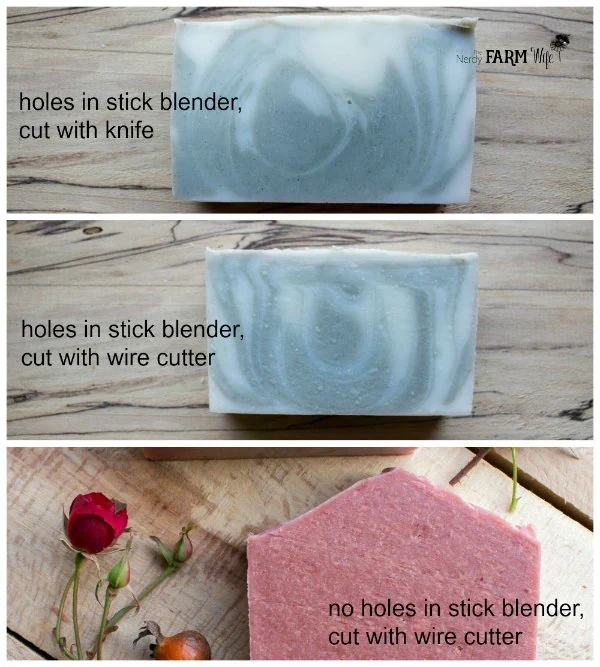
Use the location and structure of the spots together with the actual ingredient and process record. Small cavities, waxy-looking inclusions and concentrated white pigment can all look pale in a photograph, while undissolved alkali presents a different concern. Appearance alone cannot conclusively identify an unknown white inclusion or establish that a batch is suitable for use.
Jan Berry groups several mechanisms under internal white spots: solid-fat components that were not kept properly melted, air bubbles, undissolved lye and poorly distributed zinc oxide or titanium dioxide. Treat those as different investigations. Do not rub, taste or deliberately touch a spot to decide which group it belongs to. Keep fresh or uncertain soap protected and handle it with appropriate gloves.
First Separate Cavities from Material
Look at a cut face under consistent lighting. Does the pale feature appear to be an opening, a solid inclusion, a streak or a color concentrated within otherwise continuous soap? A light-catching edge around a small hole can look like a white dot in one photograph and disappear in another.
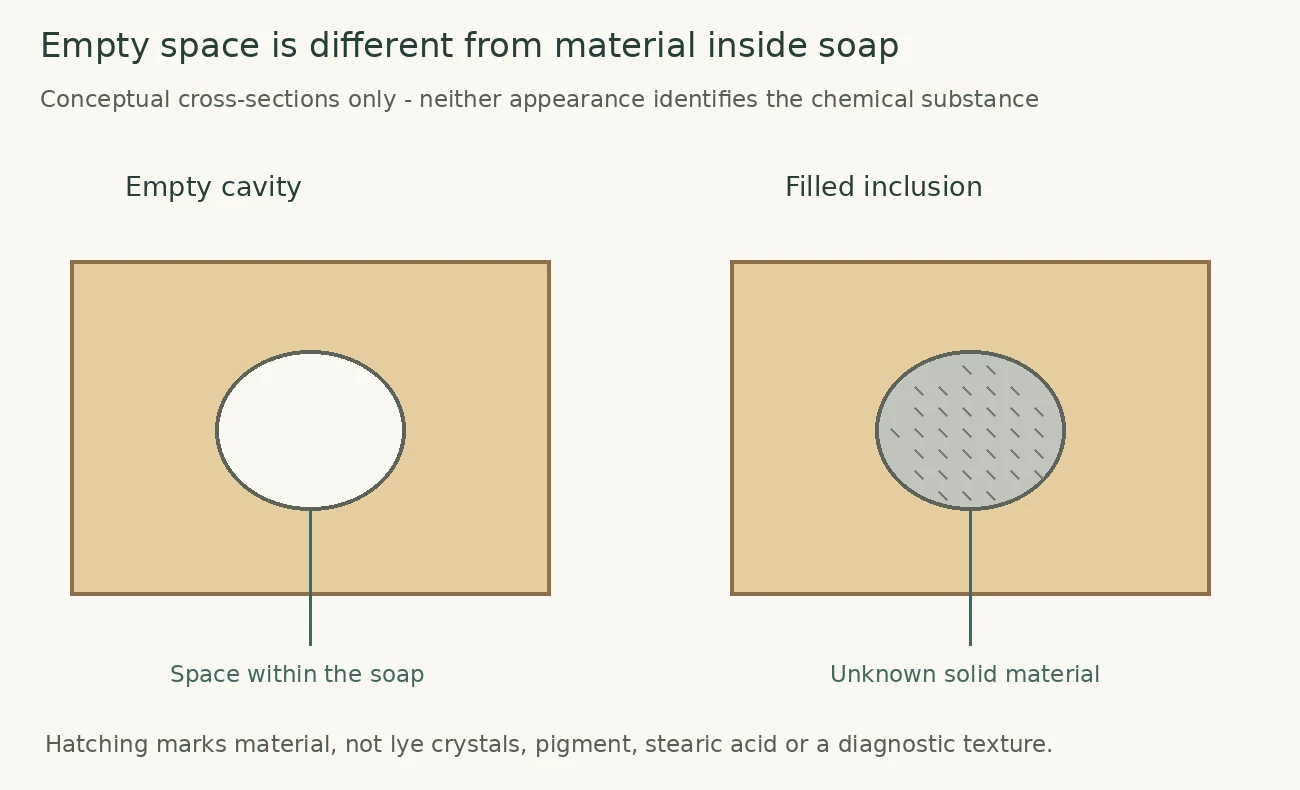
The cross-sections in this section isolate that structural question: an empty space versus material within the surrounding soap. The hatching indicates an unknown solid, not a particular ingredient or a visual test for alkali.
Record whether the features occur throughout the loaf, only in one colored portion, or only on an exposed surface. Surface ash and flat pale marks that do not continue into the cut interior are different questions from material distributed through the bars. Do not treat them as interchangeable just because both are white.
Preserve the actual recipe, pigment identities, fat preparation, alkali-dissolving observations and cutter type. Those records can help distinguish mechanisms in a way that a close-up photograph alone cannot. If the recipe or ingredient quantities are uncertain, that uncertainty remains even when one possible cosmetic explanation looks convincing.
The real source comparison above concerns air bubbles and cutting appearance. It is not a four-way diagnostic chart or evidence that every white dot is an air cavity.
Air Bubbles Are Openings, Not White Ingredient Particles
Berry notes that immersion blending can incorporate air and that a wire cut can make bubbles more conspicuous than a knife cut. Her comparison photograph records differences in the resulting faces. Changing how a surface is cut may change what is visible without changing the batch's composition.
For the next batch, use short powered bursts as appropriate and avoid bringing extra air into the batter. Before switching on an immersion blender, keep the head submerged and carefully release trapped air according to the tool's safe handling instructions. Do not run it above the surface or lift a spinning head through fresh batter.
The historical source photograph also discusses drilling a blender head. That is not a necessary step to copy: modifying an electrical tool is a separate equipment decision. The useful observation here is about air incorporation and how cavities appear after cutting.
If the actual feature is a solid particle rather than an opening, a bubble explanation does not account for it. Likewise, a plausible air-bubble pattern does not resolve a known alkali-weighing or mixing error elsewhere in the batch.
Solid-Fat Spots Lead Back to Melting and Cooling
Berry describes smooth, waxy-looking spots associated with solid fatty-acid components in hard fats such as palm, tallow, lard and butters. Some components require more heat to become fully melted than others, and parts of the blend can start setting again as it cools.
Check whether the fats were fully melted and stirred before the measured portion was taken. For palm oil in particular, Berry recommends melting and mixing the whole container before portioning so different parts do not contain an uneven mix of components. Use the actual supplier's preparation and storage directions for the product you have.
Then review when cloudiness, granules or thickening appeared. Did it happen before adding lye solution or fragrance? Did a hard-fat blend cool substantially while other preparations were still unfinished? Those observations are more useful than deciding that every pale fleck must be stearic acid.
A next-batch temperature change should keep the actual fats suitable for incorporation while also respecting the recipe's heat behavior. "Use the lowest temperature possible" can introduce false trace; "make everything much hotter" can create a different thermal problem. You need the condition of the ingredients, rather than one universal number copied from a different blend.
Do not use the source's texture descriptions as a request to squeeze an unknown particle between bare fingers. They describe reported appearances and properties, not a safe identification test.
Pigment Flecks Need the Exact Product and Dispersion Method
If the batch used zinc oxide or titanium dioxide, poorly broken-up colorant is another possibility. Look at whether the flecks are concentrated in the portion that received that product and whether the preparation contained visible clumps before it was added. That association is useful evidence, but it cannot rule out a separate problem by itself.
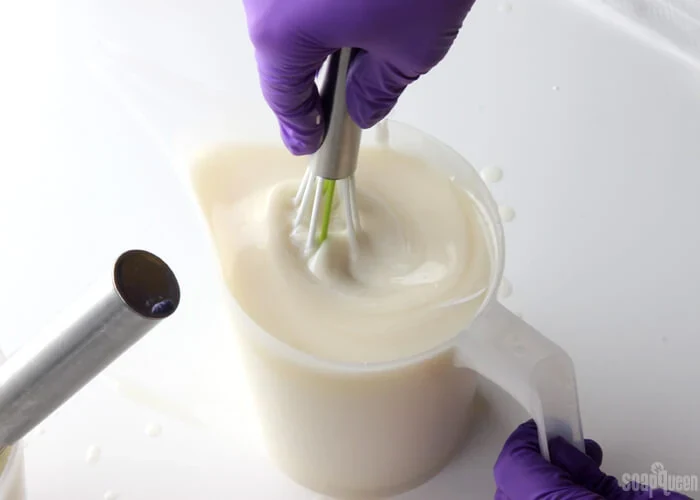
Berry recommends preparing those colorants in a compatible liquid according to the product and recipe directions rather than dropping dry powder into thick batter. Oil, water and glycerin are not universal substitutes for one another. Record the exact product, amount, carrier and portion size.
The real white-batter mixing photograph in this section comes from Soap Queen's Red Hanger Swirl tutorial. In that specific recipe, titanium dioxide is prepared in oil, with optional micronizing to break up clumps, before it is whisked into a soap portion. It illustrates actual preparation and incorporation, not proof that every product labeled titanium dioxide requires the same carrier.
Keep any carrier liquid in the formula record. If a preparation intended for the whole batch all enters a small portion, its local concentration changes. A cleanly mixed sample and a correct usage rate are separate goals; an even color is not permission to exceed the applicable product guidance.
Suspected Undissolved Alkali Changes the Decision
Berry identifies incompletely dissolved lye as a possible source of crystalline material in soap. Review the original solution preparation: was it thoroughly stirred, was residue left at the bottom, and were the actual water and alkali weights recorded? These questions concern what was observed before pouring, rather than a later attempt to name crystals from a bar photograph.
A clear-looking solution alone cannot prove that the correct ingredient or quantity was used. Conversely, uncertainty about an inclusion should not be converted into a confident diagnosis of excess sodium hydroxide. Keep the known observations and unknowns separate.
If undissolved alkali is suspected, keep the batch out of use and protected from contact while it is assessed. Do not cut out the visible dots, taste the surrounding soap or rely on the absence of a tingling sensation. A smooth remainder does not prove that every particle has been removed or that ingredient distribution was uniform.
Recovery depends on reliable quantities and an applicable procedure, not on the fact that a source mentions rebatching. Unknown measurements, material losses or uncertainty about what the particles are can prevent a dependable correction. Waiting longer does not establish the identity of an unknown inclusion.
Build a Comparison That Can Actually Answer Something
| Observation and record | Useful investigation | What it cannot establish |
|---|---|---|
| Openings become more conspicuous with the cutting method | Air incorporation and the cut surface | That all pale features are harmless bubbles |
| Waxy-looking material follows incomplete melting or cooling | Preparation and distribution of hard fats | Exact chemical identity from appearance |
| Flecks cluster in a portion with white pigment | Product dispersion, amount and mixing time | That another recipe error is absent |
| Residue was observed in the lye vessel or crystals are suspected | Actual dissolving step and complete quantities | A safe correction from a guessed particle weight |
For example, a documented white-pigment portion with visible preparation clumps gives you a specific dispersion change to test next time. A loaf with no white colorant and an uncertain lye-dissolving step needs a different investigation. Calling both "white spots" should not send them through the same remedy.
Keep photographs and notes of the location, cutting method and relevant ingredient preparation. On the next checked batch, change the condition supported by those records and observe the result. That produces a useful comparison while leaving unknown alkali or quantity questions unresolved until they have an adequate basis for assessment.