
Why are dark sticky oozy spots appearing in my honey soap?
Select an image to view it at full size.
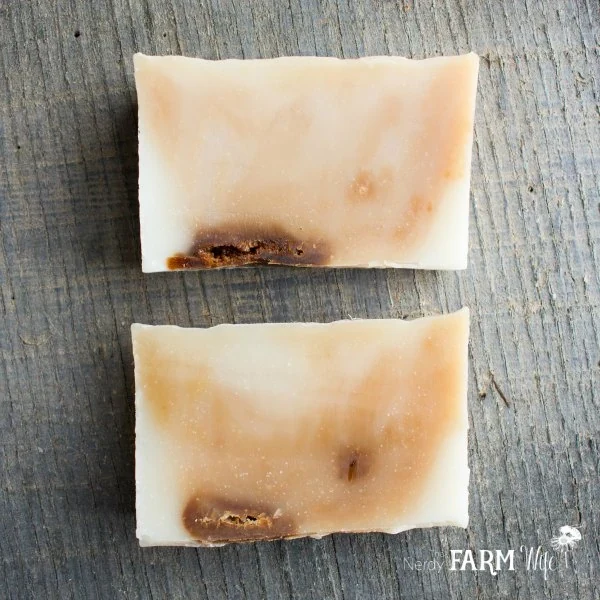
Poorly incorporated honey is one explanation for dark, sticky, oozy spots in a honey-containing cold-process soap. Jan Berry documents that appearance in an actual batch and recommends diluting the honey with an equal part of warm water before thoroughly mixing it into the batter next time. That explanation fits a known honey addition and a mixing problem; it does not identify every unknown wet spot in soap.
Keep fresh soap protected while investigating. Do not taste or touch an oozy spot to decide what it contains, and do not pour off a liquid or cut away a sticky patch and assume the remaining batch is corrected. The actual ingredients, weights and process history matter.
Start with the Actual Honey Addition
Berry's photograph above shows localized dark honey spots in her cold-process example. Use it to understand what she describes, rather than treating a visual match as a test of your own bar. Record whether your recipe contained honey, how much reached the batch and whether it was first diluted.
Then reconstruct the mixing sequence. Was the honey added to a fluid mixture that could still be stirred uniformly, or placed into already thick batter? Did a concentrated portion remain on the spoon or vessel wall? Was the full measured amount put into a small accent portion instead of the whole batch?
Those distinctions help explain why a known honey addition might collect locally. If you cannot reconstruct the amount, write down that uncertainty instead of calculating from the amount you intended to add. A neat recipe sheet does not establish what actually reached the mold.
Dilute Before the Batter Is Difficult to Mix
For her troubleshooting method, Berry advises an equal part of warm water to dilute the honey, followed by thorough mixing. Prepare that mixture before the batter has thickened so far that it is difficult to distribute. The purpose is incorporation, not adding a second watery layer to an already molded loaf.
Keep the dilution water in the formulation record. Decide how that water fits into the checked recipe before making the lye solution; do not quietly add it on top of an otherwise unchanged total. If your process reserves some water for an additive, the remaining water used for the alkali still has to meet the applicable recipe and mixing requirements. Do not improvise an excessively concentrated lye solution to make the totals look tidy.
An equal-part dilution instruction also does not tell you how much honey belongs in every recipe. Honey dosage, batch size and the amount entering a particular portion are separate decisions. Follow an established honey-soap formula for those quantities instead of increasing honey until the batter looks or smells stronger.
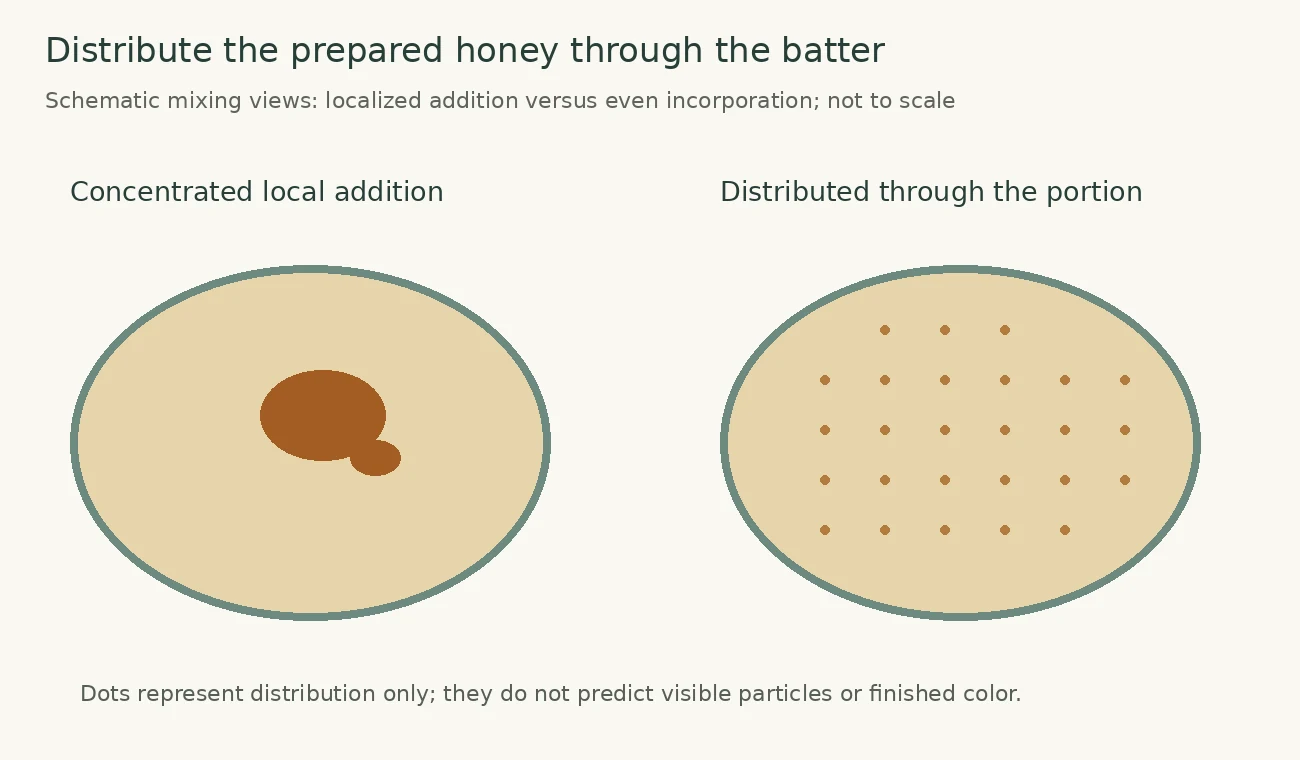
The mixing schematic in this section contrasts a localized addition with an evenly incorporated one. It represents distribution, not a microscopic photograph, a validated stirring time or a prediction of how dark a finished soap will become.
Distribute It Through the Whole Intended Portion
Once the diluted addition is ready, incorporate it at the stage specified by the recipe while the mixture remains workable. Reach the sides and bottom of the vessel rather than stirring only the center. Check for visible concentrated material before the pour, not after the soap is already setting in the mold.
If a fragrance or a complicated design leaves little working time, simplify the next test. One uniformly mixed honey batch is easier to assess than several colored portions with different honey concentrations. Do not respond to late thickening by adding guessed oil or water to restore flow.
Keep a useful comparison record: actual honey quantity, dilution water, what portion received it, mixing order and whether visible streaks remained. A new batch with better distribution can then be compared with the earlier one without attributing every change to one extra minute of stirring.
Review Heat and Other Liquids Separately
Honey also belongs in the thermal record. Berry includes honey-containing batches among those that may develop excess heat, and her cracked calendula, oatmeal and honey loaf shows overheating alongside partial gel. That is a different photographed condition from unmixed sticky honey spots.
If the top is rising or cracking beneath insulation, assess the heat-retention setup rather than diagnosing the crack as a honey pocket. Remove unnecessary covering only when that can be done without contact with the fresh soap or destabilizing the mold. Do not add heat simply because some edges remain pale.
Likewise, free liquid spreading from a cavity or a known ingredient error deserves its own investigation. Color and stickiness do not establish whether an unidentified liquid is honey, oil or lye solution. Keep the batch out of use while a mixing, quantity or liquid-loss problem remains unresolved.
The practical next-batch change is specific: measure the honey, prepare its dilution within the formula's water plan and incorporate it uniformly while you still have working time. That addresses the documented honey-spot mechanism while leaving unrelated soap problems available for the separate checks they need.