
Before Adding More Lye to a Soft Soap Rebatch: What Must You Know?
Select an image to view it at full size.
A soft bar does not tell you how much lye, if any, is missing. Before considering an alkali correction, you need a reliable account of the intended recipe, what actually entered the batch and what remains in it. “I think I used too little” is a reason to investigate, not an amount to add.
In a troubleshooting exchange, Hallie asked Jan Berry how to rebatch soap that seemed too soft and possibly short of lye. Berry's first question was whether the exact missing amount was known. That distinction matters more than finding a rebatching temperature or deciding how finely to grate the bars.
Separate the Observation From the Suspected Cause
Begin by writing the observation as an observation: when the soap was made, when it was unmolded, how it feels now and whether the whole batch behaves similarly. Keep “possibly under-lyed” in a separate line until you have evidence for it.
Water and alkali do different jobs. Kevin Dunn explains that sodium hydroxide reacts with the oils, while water dissolves it; water is not a substitute for the alkali required by the oil formula. His experiments also show that different water levels can produce different initial hardness even when the proportion of alkali to oil is unchanged. Softness alone therefore cannot quantify an alkali shortfall.
A batch that firms as water leaves has changed in handling, but that observation does not reconstruct its original composition. Likewise, elapsed time cannot tell you which container was misweighed. Keep the chemical question separate from the physical question of whether the bars can be cut or grated.
Recover the Complete Intended Formula
Find the original recipe record, including every base oil, its exact identity and its mass. Record the intended sodium hydroxide amount, its specified purity if the calculation accounted for it, the intended water amount and the chosen lye discount or superfat setting. Include other ingredients and any separately prepared solutions.
Do not rebuild the record from the batch's nickname. “Olive and coconut” is less useful than the actual ingredient entries and weights. Dunn notes that calculated alkali demand rests on oil saponification values, which vary between samples; it is not a number that can be recovered from the total bar weight. A calculator also needs the appropriate oil identities rather than an approximate description.
Keep the original calculation beside any new check. If a copied recipe, spreadsheet and saved calculator file disagree, resolve the disagreement before treating one of them as the intended formula. A freshly generated number cannot establish what you intended on the day of making.
Reconstruct What Actually Went Into the Batch
Now make a second column for the actual additions. Use contemporaneous weighing notes, saved scale readings or another specific record where available. Distinguish a verified difference from a quantity remembered approximately afterward.
For example, an intended weighing and an actual weighing recorded in the same units can establish a discrepancy in the measured product. A general memory that the container “looked a little low” cannot. Even a documented discrepancy is only one input: the oils and the rest of the process must also match the record before it describes the whole problem.
Useful items to reconcile include:
- Whether every weighed oil actually entered the mixing vessel.
- Whether the recorded alkali was dry product or a premixed solution.
- Whether all of the prepared solution was transferred, or some remained behind or spilled.
- Whether water or another solution was added separately.
- Whether anything was added after the initial pour.
Record an unknown as unknown. Do not replace a missing actual weight with the recipe's intended weight simply to complete the table. That would erase the very uncertainty the investigation is supposed to resolve.
Identify the Alkali Product and Its Basis
Read the actual product identity and available documentation. Sodium hydroxide, potassium hydroxide and a diluted solution are different inputs; a familiar container or the word “lye” is not enough to establish which mass the recipe refers to.
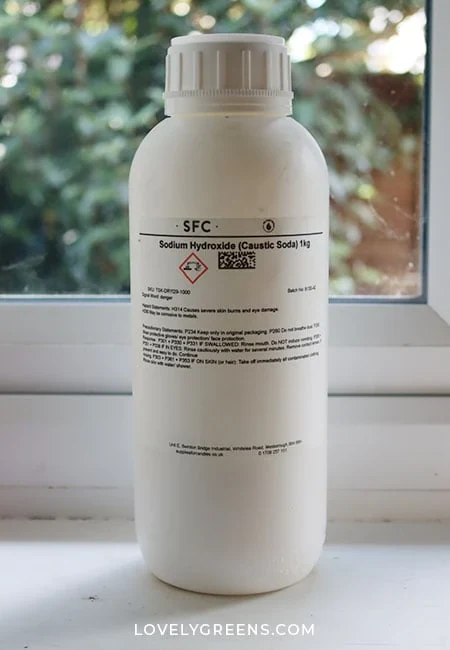
The product-label photograph shows why keeping the actual packaging matters. Its role here is identification, not approval of every similarly shaped bottle. Keep the relevant label, stated purity or concentration, and the batch's measurement basis with the formula record.
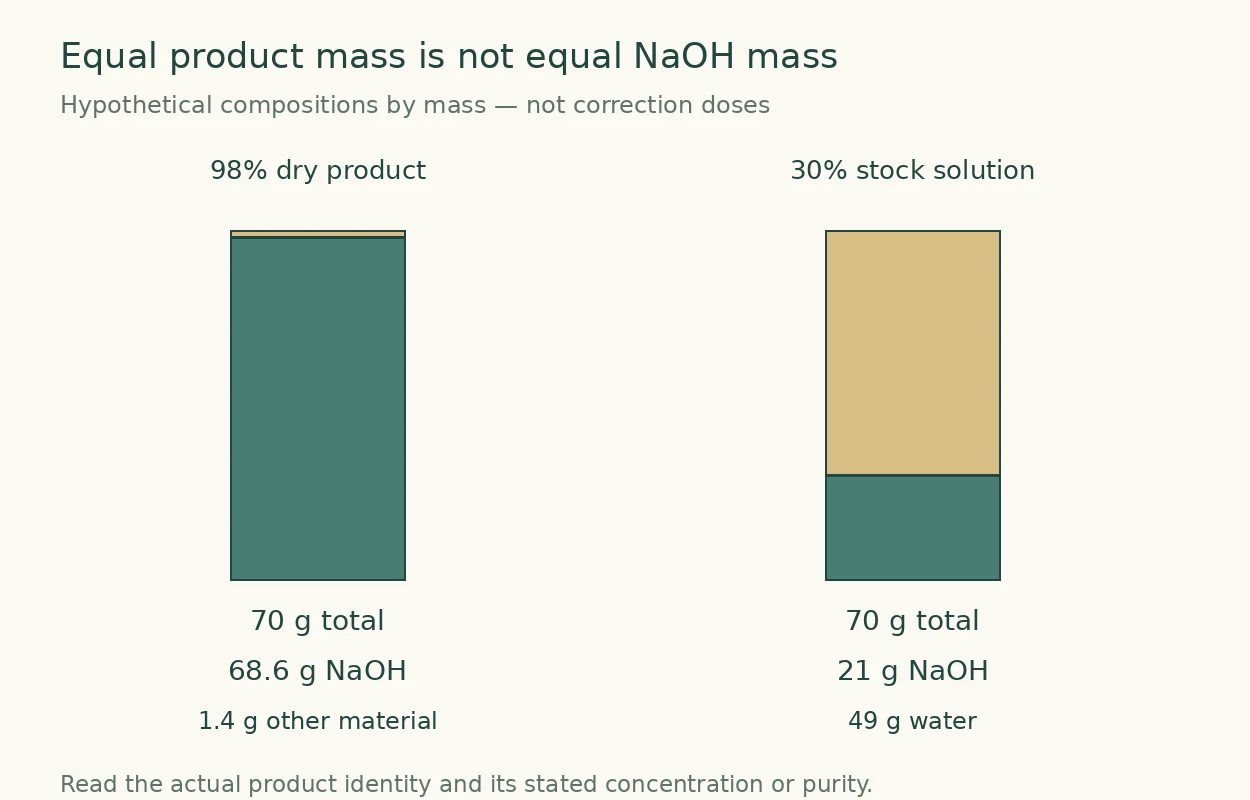
For a hypothetical comparison by mass, 70 grams of a product specified as 98% sodium hydroxide contains 68.6 grams of sodium hydroxide and 1.4 grams of other material. Seventy grams of a solution specified as 30% sodium hydroxide contains 21 grams of sodium hydroxide and 49 grams of water. Those equal total masses do not supply equal alkali.
The diagram compares those compositions only. Neither quantity is a correction recommendation. The general solution accounting is the same distinction used in Classic Bells' masterbatch explanation: alkali mass is the stated mass fraction multiplied by solution mass, and water mass is the remainder.
Do not assume an unidentified or poorly documented stored solution still has the concentration of the recipe you think was used to prepare it. If its identity, preparation record or current condition leaves that unresolved, the active alkali contribution is unresolved too.
Reconcile the Material You Still Have
The original batch and the material now awaiting rebatching may no longer be identical. Note whether you retained every bar, discarded a liquid layer, lost material during handling or combined leftovers from another batch. Include any previous attempt to correct, dilute or remelt it.
A missing portion is particularly important when the batch separated. You cannot assume that discarded liquid and retained solids had the same composition, then reduce every ingredient by the same percentage. Knowing the current total mass does not reveal what was in an unrecorded loss.
This is where a plausible explanation can stop short of a usable correction. You might know that a certain amount was omitted originally but still lack a reliable account of what remains. Preserve both facts instead of allowing the known omission to conceal the later uncertainty.
David Fisher's rebatching guide limits mistake correction to mistakes that are understood. It specifically excludes treating a batch that merely seems wrong, or is suspected of being lye-heavy, as an ordinary rebatching project.
Decide What the Evidence Allows Next
If the intended formula, actual additions, product basis and retained material reconcile, you have a record that can support assessment of a specific correction. Keep the full record together; the difference between two alkali numbers alone is not a complete rebatching procedure.
If one of those essential quantities is missing, do not invent a dose, add dry alkali to absorb softness or treat a firmer bar as confirmation that the original suspicion was right. Ask for help with the documented problem and state the missing information plainly. Berry's response to Hallie makes the central point: lye is not something to guess.
Any later correction involving lye solution retains the hazards of that solution. Fisher also points out that its water contributes to the rebatch's total liquid, so it must be included rather than followed automatically by the usual separate wetting addition.
The useful outcome is a traceable explanation of the batch, including any unresolved gap. Establishing that explanation comes before choosing a correction amount or applying heat.