
Why Melt and Mix Palm Oil Before Weighing a Soap Batch?
Select an image to view it at full size.
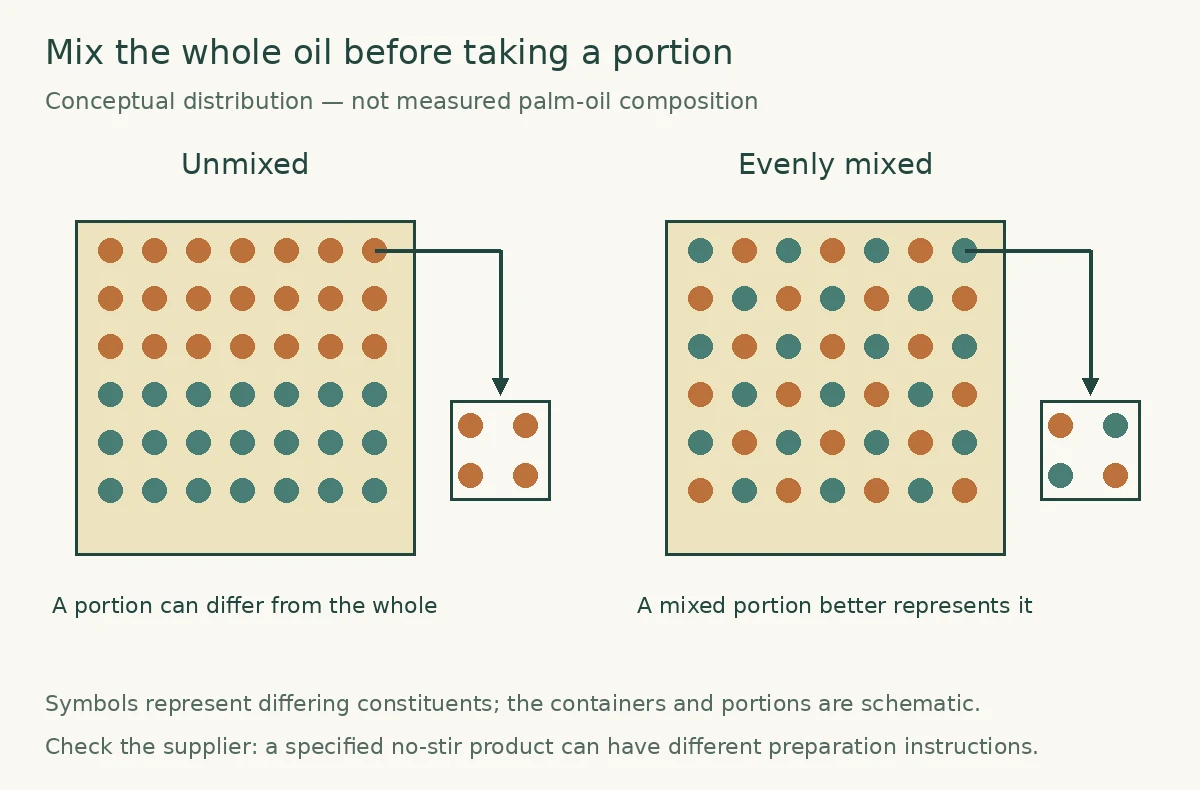
Melting and mixing palm oil before taking a portion helps that portion represent the whole container. Merely melting the scoop you have already weighed does not accomplish the same thing: any difference between that scoop and the rest of the container has already entered your recipe.
Check your exact product first. Soap Queen directs makers to fully melt and mix the refined palm oil described in its guide so its constituents distribute evenly. Some suppliers sell a specifically prepared no-stir palm oil with different instructions. Those are product distinctions, rather than a reason to assume every tub should be handled identically.
The Measurement Starts Before the Scale
A scale can accurately measure the portion you put on it without establishing that the portion has the intended composition. This is why preparation and weighing are two separate parts of ingredient control.
Imagine a container whose constituents are not distributed evenly. Taking material from one local area can give a different balance than taking a representative portion from the whole. In the diagram, the colored symbols make that distinction visible; they are conceptual constituents, not a measurement of palm oil or an illustration of exact layers in your own container.
For the palm oil covered by Soap Queen's preparation advice, fully melting and mixing addresses that distribution before portioning. Simply seeing some liquid, or melting only a top scoop afterward, does not establish that the original container was uniformly mixed. Follow the supplier's applicable heating and mixing directions rather than borrowing a temperature or a heating arrangement from an unrelated product.
The sequence to keep clear is preparation of the whole product as directed, followed by weighing the required portion. If the container is too large for your equipment or you do not know how it may safely be heated, resolve that with the supplier instead of improvising a way to heat the packaging.
What If You Have Never Done This Before?
It does not follow that all of your earlier soap is ruined. In her FAQ, Elly describes the likely change as subtle, while explaining that a nonrepresentative palm portion can change the intended composition. In the worst case she describes, the superfat may end up higher or lower than intended because different fatty-acid compositions have different saponification requirements. She also notes that the significance depends on how much palm oil is in the recipe.
That is a possible source of variation, not a diagnosis of every soft, crumbly or unusual bar. The preparation history alone does not tell you the actual composition of a previous scoop or quantify an alkali correction. A bar that looks ordinary also cannot retrospectively establish that its portion was representative.
Keep the old batch record: exact palm product, its proportion, how it was taken from the container, other ingredients and the observations you are concerned about. If a batch has a specific defect, investigate the complete formula and process. Do not automatically add lye, extra oil or another ingredient because you now realize the palm preparation was uncertain.
For future batches, correct the preparation record and technique. That gives you a clearer basis for comparing later results without turning an unmeasured past variation into a guessed repair.
Read the Exact Product’s Preparation Instructions
The word “palm” on its own is too broad for this decision. Keep the supplier, product name, ingredient identity and any preparation instructions together with the recipe.
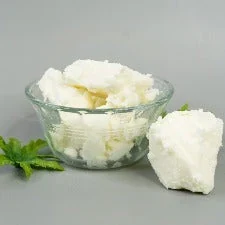
Windy Point, for example, describes its Palm Oil — No Stir, Sustainable product as fully homogenized and explicitly says that the entire container does not need melting before scooping. The accompanying photograph belongs to that exact listing. It illustrates the exception to look for in product documentation; its appearance cannot identify an unlabelled oil as no-stir.
Do not infer no-stir status from “refined,” “sustainable,” a pale color or a soft consistency. Check for an explicit instruction applying to your product. If the label and the website seem inconsistent, ask the supplier which preparation applies to your container.
Also distinguish ordinary palm oil from other ingredients with a similar name. Soap Queen lists palm kernel flakes separately from refined palm oil and describes a different material and different soapmaking behavior. Switching ingredients to make preparation easier is a formulation change, not just another way to scoop the same oil.
If you replace an oil type, recalculate the formula with the appropriate ingredient entry rather than carrying over the old alkali amount unchanged. Elly identifies recalculation after oil substitutions as the normal practice because oil types have different fatty-acid profiles and alkali requirements.
Make the Next Batch Traceable
Before weighing, record the product identity and the preparation you actually used. A short entry such as “whole container prepared and mixed according to this product's directions, then portion weighed” conveys more than simply checking off “palm melted.” For a documented no-stir product, retain that specific instruction instead.
Then record the measured portion, the recipe version and any departure from the planned process. If you divide a larger supply into smaller containers, preserve its identity and preparation history on those portions; do not let an unlabelled jar become an unexplained ingredient in the next batch.
When comparing outcomes, keep other changes visible. A new palm supplier, an oil substitution and a water change introduced together do not let you isolate palm preparation as the cause of a different result. A clear record helps you distinguish what changed from what you merely suspect.
The practical aim is a reliably identified and appropriately prepared ingredient. Use the instructions for the product you own, prepare it before portioning when those instructions require it, and keep earlier uncertainty separate from any claim that an old batch needs a chemical correction.