
Lye Concentration vs Water as a Percentage of Oils
Select an image to view it at full size.
Lye concentration and water as a percentage of oils use different totals. Lye concentration compares the lye with the combined lye-and-water weight. Water as a percentage of oils compares the water with the oil weight. Entering the same number in both fields will usually give different water amounts. A water-to-lye ratio is a third way to describe the same lye-and-water relationship.
The useful question when copying a recipe is therefore “What does this percentage describe?” Here is how to translate the settings and check them in the soap calculator without changing the intended water amount.
Start with Three Separate Weights
Call the total oil weight O, the calculated lye weight L, and the added water weight W. Use one weight unit throughout the calculation. In the examples below, the lye is treated as 100% NaOH for the arithmetic; the examples illustrate settings rather than a complete soap formula.
The definitions are:
| Setting | Calculation | What the denominator contains |
|---|---|---|
| Lye concentration | 100 × L ÷ (L + W) | Lye and water together |
| Water : lye ratio | W ÷ L | Lye alone |
| Water as % of oils | 100 × W ÷ O | Oils alone |
For example, suppose the oil total is 500 g, the calculated NaOH is 70 g, and the water is 140 g. The concentration is 70 ÷ 210 × 100 = 33.33%. The ratio is 140 ÷ 70 = 2 : 1. Water as a percentage of oils is 140 ÷ 500 × 100 = 28%.
Those three settings describe exactly the same example. None of them says that the oil total includes water or lye. Keep that distinction when reading the total oil target in the calculator.
Calculate Water from a Concentration or Ratio
If you already have the calculated lye weight and a specified concentration, rearrange the definition:
Water = lye × (100 − concentration) ÷ concentration
For 70 g of lye at exactly 33% concentration, water is 70 × 67 ÷ 33 = 142.12 g, rounded for display. The corresponding water-to-lye ratio is 67 ÷ 33 = 2.0303 : 1. This is slightly different from 2 : 1, which gives 33⅓%, rather than exactly 33%.
For a stated ratio, the calculation is shorter: water = lye × ratio. At 2 : 1, 70 g of lye corresponds to 140 g of water. To convert that ratio back to concentration, use 100 ÷ (1 + ratio).
The following are mathematical conversions, not recommendations for choosing a working concentration:
| Concentration | Equivalent water : lye | Water for 70 g lye |
|---|---|---|
| 30% | 2.3333 : 1 | 163.33 g |
| 33% | 2.0303 : 1 | 142.12 g |
| 33⅓% | 2 : 1 | 140 g |
| 35% | 1.8571 : 1 | 130 g |
A calculator may show fewer decimal places than it uses internally. Compare the underlying settings before interpreting a tiny display difference as a changed formula.
Why Oil-based Water Percentages Behave Differently
Holding water at a fixed percentage of oils does not hold concentration constant when lye demand changes. Different oils can require different amounts of alkali, so an unchanged oil total and water percentage can still produce a different lye-solution concentration.
Consider two arithmetic cases with 500 g of oils and water set to 30% of oils. Both receive 150 g of water. If one case requires 65 g of lye, its concentration is 65 ÷ 215 × 100 = 30.23%. If the other requires 75 g, its concentration is 75 ÷ 225 × 100 = 33.33%.
The water amount stayed fixed; the concentration changed. Conversely, if concentration stays fixed while lye demand changes, the water amount changes with it. This explains why changing an oil or a lye-discount setting can change the water output under one mode but leave it unchanged under another.
Match a Copied Recipe in Soap Draftbook
In the interface example below, a 750 g oil blend at 33% concentration converts to about 28.77% water as a percentage of oils. Switching basis keeps its 215.79 g added water unchanged; the control retains more decimal places than the rounded results. This is a separate calculator example from the 70 g arithmetic example above.
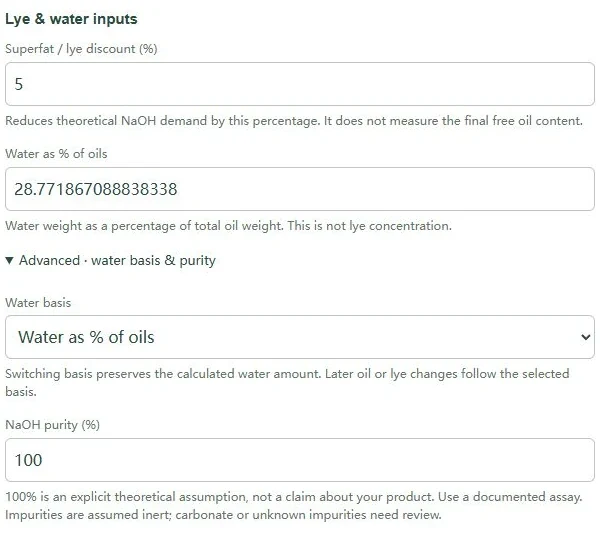
Enter the exact supported oils and their weights first. Check the oil identities, total, lye-discount setting and NaOH purity assumption against the source recipe. A mismatch in any of those inputs can affect the lye result before water is considered.
Expand Advanced · water basis & purity. Choose the water basis named by the recipe, then enter its value. For a recipe specifying 33% lye concentration, select concentration and enter 33; do not put 33 into water as a percentage of oils.
Read both the added-water weight and Equivalent water settings in Results. When you switch the basis in this workspace, it preserves the calculated water amount and converts the setting. Subsequent changes to oils or lye inputs then follow the newly selected basis.
If the source gives only water and lye weights, calculate their concentration or ratio directly. If it says only “30% water,” check the original instructions for the denominator. Choosing whichever field produces a familiar number does not resolve the ambiguity.
Keep Concentration Separate from Purity
The purity field describes the NaOH product, while the concentration field describes its relationship to added water. They are separate inputs. Soap Draftbook labels its water calculation as a nominal concentration using NaOH product weight divided by product plus added water; impurities are assumed inert. That is not a laboratory measurement of the active NaOH concentration.
Before comparing two calculators, match their purity and water definitions as well as their numerical settings. Also check whether extra liquids or reactive additives are involved: this workspace does not account for milk, acids, salt or other additives. For the supported inputs and calculation limits, read the calculator guide.