
Why Does Poured Soap Separate into Oil Layers or Puddles, and How Does False Trace Affect This?
Select an image to view it at full size.
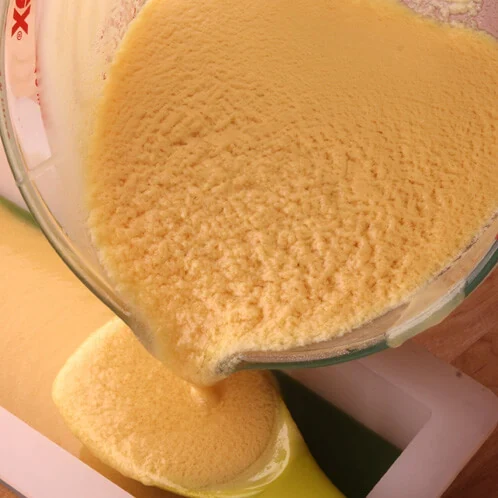
Oil layers or pools appearing after a cold-process pour can mean the oils and lye solution were not incorporated into a sufficiently uniform mixture before the mold was filled. One route is false trace: cooling fats make the batter look thick even though that thickness is not evidence of a properly mixed emulsion. Fragrance behavior can also contribute to separation, so reconstruct the actual sequence rather than assigning every oily surface to one cause.
Keep the batch protected and do not pour off an unidentified layer. Removing material changes the quantities remaining in the mold. A dry-looking top afterward would not show that the formula or mixture has been corrected.
Distinguish Thickness from Incorporation
When oils and lye solution are combined, the important mixing requirement is their distribution through the raw mixture. Modern Soapmaking distinguishes emulsification from the later visible thickening called trace: an emulsion may still be thin, while continued mixing creates progressively thicker consistencies. Its guidance identifies visible ribbons of oil as a sign that the mixture is not yet sufficiently incorporated.
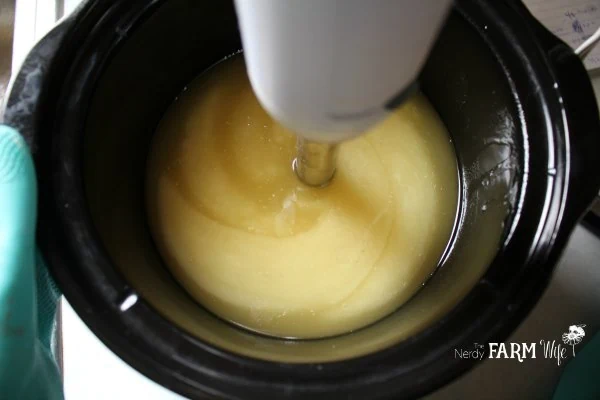
Jan Berry's mixing photograph in this section shows those visible swirls rather than a uniform batter. The image illustrates an earlier-stage warning sign; it is not a photograph of a batch already separated in its mold. Record whether anything like that was visible when your batch was poured.
Do not use the mere presence of a spatula trail as the only criterion. Thick batter can have different reasons for being thick, and a briefly persistent surface mark does not measure ingredient distribution. Conversely, a suitably mixed thin emulsion should not be described as uncombined solely because it flows readily.
The goal is a workable understanding of the actual mixture, not the thickest consistency possible. That matters especially when a fragrance rapidly reduces working time: rushing an uneven mixture into the mold does not complete the missing incorporation step.
How Cooling Fats Can Produce False Trace
Some ingredients in a hard-fat blend can begin setting as they cool. The mixture then appears thicker because of that physical change, rather than because the whole batch has reached the state the maker intended. Modern Soapmaking and Berry both identify cool, setting fats as a route to false trace and later uneven incorporation.
Check the actual fat identities and whether they were fully melted and mixed before use. Record whether cloudiness or granules developed before the lye solution or fragrance was added. A temperature number copied from a different formula is less useful than understanding whether the particular fats in your vessel remained suitable for that process.
This is why “soap as cold as possible” is not a universal strategy. Lowering temperature may help with some fast-moving conditions, yet allowing the hard fats to set creates another problem. Nor do oil and lye temperatures have to be within an arbitrary few degrees to prove a good mixture; the actual state and behavior of the ingredients matter.
If the mixture has not yet been poured and is visibly uneven, do not treat its thickness as permission to transfer it. Continue only under the established method for that formula. Once it is in the mold and separating, the task changes from achieving a suitable pre-pour mixture to assessing an already nonuniform batch.
Check the Fragrance Sequence Too
Ask whether the mixture looked uniform before fragrance addition, whether visible oil appeared immediately afterward, and whether rice-like lumps or rapid stiffening accompanied it. Soap Queen's fragrance tests show that ricing, separation and seizing can occur together. Granules and free oil are different observations even when present in the same pot.
The source's close-up photograph above shows free yellow liquid around grainy batter during transfer. It demonstrates a visibly separate phase, not simply a smooth batter becoming thick. Its appearance should not be used to identify the chemical composition of liquid leaking from your mold.
Keep the exact fragrance product and measured amount in the record. A supplier's cold-process behavior notes may help investigate a known product, but a scent name shared with another brand is not evidence that the two mixtures behave alike. If several variables changed, do not assume the fragrance alone explains the outcome.
Do not try to disperse a separated molded batch by adding extra fragrance or oil. Those additions change the formulation and can make the quantities harder to reconstruct. A later reprocessing decision needs the actual composition and an applicable method; it is not established by the fact that fragrance separation is a known phenomenon.
Treat Timing and Material Loss as Important Conditions
A separation noticed immediately after pouring is not the same situation as liquid appearing several hours later or escaping when a bar is cut. Record when the problem became visible, what the soap had done in the meantime, and whether the mold retained all the material.
If the liquid remains in the same secured container, you may still have more of the original material available for assessment than after a spill or deliberate draining. That does not by itself qualify a recovery method, but it preserves information that would be lost by pouring a layer away.
If oil or another liquid has escaped, do not infer its composition from its color, smell or the amount of remaining soap. A mass lost from the batch is not automatically a known mass of one ingredient. Adding the same weight of oil or alkali would therefore be a guess, not a correction derived from the original recipe.
Berry's discussion of cavities that release oil or caustic liquid emphasizes this quantity problem. A neat-looking remainder cannot tell you which components were lost. Keep the batch out of use while that uncertainty is unresolved.
Make a Better Pre-Pour Check Next Time
Use one checked formula, record actual quantities and preserve any changed ingredient identities. Prepare compatible, stable equipment and the mold before mixing so there is no need to stop and search for tools after the ingredients are combined. Maintain protection around the fresh batter.
Then observe the actual mixture rather than following a timer alone. Look for visible oil ribbons, uneven regions or a cooling fat blend that has thickened before adequate incorporation. Use a simple design when testing an unfamiliar fragrance so several colored cups do not obscure which portion changed first.
Keep deliberate comparisons manageable. If you change the water setting, record its basis and recalculate the formula; if you change temperature or fragrance-addition timing, keep the other conditions clear. More blending can change working time, and less water is not a substitute for understanding the mixture.
The useful conclusion should name what was observed: visible oil before pouring, sudden separation after fragrance, or a layer noticed later in the mold. Those records help distinguish an incorporation problem from other surface changes without pretending that every pool has the same cause or the same recovery route.