
Why Is the Top of My Soap Cracking, and What Should I Check?
Select an image to view it at full size.
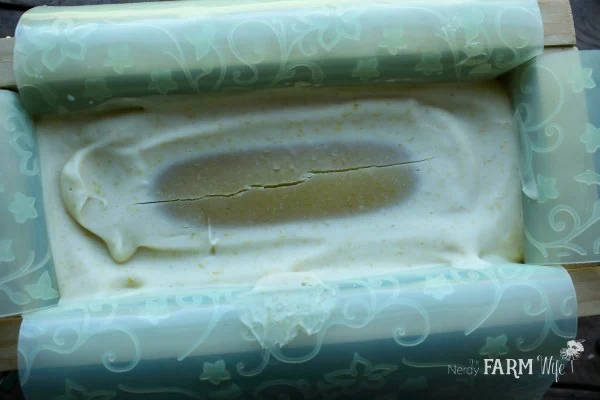
A crack developing across freshly molded cold-process soap can be a sign that the batch is retaining too much heat. Check whether the top is also rising, the center is changing appearance, and the mold is covered or insulated. But heat is not the only context to review: Jan Berry also reports top cracking associated with heavy alcohol spraying and with some high-powder, low-water combinations. The recipe and timing help distinguish those investigations.
Keep fresh soap protected from contact. If a batch is expanding or becoming difficult to handle, do not press the crack closed or move an unsupported mold to improve its appearance. A cosmetic repair does not establish what caused the split or resolve an unknown formulation issue.
Check What Happened Before the Crack
Write down when the crack appeared relative to pouring. Note the actual starting temperatures, mold type, fill depth, covering, added heat and room conditions. Record ingredients such as honey or milk and the exact fragrance, rather than describing the batch only as “the usual recipe.”
Berry's calendula, oatmeal and honey photograph shows a long central crack in a loaf whose center had gelled while its edges remained lighter. The source identifies overheating and partial gel in the same example. This is why a pale outer area does not automatically mean the entire batch needs more heat.
Watch the shape as well as the color. A split that is opening while the surface rises is a different current handling concern from a faint line noticed on an already cool top. Record visible liquid or material escaping separately; do not assume the crack explains its composition.
If you covered or heavily insulated a batch that is developing heat-related cracking, Berry's guidance is to remove the insulating layers. Only do this when they can be removed without touching the soap or destabilizing the mold. Do not add another blanket merely because part of the surface remains pale.
Do Not Use Partial Gel as a Heat Gauge
The cut sample in this section shows a darker central area with lighter edges: an appearance associated with partial gel. It is a different sample from the cracked loaf above. It illustrates a heat-history boundary, not a thermometer reading or proof that every central oval corresponds to the same peak temperature.
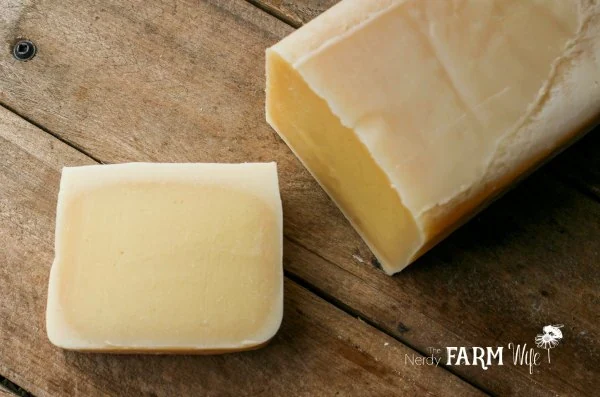
A batch can have an excessively hot center while the outer soap follows a different path. The useful question is what is changing now, together with the actual heat-retention setup—not whether the whole loaf has reached one shade.
Do not use an improvised cycle of heating and rapid cooling to chase an even color. Nor should a cold area in one batch be treated by automatically applying the same extra heat to another formula. Mold geometry, ingredients and the covering arrangement belong in the comparison.
For a future pour, decide whether the process is intended to encourage or avoid gel and use an established method suited to that formula. A crack investigation should not become an unplanned experiment on a fresh caustic loaf.
Review Surface Spraying Separately
Berry identifies heavy alcohol spraying on the top as another circumstance associated with cracking. If alcohol was used to reduce soda ash, record the product, application and whether the spray was unusually heavy compared with earlier batches. Do not assume that every crack following a spray has the same cause; the batch may also have been heating strongly.
Adding more spray is not a repair for an existing crack. Keep any future application within the actual product and process instructions. If you compare a lighter application or a different covering arrangement next time, make that one deliberate change rather than also changing the water, fragrance and mold.
This distinction matters because a surface treatment and the bulk batch's heat retention are different variables. Removing a blanket does not establish that a powder-heavy surface mix is correct, and reducing spray does not solve an overheated recipe by itself.
Check Powder Additions and the Water Setting
Berry reports a chalky, cracked result when using excessive zinc oxide to lighten soap, and notes that high clay additions with reduced water can leave a dry, cracked top. These are source observations to consider when the actual batch used those ingredients; they are not a reason to diagnose zinc oxide in an unidentified soap.
Review the real amounts and their basis. Was a powder weighed for the full batch, then put into only one small portion? Was its dispersion liquid included in the total formulation? Did you reduce the base water while also increasing a water-absorbing addition? A recorded change is more useful than a vague statement that the soap was “dry.”
Use the colorant or clay supplier's applicable dispersion instructions and an established formula for the addition. Do not sprinkle dry powder over a thick batter and assume that more blending will always distribute it adequately. Likewise, adding guessed water to an already cracked loaf is not a controlled correction of its original formulation.
If an addition's actual amount is unknown, preserve that uncertainty. A calculation based on what you intended to add cannot substitute for what reached the batch.
Keep Appearance and Batch Condition Separate
| What is known | What it helps you investigate |
|---|---|
| Crack develops with rising heat and heavy insulation | Unnecessary heat retention and the ability to remove covering with controlled handling |
| Crack follows a heavy surface spray | The application history, alongside the rest of the thermal record |
| A chalky or dry top accompanies a changed powder/water combination | Actual powder quantity, dispersion and the chosen water setting |
| Liquid escapes or the batch has a known weighing error | A separate quantity or mixing problem; closing the visible crack is not the answer |
Do not classify a batch as ready for use merely because a top crack is shallow or can be trimmed away. Equally, a crack alone does not reveal a missing ingredient or an exact alkali correction. Keep the recipe, actual weights and process history available while assessing the whole result.
Finish the record with a specific description: when the crack opened, whether the center was changing, which covering was present, and whether spray or powder additions had changed. That gives the next batch a clear variable to adjust instead of repeating the same appearance under several new conditions.