
Why Concentrated Lye Solution Can Develop Crystals in the Cold
Select an image to view it at full size.
A concentrated sodium-hydroxide solution can develop a solid phase when it becomes too cold for that particular composition to remain fully liquid. A solution that was clear when prepared is therefore not guaranteed to stay uniform in a colder storage area. Once solid material is present, the clear liquid above it should not simply be weighed as though the original concentration still applies.
That explanation does not identify an unknown deposit by sight. An unexplained crust could involve incomplete original dissolution, contamination or a changed solution as well as cold-related crystallization. Keep the container secured and labeled while investigating its actual contents and history; do not pour off the liquid, discard the solids and continue with the original recipe calculation.
Concentration and Temperature Belong Together
Water can hold a large quantity of dissolved sodium hydroxide, but a concentration number alone does not describe every condition in which the mixture will remain liquid. The International Chemical Safety Card gives a solubility value at a stated temperature: 109 g sodium hydroxide per 100 mL water at 20°C. The temperature is part of that physical-property statement, not an optional detail.
In soapmaking, the word “concentrated” also needs a number and a basis. A nominal 50% solution made from pure NaOH and water contains equal masses of each. A 33⅓% solution contains twice as much water as alkali. Those mixtures should not be assigned one common crystallization temperature merely because both are described as lye solution.
The Classic Bells masterbatch guide describes concentrated NaOH forming a glass-like sheet at the bottom after cold storage. Modern Soapmaking also warns that concentrated solution can precipitate as it cools. These descriptions explain why storage temperature matters; they are not evidence that every white or transparent deposit is the same substance.
Why the Clear Upper Liquid Is Not a Reliable Shortcut
The original concentration calculation assumes a known, uniform mixture. If some material has moved into a separate solid phase, the remaining liquid and the solids are no longer represented by simply taking a convenient portion from the top.
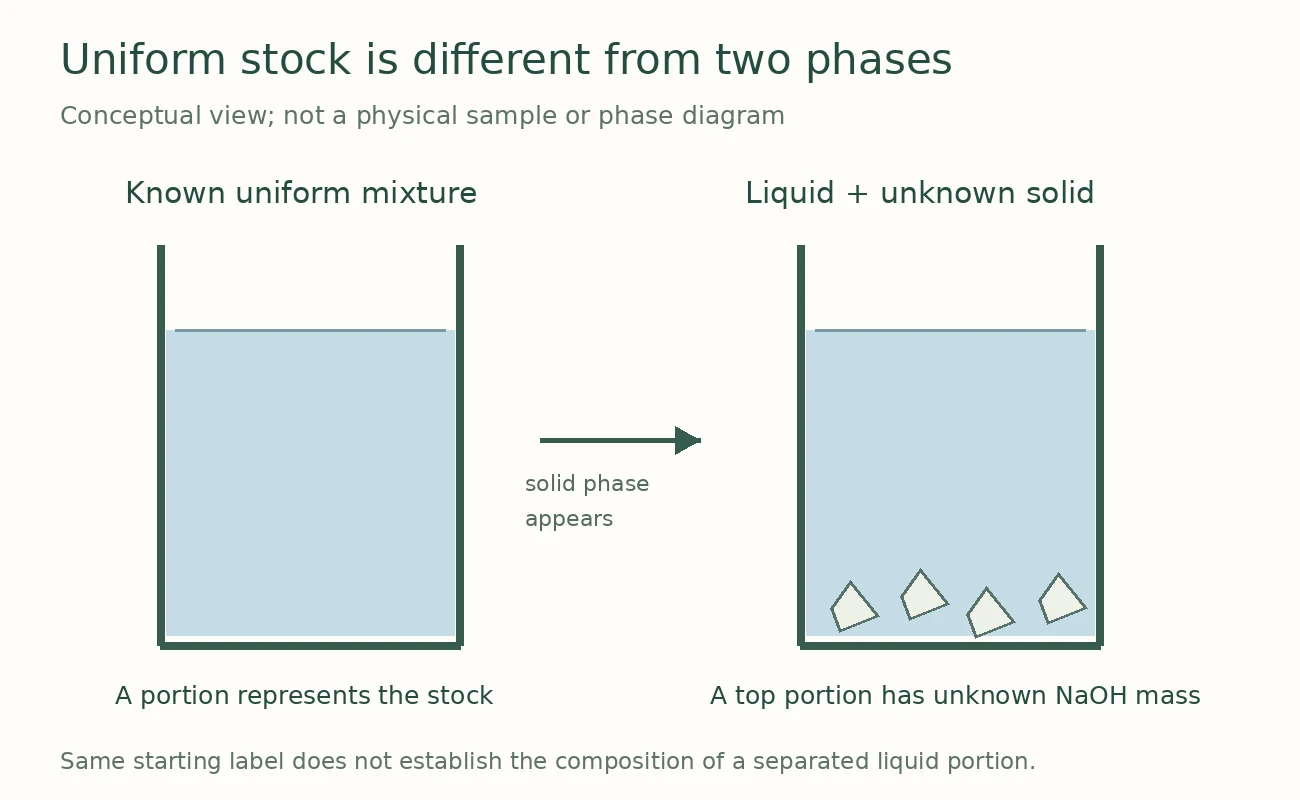
For example, a hypothetical stock made from 500 g NaOH and 500 g water starts with a nominal 50% mass calculation. If it later develops an unknown amount of solid material, removing 200 g of clear liquid does not establish that you have removed 100 g NaOH. You would need the actual composition of that liquid; the original total alone does not supply it.
The conceptual diagram shows that accounting distinction. It does not predict a crystal shape, a phase temperature or the composition of a real deposit. Its point is that weighing one phase is different from weighing a known uniform stock.
Do not turn the unknown solid into a small rounding allowance. Alkali quantity is a fundamental input to the soap calculation. Ignoring material that remained in the storage vessel can change what actually enters the batch, even if the scale accurately measures the liquid you pour.
Do Not Apply One Internet Temperature to Every Stock
The two soapmaking sources use different temperature guidance. Modern Soapmaking warns about cold conditions below 25°C in its discussion of 50% solution. Classic Bells advises storage at 18°C or warmer for its stated 33–50% masterbatch range and describes crystallization below about 16°C. These statements should retain their source and concentration context rather than being combined into a single universal freezing point.
A cautious storage recommendation is also not necessarily an exact phase-boundary measurement. The underlying mixture, concentration and conditions matter. This article does not resolve those source statements into a new numerical limit, and a household thermometer reading alone cannot establish the identity or composition of a problem stock.
Use the documentation for the actual chemical product and the intended stock preparation when choosing storage conditions. If the concentration is unknown, a temperature rule quoted for a different solution is not enough to make it known again.
Check the Preparation and Storage Record
Begin with the original quantities and product identity. Record whether the stock contains only sodium hydroxide and water or also other materials. Check the product purity used in the calculation, whether the alkali was fully dissolved initially, and whether any material was spilled or left in the mixing vessel.
Then check what changed. Was the container moved from a warmer room into an unheated garage? Was it opened repeatedly? Is its cap sound, and is there evidence of leakage or other contamination? Record the observed temperature and timing rather than deciding that cold must be the cause simply because it is winter.
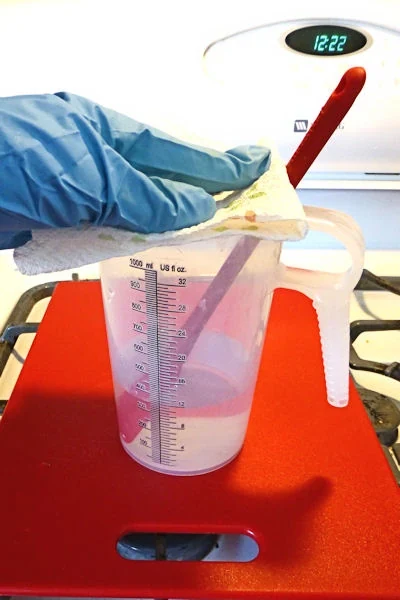
The cover photograph shows the mixing vessel in Classic Bells' masterbatch guide, with a hand holding a loose cover over the top. It illustrates that preparation and handling are separate steps from later closed storage. It is not a photograph of cold crystals or a demonstration of how to recover them.
A missing preparation record is a real limitation. Do not reconstruct the starting concentration from how thick the liquid looks, the size of the remaining deposit or the amount of soap you hoped to make from it.
Keep Recovery Separate from the Explanation
Classic Bells states that solid alkali must be fully dissolved before the solution is used, while also saying the author avoids warming lye solution for safety reasons. That combination should not be compressed into a casual instruction to heat a crystallized bottle.
Warming, dilution and transfer involve caustic material and potentially substantial heat. ICSC 0360 identifies sodium hydroxide as corrosive and notes heat generation on contact with water. Follow the actual product guidance and suitable equipment requirements; do not improvise by microwaving the container, sealing a hot mixture or adding guessed water.
If the composition or required handling cannot be established, keep the stock out of the soapmaking process and obtain appropriate product-specific advice or disposal guidance. There is no benefit in preserving an old concentration label at the cost of an uncertain batch calculation.
For future stock, keep the preparation date, ingredients, actual masses, concentration basis and storage requirements on the record and container. Preventing an avoidable cold-storage problem is much easier than proving what is in the liquid after an unknown deposit has formed.