
Why Cold-Process Soap Can Rise and Overflow Like a Volcano
Select an image to view it at full size.
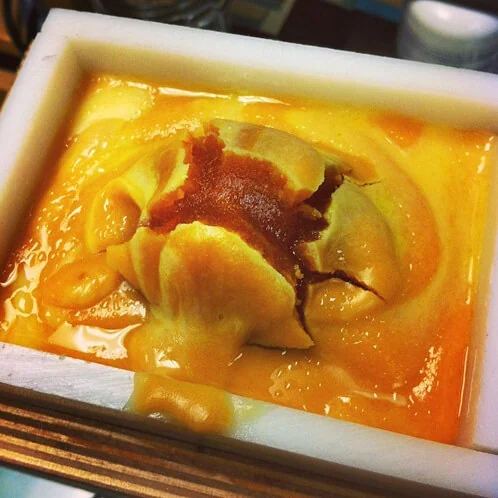
A cold-process “soap volcano” is an overheated batch that expands upward and may escape its mold. Sugar-containing additions, some fragrances and the way a batch retains heat are all useful things to investigate. Soap Queen documents an eruption in pumpkin-puree soap and reports a more severe overflow involving coconut milk; those examples explain why a checked oil-and-lye calculation is only one part of planning an additive recipe.
If a batch is actively rising or releasing hot material, keep people away and do not lean over it, press it down or attempt a hurried transfer. Protect the area from access while it settles. Any spill or exposure needs the actual material's handling and emergency guidance; a general soap tutorial is not a reason to handle moving caustic batter with bare hands.
Distinguish Expansion from Ordinary Gel
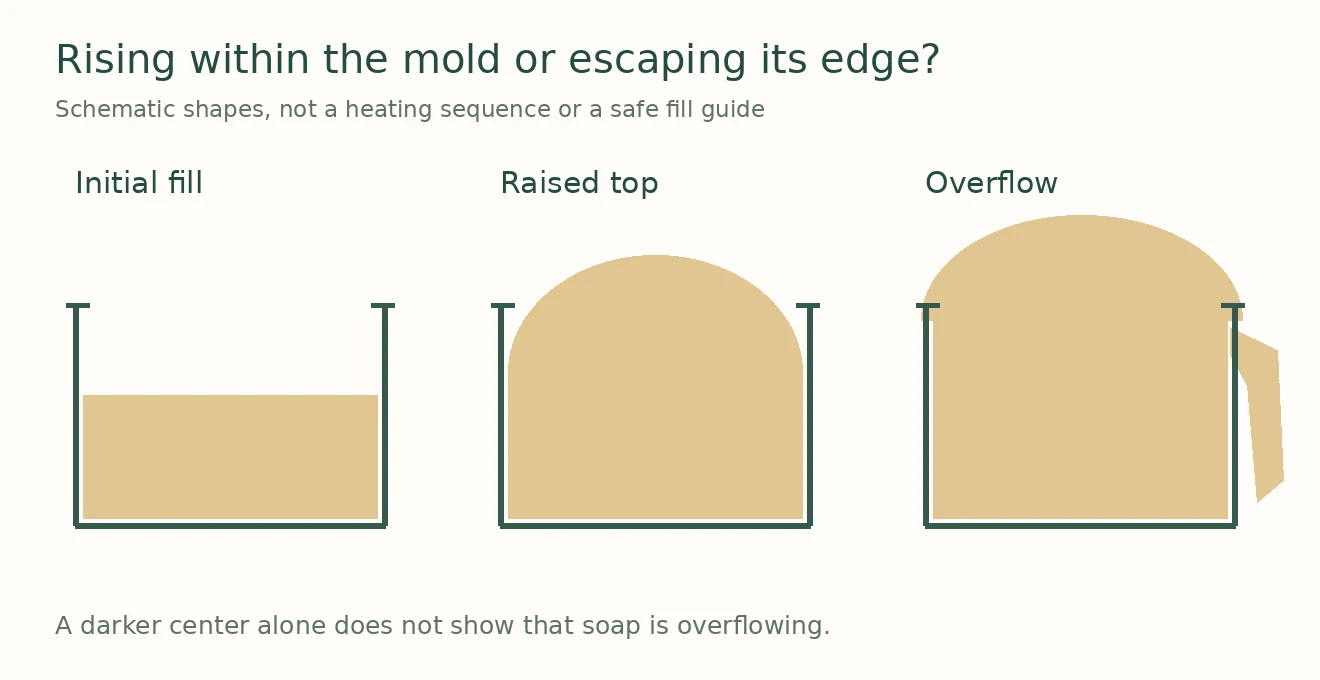
Soapmaking generates heat as the oils and alkali react. Gel describes a heat-related change in the fresh soap's appearance; expansion that raises the top and pushes material over a mold edge is a different observation. A darkening center alone does not establish that a volcano is developing.
In Soap Queen's photographed pumpkin-puree example, the surface has broken upward and material has moved over an edge. The picture is an actual source example of the named problem, not a model of how much every sugar-containing batch will expand. Its yellow color is not a diagnostic threshold.
The outline drawing in this section separates three shapes: an initial fill, a raised top, and material extending outside the mold. It illustrates the distinction between a change in appearance within the mold and a loss of containment. It gives no safe fill height, heating instruction or measured progression for your recipe.
Record what you actually observed: a rising dome, a crack, a collapse, overflow, or liquid escaping independently. Those details matter because a quiet crack and an expanding spill do not call for the same handling. Photographs can be useful if they can be taken without approaching an unstable batch.
Review Additions Without Assuming One Ingredient Explains Everything
Soap Queen identifies natural sugars, including fruit purees, and alcohol as additions associated with excessive heat in its cold-process examples. Jan Berry also lists milk, honey, pumpkin and beer when discussing overheating. This does not mean a small amount of one ingredient makes an eruption inevitable; the complete recipe and process still matter.
Write down the actual addition, its product or preparation, and its weighed quantity. “Milk soap” is not enough to reconstruct whether milk replaced water, was added separately, or changed the total liquid plan. A puree can introduce both water and solids. Beer or another alcoholic ingredient introduces preparation questions beyond the water setting alone.
Do not add these materials to a familiar plain-water recipe on the assumption that the original method automatically covers them. Choose an established additive-specific formula and process, account for its quantities deliberately, and confirm the alkali calculation. The amount needed to saponify the oils does not by itself define how the whole mixture will behave in a hot mold.
Fragrance belongs in the same review. Soap Queen reports rapid heat alongside some fragrances that accelerate or seize. That makes the exact product and its cold-process behavior notes relevant, rather than just its scent name. A previously successful fragrance also cannot compensate for a substantially different batch size or heating arrangement.
Check the Size and the Heat Arrangement
Heat management changes when a formula moves from small cavities to a larger loaf or production block. SoapEquipment's published large-batch discussion specifically warns that large block pours can become much hotter and that some formulas run hotter than others. Its advice comes from production molds; it should not be copied as a universal household temperature target or covering method.
Record the real mold dimensions, filled amount, material, support and insulation. Include the bottom as well as the top: the whole arrangement controls how the mold exchanges heat with its surroundings. Note any towel, blanket, cover, oven or other added heating step, plus the room conditions.
Look for changes from the previous successful batch. Did you double the recipe and put it into one deeper mold instead of two familiar molds? Did a warmer room coincide with the same heavy covering? Did you keep an oven step while adding a different fragrance or a sugar-containing ingredient? These are useful comparisons because they identify actual changes instead of guessing from the finished soap alone.
For a first test of a new additive or fragrance, a smaller controlled batch reduces the amount at stake and makes the result easier to document. It does not make an unsuitable recipe safe, and scaling still requires recalculating and planning the equipment.
Do Not Turn a Cosmetic Fix Into an Emergency Procedure
Some historical tutorials describe scooping soap back into a mold, reshaping a sag or pressing cracks closed. Those accounts assume particular materials and conditions. They are not instructions to reach into a batch while it is swelling or spilling. Keeping control of exposure and access comes before saving the appearance.
Allow the batch to become stable in its protected location rather than improvising cooling water, extra oil or neutralizers. Sodium hydroxide is corrosive, and contact with water releases heat; an unplanned addition can introduce another hazard as well as making the batch quantities uncertain. ICSC 0360 gives chemical handling and exposure precautions, which must be read alongside the actual product information.
Once the batch is no longer actively changing, preserve the record of any lost material. Do not assume that an overflow contained only excess water or that cutting off an erupted top corrects an unknown formulation. Reprocessing or disposal is a separate decision requiring the actual composition and circumstances.
Likewise, normal-looking soap after the event is not a guarantee that the batch is suitable to give away. An understood surface defect, unknown ingredient loss and visible pockets of liquid are separate questions. Keep the batch labeled while those are resolved.
Plan the Next Comparison Before Mixing
Start with a checked formula and the exact additive instructions you intend to follow. Review the proposed mixing temperatures, mold and insulation together, rather than lowering one number while leaving an excessive heating arrangement unchanged. Jan Berry recommends cooler subsequent processing for overheated sugar-containing recipes, but the working range still has to suit the actual fats and method.
Change one meaningful part of the plan at a time when testing. For example, retain the documented formula and fragrance while evaluating the mold or insulation arrangement. If the additive or fragrance itself changes, record that separately so a different result is not attributed to temperature alone.
Prepare the mold location and access controls before the lye is opened, and monitor the fresh batch without treating a particular appearance as proof of safety. The useful conclusion is a clear heat history and an interpretable next test—not a rule that every milk soap erupts or that every gelled loaf is overheating.