
How Far Can You Reduce Water Before Lye Stops Dissolving?
Select an image to view it at full size.
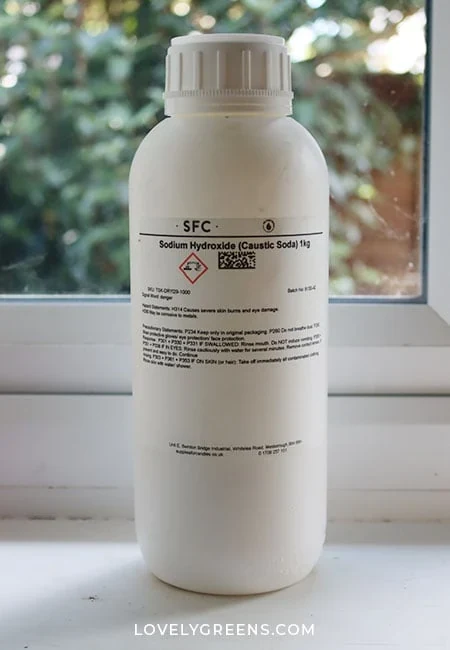
There is no single water-discount percentage that establishes whether sodium hydroxide will dissolve. The relevant quantities are the alkali and the water actually present together, and the temperature matters. In ordinary soapmaking guidance, equal masses of sodium hydroxide and water—a nominal 50% solution—are commonly treated as the concentrated end of the working range, not a universal physical solubility limit or a recommended setting for every recipe.
Do not turn an arithmetic limit into a mixing experiment. If a recipe requires more alkali than the planned dissolving water can accommodate under the actual conditions, revise the plan before dispensing it. More heat from dissolving the alkali does not establish that the solution will remain clear as it cools. Unresolved solids, unknown composition or a changed water allocation are reasons to stop before using that solution in a soap batch.
Calculate the Strength of the Actual Lye-Water Portion
For a simple hypothetical solution made from pure sodium hydroxide and water, concentration by mass is:
NaOH concentration = 100 × NaOH mass ÷ (NaOH mass + water mass).
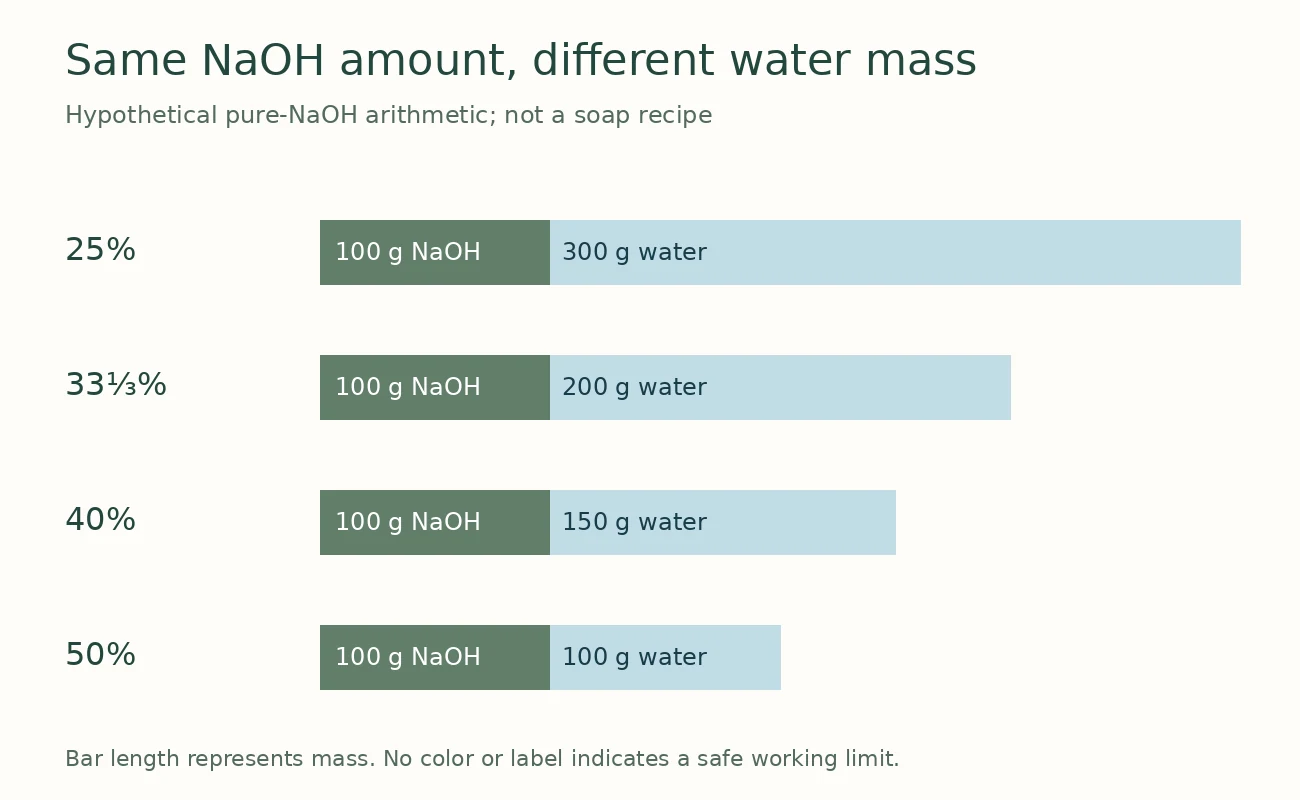
With 100 g NaOH and 200 g water, the nominal concentration is 33⅓%. With the same 100 g NaOH and only 100 g water, it is 50%. The alkali requirement has not changed; the amount of solvent has. These are arithmetic examples, not complete soap recipes or instructions to prepare either solution. Commercial purity and other dissolved ingredients require their own accounting.
The proportional strips in this section keep the alkali amount fixed. They make the change in water visible: moving from 200 g to 100 g water removes half the solvent, even though the displayed concentration rises by only about seventeen percentage points. A modest-looking change in a calculator field can therefore represent a substantial change in the actual mixing portion.
Oil mass is not the denominator of that equation. If you enter a water amount as a percentage of oils, check the resulting NaOH-to-water relationship after the oil blend has determined the alkali amount. The same water-as-oils percentage can produce different solution strengths for different blends.
Understand What the Familiar 1:1 Boundary Means
Modern Soapmaking presents a 1:1 water-to-lye mass ratio as the most concentrated conventional soapmaking solution under suitable conditions, and recommends a less concentrated limit in its ordinary practice. That is useful advice about the author's process, but its broad statement that lye cannot dissolve in less than its own weight of water should not be read as a temperature-independent law.
The ILO/WHO International Chemical Safety Card gives sodium hydroxide's water solubility as 109 g per 100 mL at 20°C. Notice both the temperature and the units: grams of substance per volume of water is not the same statement as percent by mass of the final solution. This physical reference does not prescribe a household soapmaking concentration, and it should not be used as a target to approach while mixing.
The practical distinction is important. A source can describe a conservative working convention without defining the exact saturation boundary for every temperature, purity and composition. Conversely, knowing a substance has high solubility does not qualify a concentrated solution for your vessel, storage conditions or intended process.
For a conventional soap recipe, follow a method with an established water setting appropriate to that formula and procedure. If you want to change it, make the change deliberately and keep the actual solution strength visible. Do not take a physical-property value as permission to minimize water until solid alkali just disappears.
Count Water Where the Alkali Must Dissolve
A recipe's total liquid is not always the liquid initially holding the alkali. Suppose a hypothetical calculation calls for 100 g NaOH and 200 g total water, but you reserve 120 g of that water for a later addition. Only 80 g remains in the initial dissolving portion. Its nominal concentration would be 100 ÷ 180 × 100 = 55.6%, even though the full recipe's planned NaOH-and-water total corresponds to 33⅓%.
Adding the reserved water later does not make it available at the initial dissolution step. That distinction is the reason to write down both the total-water plan and the actual dissolving-water allocation before starting. Modern Soapmaking uses separate dissolving water and later alternative-liquid additions to explain the same accounting problem.
Also distinguish an alternative liquid's total mass from its water content. Milk, a puree or another ingredient is not automatically equivalent to the same mass of plain water. Its solids and other reactive components can change the formulation and handling questions. This article's simple concentration arithmetic should not be stretched into a method for an unreviewed additive recipe.
If the chosen method does not provide enough suitable dissolving water, change the allocation or choose a different established method before opening the alkali. Do not compensate by adding guessed quantities after the materials are already combined.
Check the Cooling and Storage Conditions Too
A solution that looks clear while warm is not automatically suitable after cooling. The original Modern Soapmaking guidance specifically warns that concentrated lye can precipitate in cool conditions. The exact temperature at which a particular concentration develops crystals is a separate physical-property question; a single room-temperature rule should not be applied to every strength.
If crystals or a hard deposit appear, the liquid above them is no longer something you can confidently weigh as the original uniform concentration. Do not pour off just the clear portion and assume the recipe still receives the intended alkali amount. Nor should an unknown deposit be identified from appearance alone.
Use the actual product's instructions and safety data sheet for handling and storage. A first-time cold-process project is not a useful setting for improvising the warming, dilution or transfer of a concentrated, crystallized stock solution. Keep the container secured and labeled while resolving the composition and required handling.
Make the Pre-Mixing Check Concrete
Before proceeding, identify the exact sodium hydroxide product and the checked formula. Record the alkali quantity, water basis, total planned water, water reserved for other uses, and water actually available for dissolution. Calculate the strength of that initial portion rather than only copying the recipe's headline water percentage.
Then confirm the method's working conditions: compatible sound containers, appropriate chemical protection, ventilation and an uninterrupted controlled workspace. ICSC 0360 notes that contact with water generates heat and instructs that, when dissolving or diluting, the substance is added slowly to water—not water poured onto the solid. These precautions apply alongside, not instead of, a suitable formulation and water allocation.
Finally, keep the stop condition clear. Correct-looking numbers do not overrule unresolved solid alkali, an unexplained deposit, a weighing error or a substituted liquid whose role has not been accounted for. Reducing water is a controlled formulation choice; it is not a contest to reach the smallest amount in which the alkali can be made to disappear.