
Why Fragranced Soap Turns Brown After Looking Creamy White
Select an image to view it at full size.
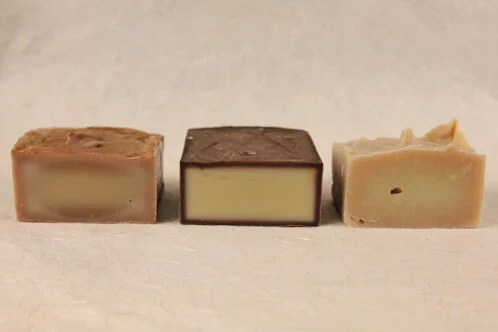
A fragrance containing vanillin can make a pale cold-process soap darken after it has been poured and cut. The color may begin on surfaces exposed to air while a freshly cut center still looks creamy. That pale center is not necessarily the final color: in Soap Queen's photographed example, it also darkens after exposure. The fragrance's appearance in the bottle and the soap's color on pouring day are therefore poor guides to the cured design.
Check the exact fragrance's cold-process discoloration information before deciding this explains your batch. Other fragrance ingredients can also discolor soap, and a brown patch with an unusual odor, liquid leakage or unresolved mixing problems needs its own investigation. A color match to somebody else's bar is not a formulation or safety test.
Why the Color Appears Later
Soap Queen identifies vanillin, a component associated with vanilla aroma, as a common cause of fragrance-related browning. Its guidance describes discoloration from off-white to dark brown depending on the fragrance. Development often takes a few days, while some scents take weeks to show their change. Those are source observations across fragrances, not a deadline by which every bar must reach its final shade.
This delay explains a familiar surprise: the batter pours cream-colored, the mold looks acceptable the following morning, and then the bars become tan or brown. Adding a white colorant before the fragrance has developed does not prove you have prevented that later change. It may simply make the initially pale soap look whiter.
In a separate fragrance-behavior test, Soap Queen documented a sample that initially looked creamy but became brown as it hardened. That test also involved ricing during mixing. Browning and handling behavior were separate results; a fragrance can create more than one problem, and a fragrance that pours smoothly can still change color later.
Do not infer the fragrance composition from its name. A scent described as vanilla may suggest something to check, but product documentation is more useful than the label's theme. Conversely, the absence of “vanilla” from a scent name does not establish that the fragrance will leave a white bar unchanged.
Read the Dark Outside and Pale Center Together
The source photograph above shows three cut fragrance-test soaps. The middle example has a dark outer rim and a creamy center. That pattern is useful because it shows how a freshly revealed interior can differ from surfaces that have already had exposure, rather than proving that two different recipes were poured into the same bar.
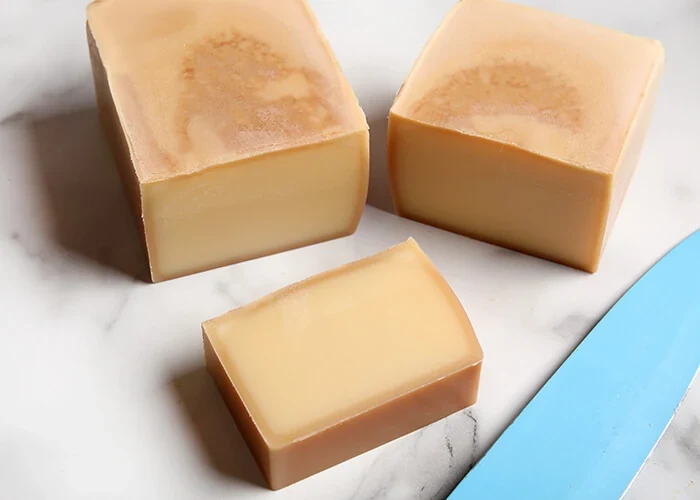
Soap Queen's dedicated vanilla-discoloration example makes the sequence clearer. The first photograph in this section shows its Vanilla Sandalwood batch at one day old, with discoloration still developing. The source also identifies a partial-gel region; heat history and developing fragrance color were both present in that batch.
A dark center with light edges can have a different explanation from a dark outer rim surrounding a freshly cut pale face. Record which surfaces changed, when they were exposed and when the soap was cut. “Brown in the middle” and “brown around the outside” are not interchangeable observations.
Use dated photographs taken under reasonably consistent light. A warm room light in one picture and daylight in the next can make a color comparison difficult. Keep the batch identifier with the bars so that a later photo is not accidentally compared with another fragrance sample.
Follow the Change Beyond the First Cut
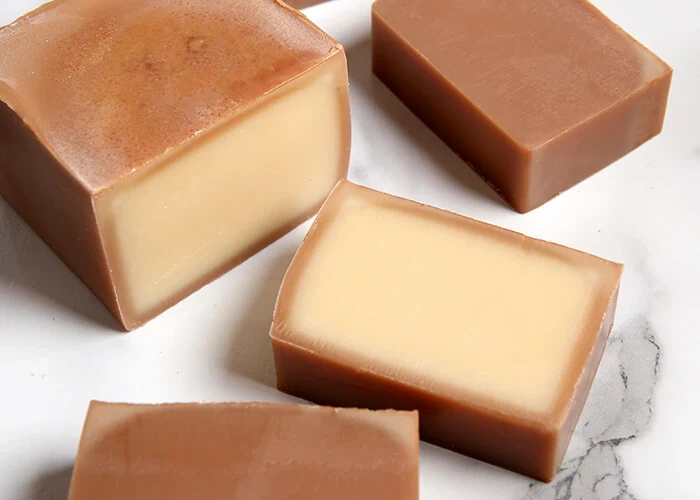
The photograph in this section shows the same Vanilla Sandalwood example after three days. Previously exposed bars have darkened, while the newly cut center remains cream-colored at the time of the photo. Soap Queen reports that the newly exposed interior subsequently changed too. This is a progression within a documented batch, not evidence that every fragrance needs exactly three days.
For your own record, note the pouring date, unmolding and cutting dates, first visible change, and later shade. Include the exact fragrance product, quantity and base recipe reference. If different portions were scented separately, record which portion received which amount rather than relying on memory after the colors converge.
Keep visual observations separate from judgments about readiness. A bar becoming uniformly brown does not show that it has finished curing or that an incorrect recipe has corrected itself. Similarly, the absence of browning after a short observation period does not establish that a fragrance will never discolor.
Decide Whether a White Design Still Makes Sense
If the goal is a reliably pale bar, the most straightforward starting point is a fragrance with suitable current cold-process performance information, followed by a small test of the complete formula. Check discoloration notes as well as acceleration: those are different properties. Avoid transferring results from a similarly named product sold by another supplier.
Titanium dioxide can lighten some tan or light-brown discoloration, according to Soap Queen, but it has limited ability to overcome a strongly discoloring fragrance. Its page also warns that using large amounts can introduce other appearance problems. It is not a reason to keep adding pigment until an uncured batch looks white. Follow the actual colorant's dispersion instructions and plan its quantity within the formulation.
Vanilla color stabilizer is another product for which process matters. Soap Queen recommends it for melt-and-pour applications but reports inconsistent results in cold-process soap: the effect may fail or be temporary. A successful melt-and-pour example is therefore not a promise for a bar made from oils and sodium hydroxide.
Make the Brown Part of the Design When Appropriate
If you want to keep the fragrance, plan for the shade it develops instead of the shade of fresh batter. A cream-and-chocolate theme can work with a browning portion, whereas a pastel design may lose the contrast you intended. The useful question is whether the actual aged sample still gives distinct colors.
Soap Queen describes scenting only part of a batch so that the scented portion discolors while an unscented portion remains lighter. This requires a deliberate allocation of fragrance. Do not automatically pour the whole batch's planned fragrance amount into a small fraction of the batter; check the applicable use guidance for the portion receiving it. The unscented section should genuinely be left out of that addition.
Before repeating a complex design, keep a small, labeled sample long enough to observe the fragrance's actual change under the intended conditions. Keep the base oils and colorants identifiable as well: otherwise a later brown shade cannot be usefully attributed to one changed ingredient.
A clear record can finish with a precise conclusion such as “cream at pouring, dark outside after cutting, newly exposed faces browned later.” That description explains the apparent surprise and helps select the next fragrance or color plan without treating every brown bar as the same problem.