
What to Do When Fragrance Makes Cold-Process Soap Thicken Too Quickly
Select an image to view it at full size.
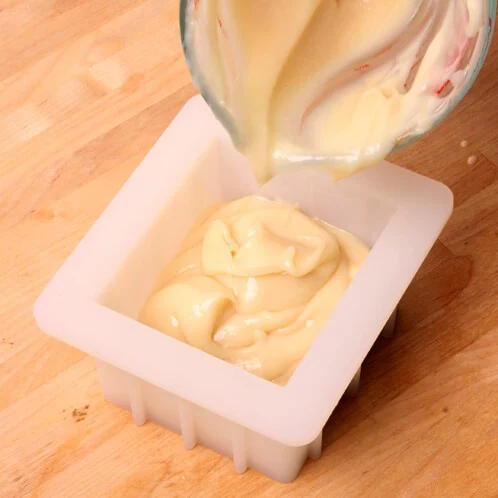
If a fragrance suddenly thickens otherwise well-mixed cold-process batter, stop unnecessary stick blending and simplify the pour. Batter that is still smooth and movable may be transferred into the prepared mold with a suitable spatula, even when it can no longer make your intended swirl. Visible oil pools, unmixed granules or a solid mass that cannot be worked evenly need a different assessment; thickness alone does not show that the ingredients are properly combined.
Keep splash protection and chemical-resistant gloves on while handling the fresh batter. Do not try to restore pouring time by adding unmeasured water, oil or more fragrance. The useful immediate decision is whether you can complete a uniform, controlled transfer—not whether you can still finish the original decoration.
Check What Changed at the Fragrance Addition
Acceleration describes batter reaching a thicker consistency unusually quickly. In Soap Queen's published fragrance tests, one sample became pudding-like shortly after fragrance was stirred in with a spoon. Further stick blending made it thicker, but the maker could still transfer it into a mold. The photograph above shows that thick batter falling in folds rather than flowing into a flat surface.
That example is a useful visual reference, not a forecast for your particular fragrance. Soap Queen tested its samples in one-pound batches with a named premixed oil blend and 0.7 ounces of fragrance. The fragrance quantity was part of that historical test; it is not a recommended dose to copy into a different formula.
Reconstruct the sequence in your own batch. Was the batter already thick before the fragrance went in? Did it change during hand stirring, or only after prolonged blending? Did you add fragrance to every color cup at once? Record the actual product, quantity, batch temperatures and point of addition while the information is still available.
A change immediately after fragrance is a useful clue. It does not exclude an already fast-moving formula, a steep water reduction or additional mixing. Jan Berry's troubleshooting guide identifies fragrance behavior, blending, water amount, temperatures and the oil blend as separate contributors to rapid thickening. Several can operate in the same batch.
Separate Smooth Thickening from Ricing or Separation
Before changing your handling, look for the feature that is actually present. The two close-ups at this decision point are Soap Queen’s separate examples: pale lumps visible on a spatula in the ricing photograph, and yellow free liquid around grainy batter in the separation photograph. They show the competing visible patterns, rather than a test of your batch’s safety.
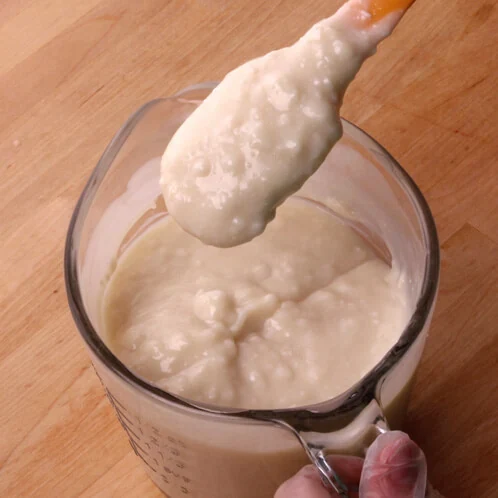
| What you can see | What it changes about the immediate decision |
|---|---|
| Smooth batter that has become thick but remains movable | Stop trying to preserve an intricate design; use a simple, controlled transfer if the mixture remains uniform. |
| Small, hard, rice-like granules | This is the appearance commonly called ricing. Additional blending may help disperse it, but also makes the batter thicker. |
| Pools or slicks of free oil around batter | Treat this as separation, potentially alongside ricing. A thick surrounding mass does not mean the mixture is uniform. |
| A stiff, clay-like mass that is very difficult to stir | This is more severe than ordinary pudding-like acceleration; do not assume it can be poured or distributed evenly. |
Look Separately for Free Oil
Soap Queen's examples distinguish the granules of ricing from the free oil pools of separation, while also showing that they can occur together. These are observations to record, not a way to identify an unknown liquid by touching or tasting it.
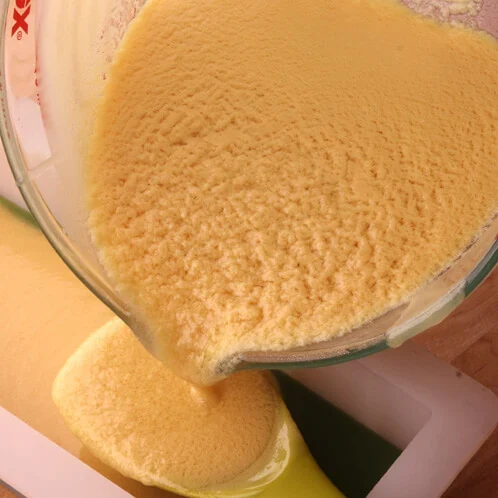
If you see several problems at once, abandon the assumption that this is merely a fast but otherwise ordinary pour. Keep the batch isolated and labeled. Any later decision to reprocess it needs known actual quantities and an appropriate method; it cannot be justified just by the fragrance's reputation.
Use the Working Time You Still Have
When the batter remains smooth and evenly mixed, put away the swirl tools and use the simplest prepared mold arrangement. Transfer it carefully with a suitable spatula rather than attempting a long, narrow pour or repeatedly lifting a heavy container to coax out a thin stream. Do not rush enough to splash fresh soap onto yourself or the work area.
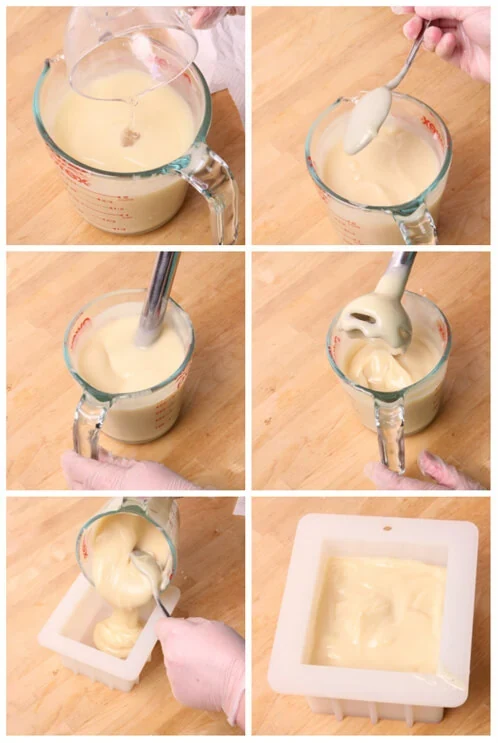
Soap Queen's sequence shown here illustrates why the original design can become unrealistic: after further blending, the batter holds substantial folds as it enters the mold. It also shows a successful transfer of that particular test batch. It does not show that blending every fast-moving fragrance will improve the outcome.
Do not continue blending merely because that was the next step in your planned routine. Mixing still has to incorporate the ingredients properly, but unnecessary mechanical blending can consume the remaining working time. If a needed ingredient is not incorporated and the mass is too stiff to mix evenly, stop treating it as ready-to-pour batter.
Do not add extra liquid oil to make the mass look softer. Oil changes the formula; extra fragrance changes the exposure calculation as well as the smell. A reserve of base oil can be part of a planned addition method for a later test, but that reserve must come from the recipe and be included in its recorded quantities. It is not an improvised correction for the current pot.
Keep Watching the Mold
Finishing the transfer is not the end of the observation. Soap Queen reports a relationship between its accelerating or seizing test fragrances and quick heat development. Avoid automatically adding the same heavy insulation you would use for a different, slower batch. Keep the mold in its protected location and monitor it for rising, cracking or other changes without putting your face or hands over the soap.
Record any heat changes alongside the earlier mixing problem. A dark center, a rough top or later discoloration is separate information; it should not be folded into a single statement that the fragrance “went wrong.” Those observations help decide what to change in the next test.
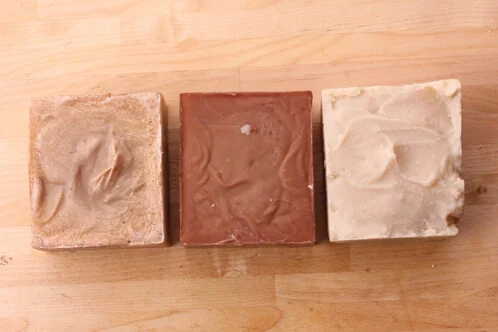
The later photograph shows Soap Queen's three fragrance samples after two days, with its acceleration example on the left. Its appearance differs from the other two samples even though they started from the same test blend. These are the source's observations, not a claim that your batch is ready to cut, use or give away after two days.
Plan the Next Batch Around Actual Fragrance Behavior
First, check the exact fragrance's current supplier information for cold-process acceleration and use guidance. A scent family or another maker's review can help you investigate, but neither replaces information about the actual product and your conditions. Fragrances with similar names are not necessarily the same mixture.
Then decide whether the design still suits that fragrance. A single-color bar or straightforward layer requires less manipulating time than many separately colored cups and a detailed swirl. If a fragrance repeatedly thickens the chosen formula too quickly, using a different fragrance for that design is often a more direct choice than repeatedly changing unrelated parts of the recipe.
For the next controlled comparison, keep the formula, batch size and recorded fragrance dose consistent while changing one relevant handling variable. For example, compare the point of fragrance addition or reduce unnecessary stick-blender time. Jan Berry describes reserving some warmed recipe oil to mix with a troublesome fragrance and adding it around emulsification or light trace; this is a method to assess with the specific formula, not a guarantee that acceleration disappears.
Temperature changes also need context. Excess heat can speed the process, but cooling far enough for hard fats to begin setting creates another kind of thickening. Do not pursue the coldest possible temperature without considering whether the actual fats remain suitably fluid. Similarly, do not add more water simply because another recipe uses it: record the chosen water basis, recalculate a deliberate change, and keep the comparison interpretable.
Finally, keep the failed design and the batch assessment separate in your notes. “Too thick for a swirl, transferred smoothly, no visible oil pools” is more useful than “fragrance failure.” It tells you both what happened and which part of the next process actually needs changing.